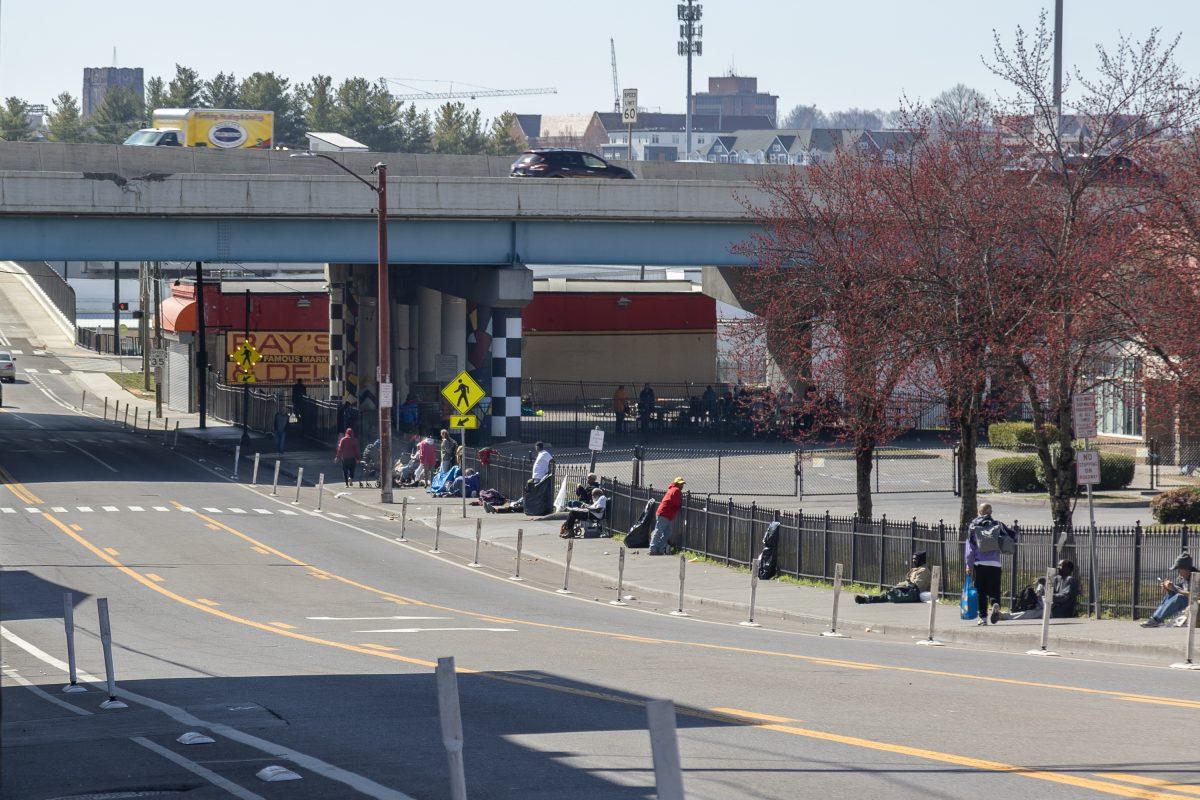
“Get off the sidewalk,” a voice rumbles from a police car’s megaphone. The vehicle sits parked in the middle of North Broadway, urging people to get up and move. The bodies begin to stir slowly, getting up and taking their time. They have nowhere to go. The voice rings over the megaphone a few more times, singling out a few stragglers.
I met up with Brandon Styles, regional overdose prevention specialist, from Metro Drug Coalition, and we walk to an area enclosed by a black metal fence. He tells me this is called the “Safe Place,” a part of Old City in the Mission District underneath the I-40 where the unhoused community can come and receive resources and be a little more sheltered.
MDC works with the Knox County Health Department, Knoxville Fire Department, AMR and Knoxville Area Project Access to create the Mission District Medical Team. The medical team has tables set up in the Safe Place to give out food, supplies like socks, drug testing kits, Narcan, toothbrushes and hygiene supplies. There’s also a small bus where the medical team does wound care, first aid and testing for AIDS and STDs.
As we walk through the Safe Place, clusters of people spread out among the asphalt. Styles goes around asking if anyone needs any wound care or supplies. The air is dirty, a mix of feces, urine, cigarettes, weed and vape smoke. The cars driving overhead on the freeway create a steady drone of traffic. The occasional loud noise causes a large flock of pigeons to scatter from underneath the bridge, filling the area with feathers as we try to get out of their way.
As we pass out Narcan, Styles gets a call and takes off to the other side of the Safe Place along with one of the EMTs. Someone has overdosed, and they rush over to help. Luckily, paramedics were on the other side of the Safe Place already, and a life was saved, but that’s not always the case.
I’ve been out under the bridge with MDC with their wound care outreach multiple times this semester. When it was cold, we passed out socks and beanies and told the people where the warming shelters were going to be as the temperatures dropped.
There are people with dogs for both warmth and protection. There’s a stolen trash can filled with blankets and belongings. Possibly everything they own is in that can. As people come for supplies, there’s some small talk, but as an outsider, they seem to be a little reserved around me. As I looked over, I saw two guys smoking meth — drug use is not uncommon here.
The last time I was there, the weather had started warming up, meaning more people would be out in the Safe Place. A woman came up and took some Narcan. She looks at me and with sadness in her voice, said, “If I had some, I might have been able to save someone yesterday.”
It seems like something happens daily, but this community is resilient. A large man comes to the table, smiling and joking around.
“Do you remember me?” he asked. I replied, “Yes, I do, Ike.” He smiled, and we had a short conversation before he went off to grab some food and other supplies at another table.
An older woman with grey hair comes up and talks to me. They have finally started to get used to seeing me out here. I asked her if there was something she would like people to know about the community out here.
“We’re not bad people. We’ve just hit hard times,” she said.
After five weeks of volunteering with MDC, I have seen a bit of everything, both good and bad, from individuals struggling with addiction to members of this community helping each other out.
They have mourned the loss of a few of their own and laughed at corny jokes and magic tricks that didn’t work. These people are sons, daughters, sisters, brothers, mothers and fathers. They are as young as 18 and as old as 65. All races, all religions. They are survivors — they have stories to tell.
After the last time I was there, I asked Styles what he would like to let the public know about the unhoused community here.
“Just to make sure that we remember that these are people, somebody does love them and they are worthy of our love,” Styles said.
Editor’s note: Ericksen Gomez-Villeda is volunteering with MDC for a semester-long grad school reporting project on opioids in East Tennessee.