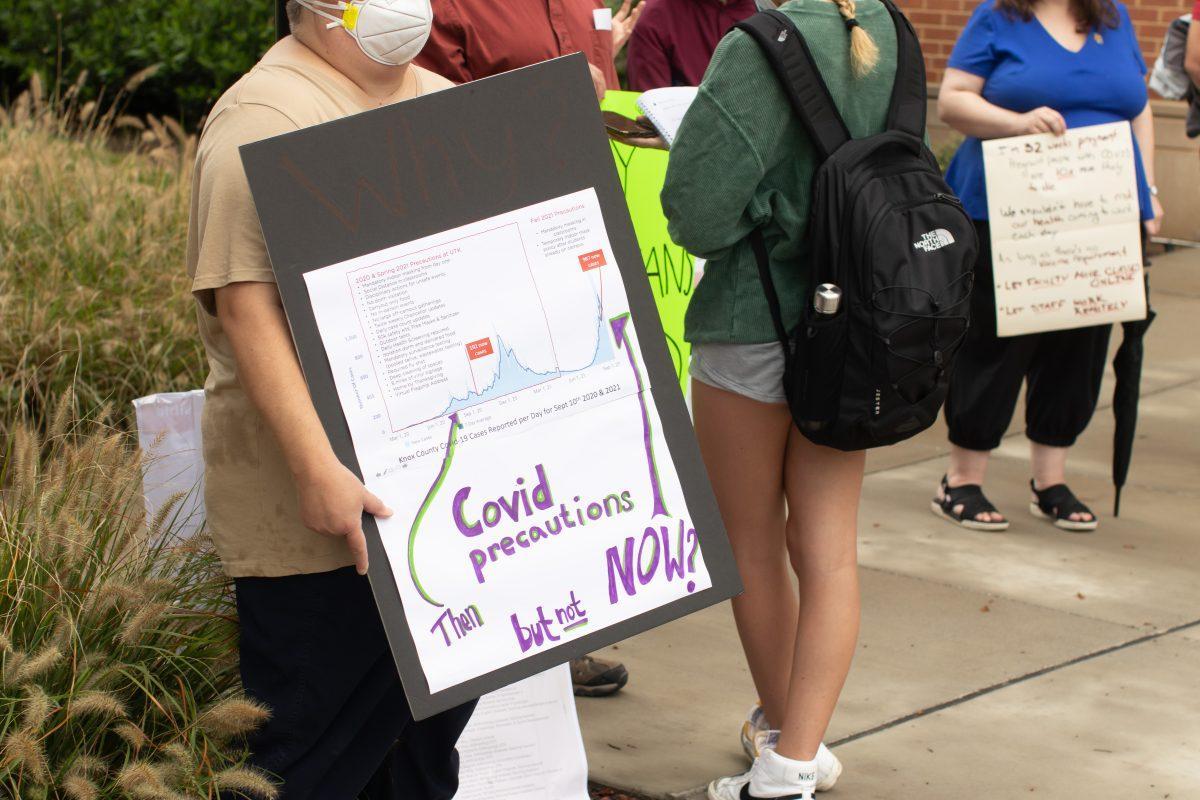
The conviction has struck United Campus Workers (UCW), as it has every semester since the outbreak of the COVID-19 pandemic nearly two years ago, that the university should be doing more to keep its employees safe.
This semester, what is being heralded as a potential new phase of the pandemic, where relatively low levels of caution are paired with record breaking case counts during a nationwide surge of the omicron variant, has raised the concerns of employees and energized UCW’s organizing efforts.
The union’s latest list of demands to UT leadership has garnered nearly 700 signatures from faculty, staff and student employees in the week since it was published on Jan. 19.
The demands, which include increasing opportunities for remote work and pausing in-person campus events until Feb. 4, are driven by what UCW organizers see as an overly relaxed posture from university leaders during a month when Knox County has seen the highest number of new COVID-19 cases since the beginning of the pandemic.
COVID-related hospitalizations and deaths in the region are not rising to the same record levels as new cases, likely due to the decreased severity of the omicron variant. In an announcement from earlier in the month, Chancellor Donde Plowman said the university was committed to maintaining in-person classes and that, “National experts have noted the benefits of focusing less on case counts when assessing the actual impact of COVID-19.”
In addition to the decreased overall severity of illness caused by the omicron variant, the legal barriers to mask and vaccine mandates, which were passed by the Tennessee state legislature and bolstered by a federal district judge, have contributed to spotty masking and an ambiguous vaccination rate on campus.
Even the most energized of organizers know that the hands of administrators are tied by law on the question of mandates. But according to Andrea Stedman, an academic advisor in the Department of Modern Foreign Languages and Literatures and co-chair of the UCW staff committee, there is more that could be done to keep workers safe.
“There’s no rule that says we can’t work remotely,” Stedman said. “We know that they can’t do anything about masking and we know that they can’t do anything about vaccines, so nobody’s gonna be telling them that it’s their fault for that, when we know that it’s the state legislature that made those decisions. However, there are a lot of tools that we have.”
Those tools, the petition says, include increased signage and “continuous messaging throughout the semester” making clear that the university “expects” masking. They also include allowing employees to work remotely “at their discretion.”
Stedman said that a narrow conception of personal choice has dominated the conversation around COVID policies, especially since the mask and vaccine mandates were lifted on Dec. 1.
“People who don’t want to wear a mask or don’t want to get vaccinated have the right and the autonomy to do that, but then we don’t have the right to work from home and we don’t have the right to ask other people to wear a mask,” Stedman said. “And some of that’s the state legislature and we are going to be working on that, but it doesn’t make sense to a lot of people and there’s a lot of frustration and there’s a lot of disillusionment and moral injury and people thinking seriously about quitting … I’m really interested to see how this semester goes.”
The petition is seeking to expand the narrative of personal choice by demanding that instructors be given the option to teach virtually. It does not demand that all classes be moved online, since many instructors prefer to teach in-person.
As the nation nears the second anniversary of the first COVID-19 lockdown, Mia Romano, senior lecturer of Spanish Studies and vice president of the UT chapter of UCW, feels that there is a misplaced confidence over the virus in light of what remains unknown, especially about the long-term symptoms of the illness.
Romano, who won a teaching award while her classes were on Zoom last school year, said she believes the threat to the traditional college experience posed by temporary virtual learning is less severe than the health threat posed to certain community members by the virus.
“Regardless of vaccination status, there’s a lot you could be doing, like masking and distancing to keep everyone safe,” Romano said. “You don’t know if the person next to you is immunocompromised or they’re caring for an elderly relative, et cetera, or that they even have COVID right now and they don’t know.”
In this way, the hundreds of employees who have signed the petition have entered the fierce national debate over schooling modality, which led to tense negotiations between Chicago’s mayor and school union earlier this month in one notable case.
UT administrators, including Chancellor Plowman and Vice Chancellor for Student Life, have communicated strong recommendations to students both to get vaccinated and to wear masks indoors. Additionally, the university is teaming with the Knox County Health Department to provide vaccine and testing clinics.
These recommendations and opportunities for immunization constitute UT’s efforts to maintain in-person learning and provide students with a semblance of normal college life. Romano said this effort displays a problem of priorities.
“Hearing that messaging about delivering what the students want, right, they want in-person classes, they want the regular in-person college experience, that hurts my stomach because there are ways to give students a great college experience during a pandemic where you make adjustments and make everyone feel more comfortable,” Romano said. “They aren’t prioritizing the safety, they’re prioritizing whatever this ‘student experience’ is.”
The student experience at UT is enabled by the thousands of university employees who come to work each day. Last week, Knox County Schools canceled four days of classes in a row due to“staffing challenges related to illness.”
Stedman said the list of demands from UCW could, in the long run, potentially prevent a similar crisis at the university and preserve the college experience that administrators and students value.
“The fact that we can’t do something like be remote for two weeks so that we can preserve the rest of the semester does come across as very short-sighted because we might be shooting ourselves in the foot for students to have the whole semester be short-staffed,” Stedman said.
UCW has presented the petition to the chancellor and is tracking the number of signatures as it climbs. In the union’s ideal future, N95 masks would be in employees’ mailboxes, teaching faculty would be able to move classes onto Zoom without providing evidence of a need beyond their own caution and essential workers would receive hazard pay.
Regardless of whether the demands translate to action on the part of administration, Stedman said the group will continue to push for increased safety precautions.
“We’re gonna keep pressuring until we get the protections that we need. We care about UT, we care about our students particularly, and that’s why we’re here,” Stedman said. “We wouldn’t be doing this petition if we didn’t care.”