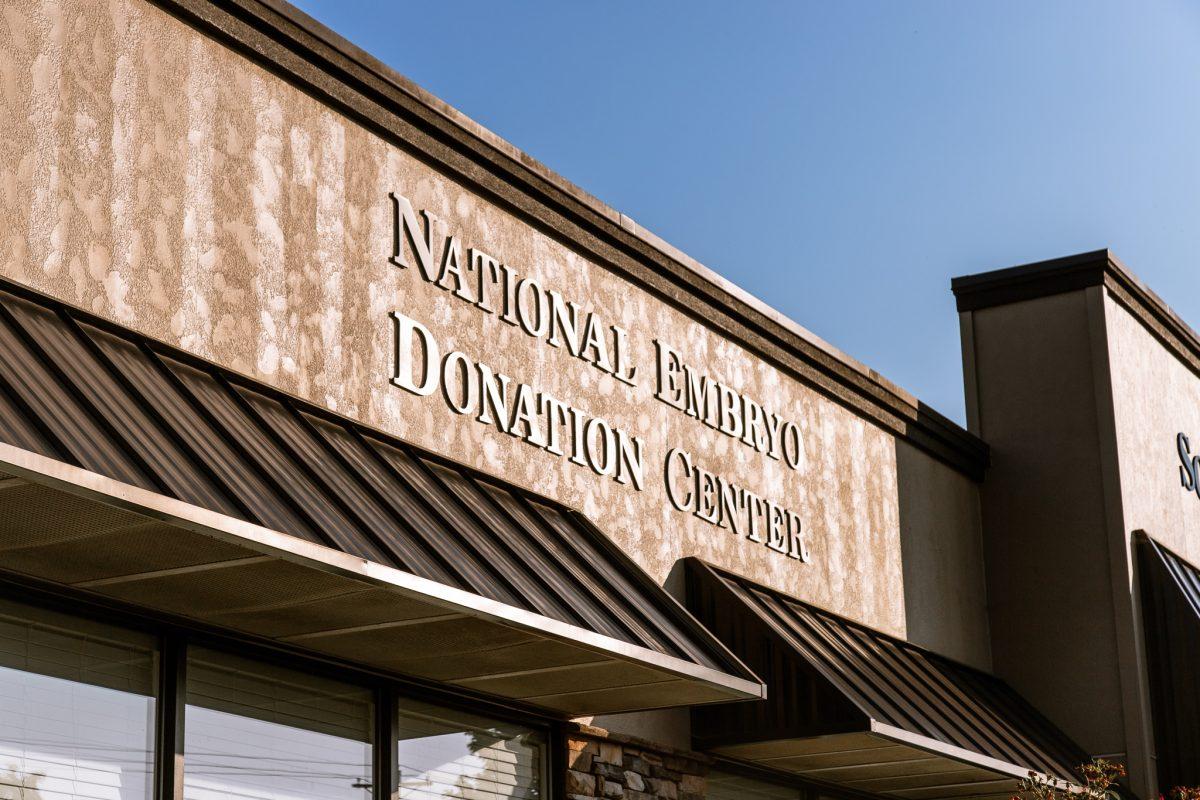
The National Embryo Donation Center (NEDC) located in Knoxville markets itself as the nation’s most comprehensive non-profit embryo donation program and has received national media attention for its work on embryo adoption.
But on the question of who can adopt an embryo, nestled into the organization’s FAQ, is a stipulation: only heterosexual, cisgender couples married for a minimum of 3 years can adopt from the NEDC.
The organization is transparent in its Christian beliefs. Dr. Jeffrey Keenan, professor and director of Reproductive Endocrinology and Infertility at UT Medical Center, serves as president of the NEDC. In a statement to The Daily Beacon, Keenan said his employment by the public university system did not prevent his leadership role with the NEDC.
“The United States Supreme Court has made it clear that being a state government employee does not negate a citizen’s freedom to publicly practice and express deeply held religious beliefs, particularly in contexts outside of their government employment,” Keenan said.
Dr. John Gordon, an infertility specialist at UT Medical, is a physician on staff at the NEDC.
The requirements to adopt an embryo come from the NEDC’s stated Christian beliefs. Mark Mellinger, marketing and development director for the NEDC, said the group is concerned primarily with honoring God’s design as stated in the Bible.
“The reason is not animus toward anybody,” NEDC marketing and development director Mark Mellinger said. “The reason our board decided that that would be the standard is because we’re a Christian organization and the historic orthodox was the union of one man and one woman. We believe that honors God to hold that standard.”
Struggles with infertility touch many people, but gay or transgender couples are often excluded from getting the chance to fix the problem. There are organizations available who do help LGBTQ couples, but many feel there is a sense of equality that is missing when organizations decide otherwise.
Same-sex marriage was legalized on the federal level in 2015, but this doesn’t stop couples from thinking about the possible rejection or discrimination they could face in seeking help to build a family.
A. Capannola, a child and family studies graduate who received their doctorate at the University of Tennessee, researches same-gender couples wanting to adopt or undergo IVF. They spoke to 18 individuals representing same-gender couples specifically in the southeast about their experiences building a family.
Capannola found that no one was rejected outright, but the looming possibility of rejection was enough for couples to decide to not go forward. They reported Christian influence was strong throughout the U.S. and many of the same-gender couples they spoke to were Christians themselves. But as their interpretation of Christianity is different from the NEDC’s, the sense of exclusion remains.
“They were like, ‘I hate that my religion is being used as a tool to deny me the right to a family because I have faith, I go to church, I participate in this community,’” Capannola said. “They felt like it was being used against them in some kind of way, and it felt like a betrayal in a lot of ways.”
Capannola said that these couples were brought up in the southern traditional Christian household just as many others.
They spoke of another couple with a perspective on whether all organizations had to serve everyone, even the people they didn’t want to help.
“With those organizations that say ‘we won’t serve same-gender couples,’ they were like, ‘I almost don’t want a law to make them serve us because if they don’t want to serve us then I don’t want them involved in building my family,’” Capannola said. “That’s a very silver lining perspective that I really appreciated.”
There is an acceptance from LGBTQ couples that comes from this exclusion that organizations have a choice to participate in. Giving organizations that choice weeds out who is genuinely there to assist same-gender couples in welcoming arms.
Even though the couples Capannola spoke to didn’t run into any barriers, there are those who do. Capannola said they probably didn’t want to speak to them because the experience was so painful, but the barriers definitely exist.
“In places like Tennessee, the needle doesn’t get moved until it does at a federal level when the state is just agreeing to follow some kind of federal ruling, it means there is this lag sort of where it’s like okay this is the rule now but you have to get people to buy into it and to catch up on all these little things,” Capannola said.
Even though the NEDC is the largest embryo donation center in the country, there are donation and adoption groups that are accessible in east Tennessee for LGBTQ couples, such as the American Embryo Adoption Agency, Tennessee Fertility Institute and the Knoxville Fertility Clinic.
“There are other embryo donation and adoption groups who will adopt to LGBTQ families, and that’s one positive thing about the movement , that the more it is proliferated, the more options have expanded and that’s life in a free country,” Mellinger said.