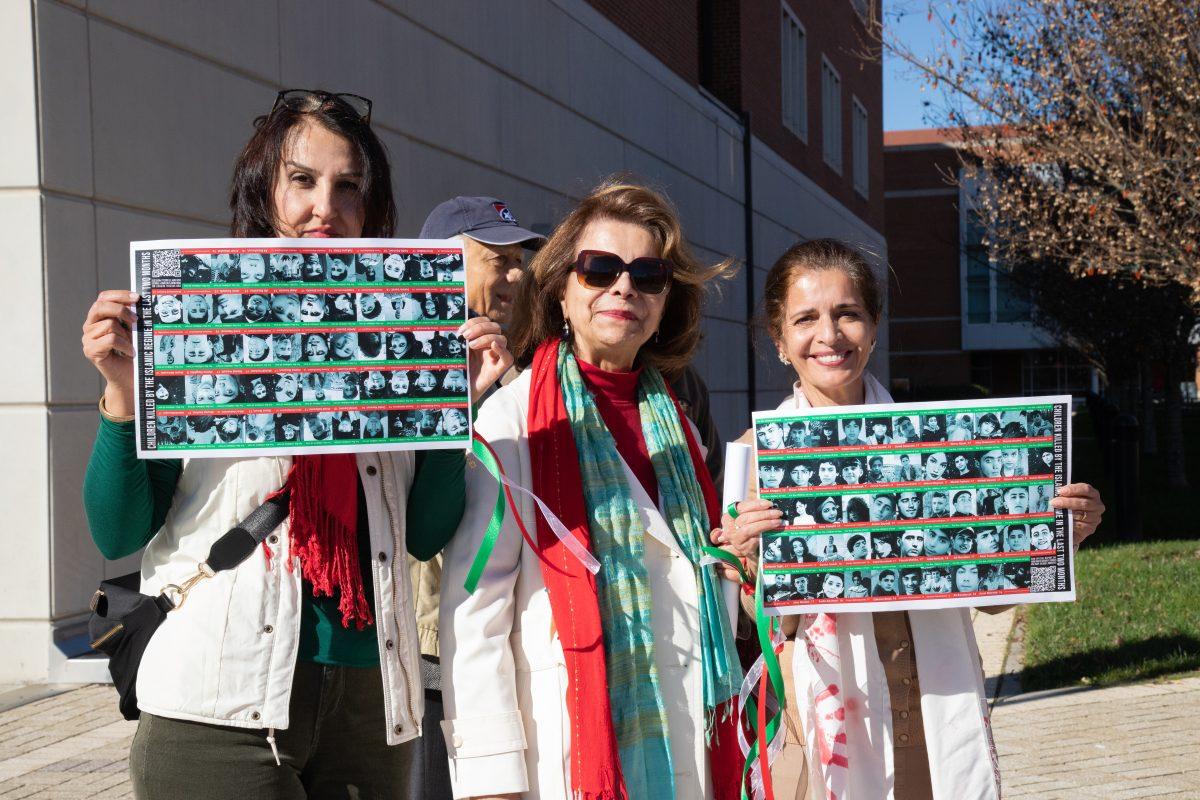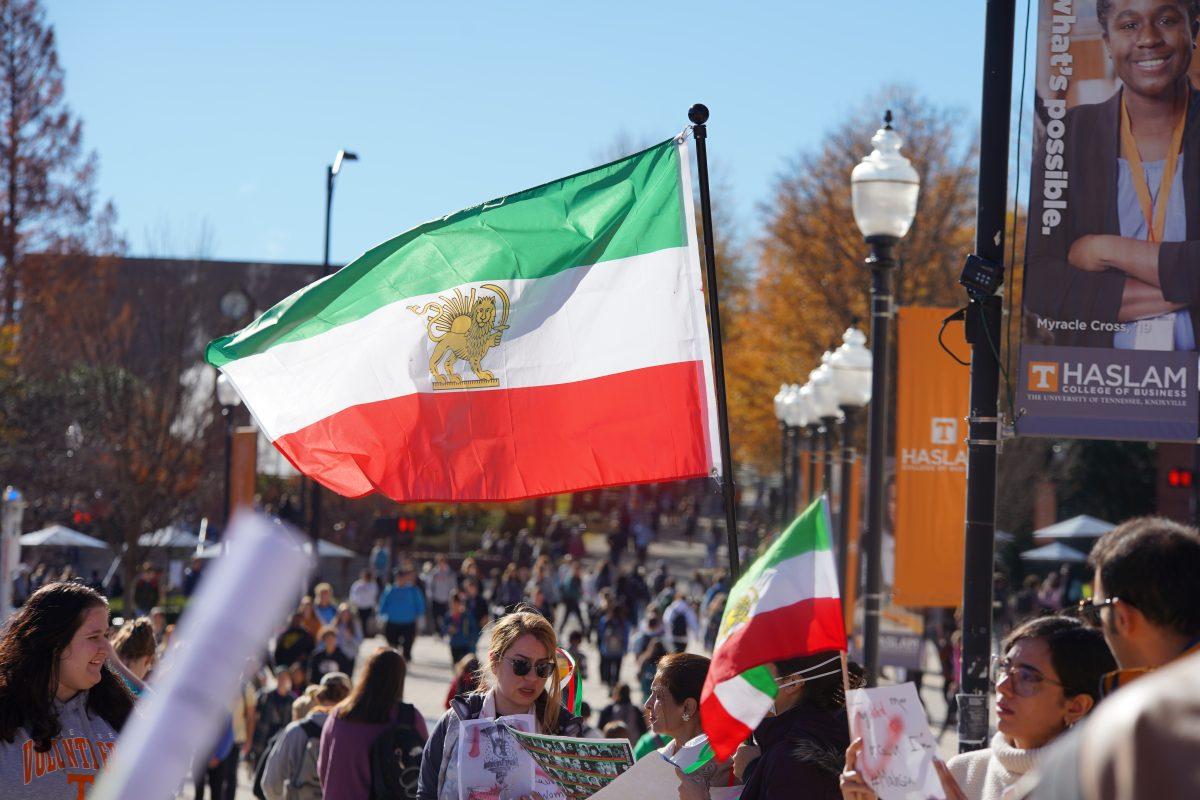
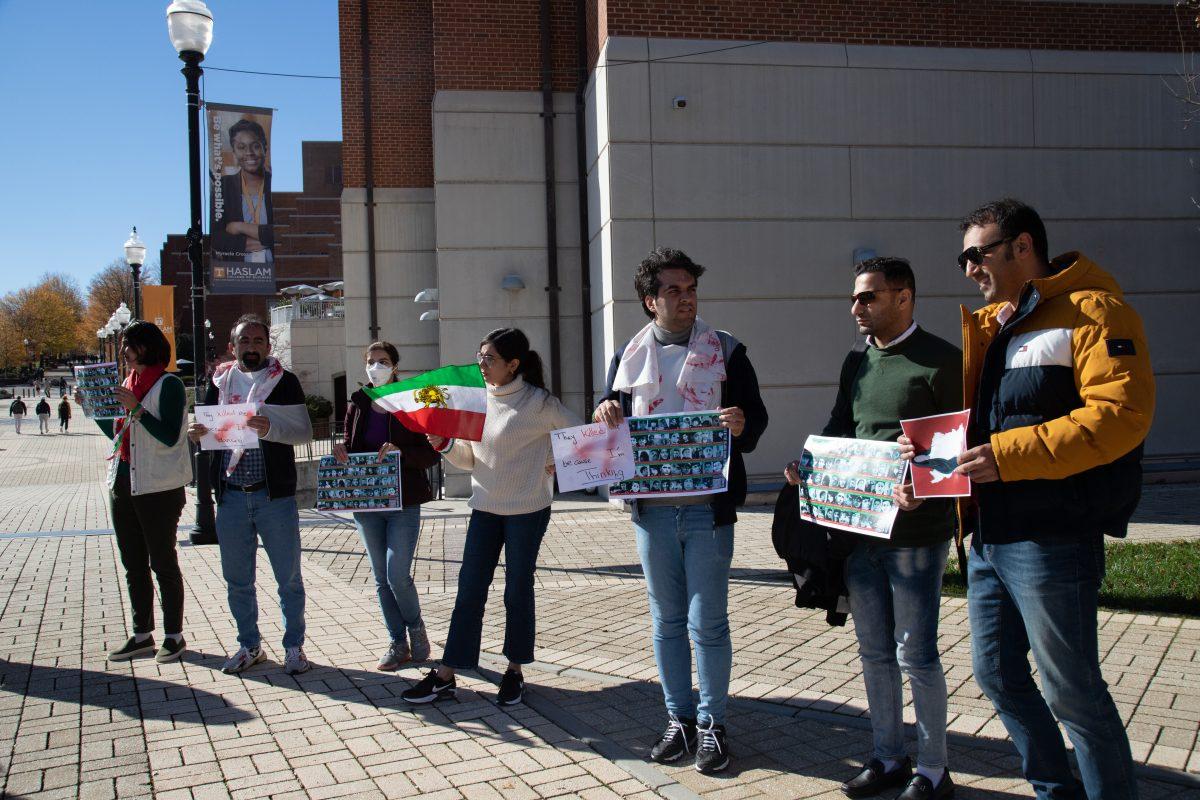
Students with Iranian Scholars for Liberty held a campus rally for Iran to stand in solidarity with Iranians fighting for freedom and gender equality on Nov. 30, 2022.
Editor’s note: Some last names have been omitted to protect the security of sources and their families.
On Wednesday afternoon, Iranian students and community members gathered on Pedestrian Walkway as part of the global Campus Rally for Iran organized by Iranian Scholars for Liberty. Over 200 universities across North America, Europe, Central America, Australia and New Zealand participated in a day of action in protest of Iran’s Islamic Republic government.
More than two months after the death of a 22-year-old woman named Mahsa Amini in the custody of the government’s morality policy on Sept. 16, the people of Iran continue to rise up against a government which has used brutal force and imprisonment to suppress protest.
Iranian Gen. Amir Ali Hajizadeh reportedly said Monday that more than 300 people have been killed in the uprisings, although human rights groups say the number is closer to 500 people, including many children killed by government forces.
The largest protests in Iran in a decade are a response to strictly enforced laws regarding clothing and social behavior under the Islamic Republic. If women do not wear a head covering according to the standards of the morality police, they may be randomly beaten and dragged to detention centers, like Amini. A CNN report found that many women who are taken to prison for offenses against laws like mandatory hijab are subjected to rampant sexual assault at the hands of government security forces.
Being seen in public with a boyfriend or girlfriend also commonly results in arrest and assault, creating an atmosphere of intense fear in public spaces.
Social media sites like Twitter and Instagram remain awash with graphic images and videos of protestors beaten and arrested by police and forcibly dragged into police cars. Nearly 20,000 people are reported to have been detained since the protests began.
Thousands of Iranian students studying abroad have mobilized through Iranian Scholars for Liberty to take a more active role in spreading awareness about the violent crackdowns.
Standing on Ped Walkway outside of the Student Union, students and local residents waved the Iranian flag and played protest songs, such as “For Woman, Life, Liberty” by the Iranian-American singer Rana Mansour, titled after the rallying cry of the anti-regime movement. Some held flyers with the faces of over 50 children killed by government forces.
For many students, the uprising has required that they take on another job in addition to their schoolwork, that of sharing and spreading information on social media in defiance of the Iranian government’s attempts to shut down internet access.
Mohammad, a doctoral student at UT, spends two hours each morning processing the news that has come in from Iran while he is asleep. Oftentimes, the news is that another young protestor has been killed or imprisoned without a trace.
“My brain is bombarded with a lot of negative news, and I try to focus on my research, but in the morning, I cannot until 10 or 11,” he said.
Sima, a doctoral student and leader in the Iranian Student Association, said she and other Iranian students are torn between their life in the U.S. and their life in their home country.
“We are living in two worlds. Here, we are UT students who need to study, who need to work for research, who need to solve problems for homework and live as ordinary people in the United States,” she said. “And when we go home, we live in another world … we have to manage these two worlds at the same time, and it’s really hard.”
Local Iranians have not demonstrated together since September, when they rallied downtown in the weeks following Amini’s death. Because there is not a large Iranian population in Knoxville, organizing is challenging. Still, students believe it is important for them to lend their voices to oppose a government that has targeted students and children.
Sanaz Izadifar has friends at her university back home who have been imprisoned, and she does not know whether they are alive or not. A doctoral student, Izadifar said the notorious Evin Prison outside the capital city of Tehran is now called “Evin University” by many people because of how many students are detained there.
“It’s like a nightmare, actually. It’s really like a nightmare,” Izadifar said. “I came out from my country and just in a few months, I see that everything is changed. My friends are killed in Iran. Some of them are in the prison.”
According to Izadifar, the best way to understand the situation in Iran is to call it a war. The scenes out of Iran are like dispatches from a war zone, where women burn their hijabs in large fires and protestors are sprayed by rubber bullets at close range, sometimes losing their eyes.
The durability of the protests in the face of brutal violence suggests a weakening in the foundations of the Islamic Republic, which established clerical rule in 1979 following the Iranian Revolution. For millions of Iranians at home and abroad calling for freedom, the events of the past few months have forever changed their already-negative view of their government.
“We hate the Islamic Republic of Iran. We want only Iran, the Iran that is not based on religion, it’s based off our people,” Izadifar said. “Our current government are, honestly, they are not humans. We don’t know how to describe them for the world because they are killers, and all the world should know that, because they enjoy killing us.”
The uprisings in Iran have touched every corner of the country and, most recently, spilled into the World Cup match between the United States and Iran, which took on broader geopolitical significance. Iranian students at UT said they prayed and wished for a loss, since the Iranian national football team has largely stood by the government.
For doctoral student Sirous, the U.S.’s 1-0 victory over Iran was another example of the split feelings of Iranian students thousands of miles from home.
“It’s a weird and complex situation in the way you don’t know whether to be happy or sad. You can’t be happy because of the problems of Iran, you can’t be sad because those players are supporting the government, so it’s a weird condition,” he said.