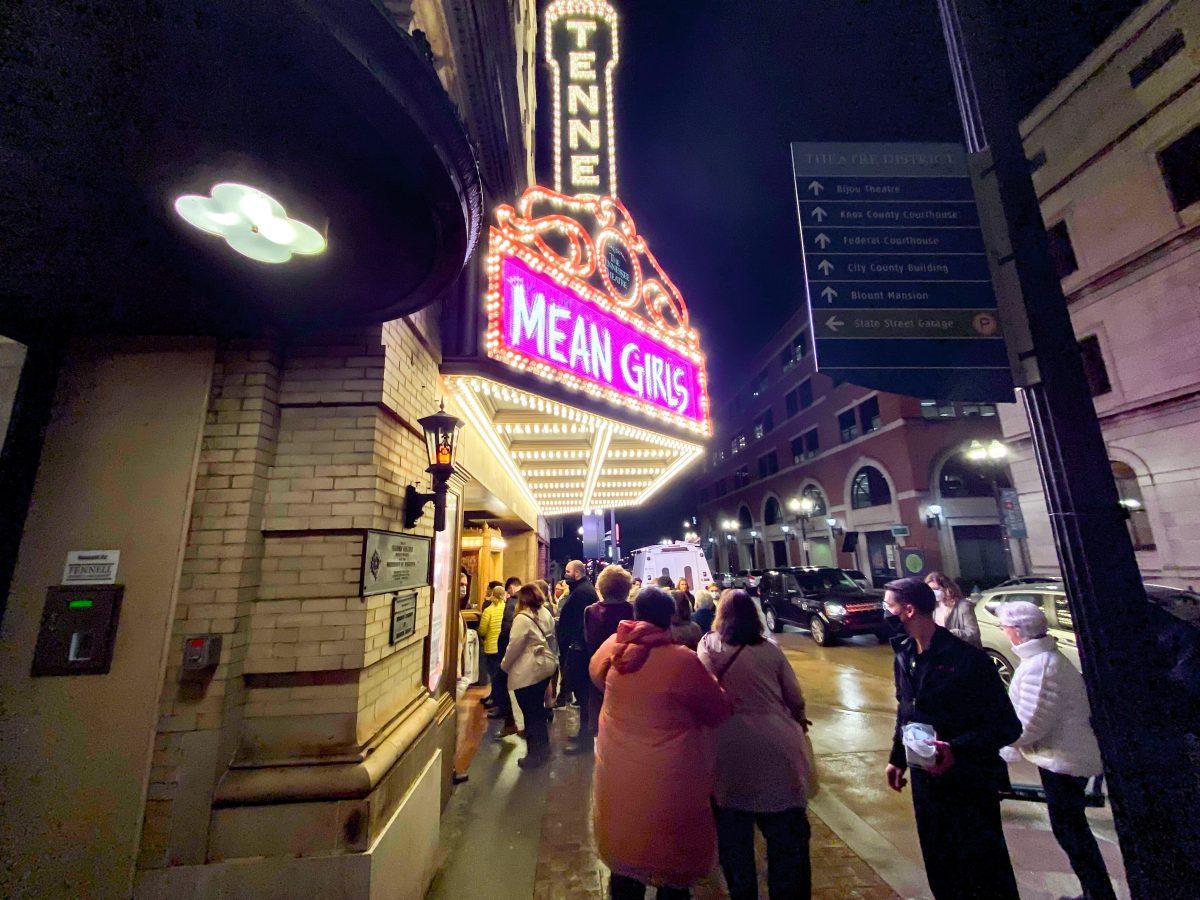
Now adapted into a Broadway musical, Tina Fey’s “Mean Girls” is one of the most popular comedy teen films to date. The musical adaptation, which premiered on Broadway in April 2018 and closed in March 2020, is now touring nationally and stopped in Knoxville this weekend at the Tennessee Theatre.
In the year of its debut, “Mean Girls” received 12 Tony nominations but ultimately took home zero. Despite the award losses, “Mean Girls” is by far one of the most creative and gleefully sophisticated Broadway musicals of the past few years.
The national touring company made this abundantly clear at their performance in Knoxville on Wednesday night, complete with impressive dance numbers, talented vocalists, a killer book and a set guided by screens and videos.
The adaptation of the 2004 movie takes the same story and places it into modern times. Although 2004 does not feel like that long ago, the new time period allows for it to integrate the effect of social media on teens, which gives much more to a plot surrounding bullying and self-esteem.
It also allows for the placement of the song “Stop,” where protagonist Cady Heron’s friend, Damian, encourages her to stop texting her crush and to think before posting and sending.
What sounds like a song that would be condescending to teens who hear about the dangers of the internet incessantly, turns out to be a song with some of the most hilarious jokes in the show, and a tap number that competes with sequences in “Newsies.” It’s clear that the creators are aware of how quickly it could go wrong and make up for it with a sense of self-awareness and humor.
It seems as though this is the theme for the entirety of “Mean Girls.” Similar to the movie, the majority of the whole high school atmosphere is ridiculous and somewhat silly and it would be easy for the intent of the story to get lost quickly.
I was concerned that it would be hard to recreate the self-awareness of the original movie, but the creators of the musical version make it clear that they are in on the joke.
The cheesy set design, complete with a mall with stores like Suburban Outfitters and Blaire’s, ridiculous images of villain Regina George’s head floating in the background during “Revenge Party” and perhaps best of all, a rainbow of pictures of George Michael, proves how ridiculous everyone knows it is — and that’s what’s so great about it.
The musical has received criticism for simple lyricism and writing, but the lyrics are exactly what you would hear from the teenagers living in this world where the daily lives of high schoolers revolve around one queen bee and her sidekicks.
Hilarious songs like “Sexy” and “Whose House is This?” might be extremely simple lyrically, but they prove the point they’re trying to make. Besides, what else would we expect from Karen, the token dumb girl portrayed in this version by Jonalyn Saxer, but lyrics like saying she loves Halloween because she can be “Disguised as someone else who is not me / but is still hot”?
And what’s funnier than a high school party where the kids literally say what every person watching a teen throwing a house party is thinking: “Senior jocks and band freaks / Throwin’ all your antiques… Hence, hope you got insurance!”
What are perceived as the sillier songs surprisingly advance the feminist morals of “Mean Girls.” Take “Sexy” for example, Karen is not your token feminist. She’s probably hated by Janis who seems to have a lot of ideas about gender that fail to recognize the girls who like pink and high heels.
But Karen says, “I can be who I wanna be and sexy” and, “This is modern feminism talking / I expect to run the world / In shoes I cannot walk in,” and alas, the dumbest character in the show presents the idea that girls should not have to act a certain way to get equal rights. Both Karen and Janis can achieve their dreams wearing whatever they want, and neither one’s knowledgeability depends on how much they present their femininity.
Consequently, the show utilizes humor and music to make some pretty nuanced statements and to respectfully point out the ridiculousness of simply being a teenager and having the world revolve around what high schoolers think of you. It also employs some more serious songs like “I’d Rather Be Me,” “Fearless” and “I See Stars” to point out the importance of not pitting women against each other and standing up for yourself.
While Regina George is vilified for the majority of the musical, she does get more of a redemption arc in this version than in the movie, in my opinion. Although numbers like “Someone Gets Hurt” and “World Burn” show how truly mean she is, they also show how everyone’s perception of her as strong and tough causes her to struggle with vulnerability and expressing her true emotions.
The musical does use some unique tactics to get the original messages from the movie across, but at the same time, Cady’s character arc is much less evident. I personally thought she was too nice and I struggled to buy into the notion that she had become the queen bee of the mean girls by the time the “Burn Book” rumors spread.
Perhaps it partially had to do with the fact that her costumes did not compare to those of Regina, Gretchen and Karen. Even so, this could be a minor flaw that has more to do with not having enough time in a musical than not having enough writing, production or acting talent.
The performances of the touring company were close to flawless, my personal favorites being Janis (Mary Kate Morrissey), Gretchen (Megan Masako Haley) and Damian (Eric Huffman). Nadina Hassan also gave a fantastic performance as Regina George, breaking barriers of what the traditionally blonde, white character can look like.
As an avid fan of the musical since it premiered on Broadway, I was slightly shocked when there were a few musical changes to the original cast recording of “It Roars” and “Fearless,” but they did not interfere with the integrity of the show at all, and perhaps improved upon the original versions.
Overall, the national tour of “Mean Girls” proved to be a fantastic follow-up to the film and used musical numbers to flesh out motives and morals in a way the movie cannot really do. Despite small changes and less characterization than I had hoped for, the touring company did a stellar job and the story retains its original morals, humor and self-awareness.