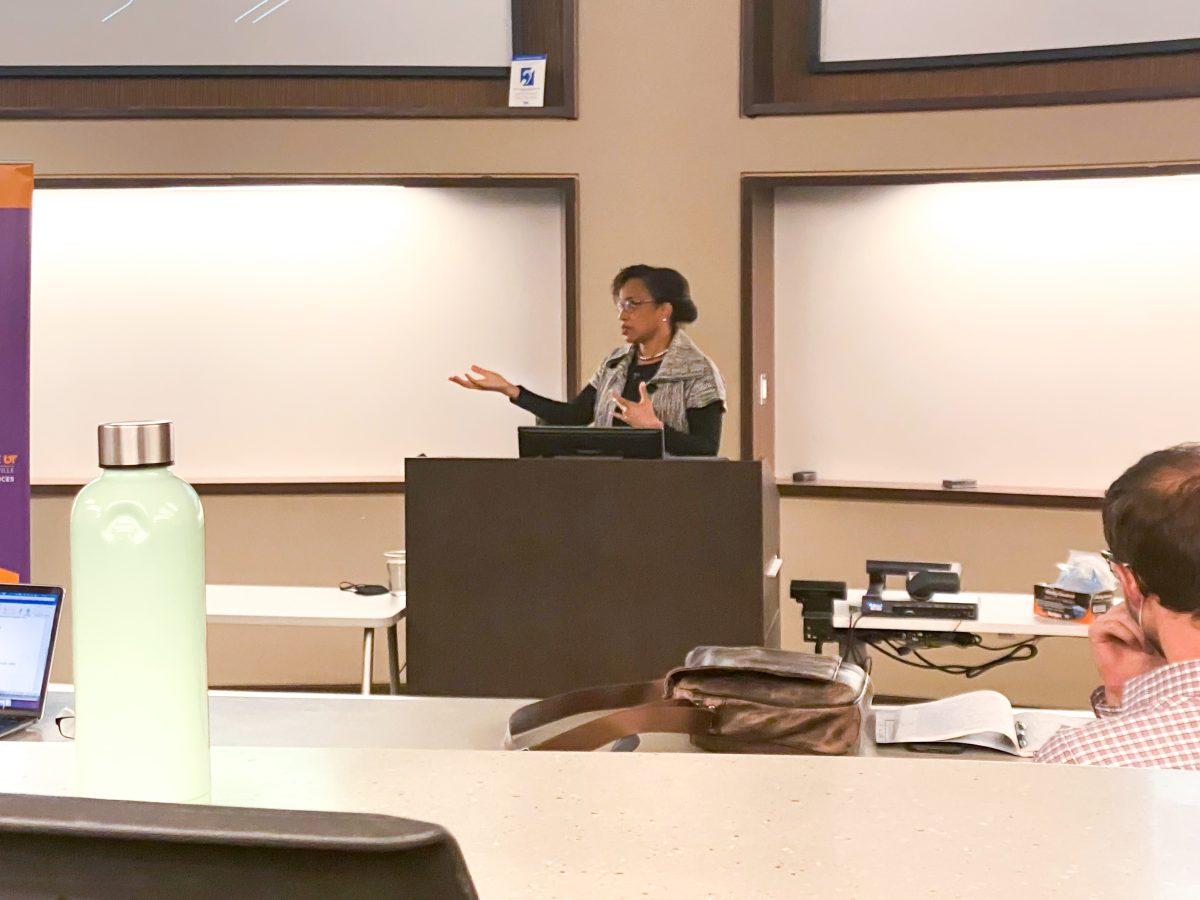
Marla Frederick, professor of religion and culture at the Candler School of Theology at Emory University and former president of the American Academy of Religion gave a lecture entitled, “The Schools of Former Slaves and the Schools of Former Slave Owners: Religion, Race and the Struggle for Education” Thursday night in Strong Hall.
The lecture was the first of a new distinguished lecture series from the Department of Religious Studies and was co-sponsored by many departments and offices on campus, including the departments of Africana Studies, English and History, as well as the College of Education, Health, and Human Sciences and the CEHHS Office of Diversity, Equity and Inclusion.
Christine Shepardson, head of the Religious Studies Department, said the department chose Frederick’s lecture on this topic in part to communicate their commitment to the study of religion, race and ethnicity but also due to Frederick’s impressive scholarly work and current leadership in the academic study of religion.
“This is a year in which her scholarship and her leadership in the field of religion is particularly visible,” Shepardson said. “And so, she’s a phenomenal scholar, but also right now she’s in a position of a lot of leadership in the field, so she seemed like a great choice.”
Frederick’s scholarship spans many subjects such as religion, anthropology, race, gender and media.
Last night’s lecture focused on how Black institutions have served as a form of resistance, how religion has shaped Black institutions and how systemic racism has led to discrepancies in funding between predominantly white institutions (PWIs) and historically Black colleges and universities (HBCUs).
Frederick began by pointing out the importance of institutions in the fight for racial justice.
“I want to reframe our understanding of the building of Black educational institutions by Black religious organizations and white religious organizations as radical, countercultural and central to the pursuit of justice sought by Black religious leaders,” Frederick said.
In fact, Frederick argued that Black educational institutions are integral to Black life, even though historians tend to discuss leaders and cultural movements more frequently.
“As a scholar of African American religion and culture, to tell the story of Black life, Black struggle, Black progress is to tell the story of black institutions,” Frederick said.
She presented historical research showing how crucial the Black church was in the late 1800s and early 1900s, despite the hoops these churches had to jump through.
This portion was perhaps most captivating to the audience as she told the story of Black women starting First Baptist Missionary Church in Sumter, South Carolina, which eventually led to the establishment of Morris College, an HBCU.
These women in the South Carolina Baptist Women’s Educational Missionary Convention received a recommendation from the male-led Baptist Educational Missionary Convention to become an auxiliary unit and hand over all their funds to the male-dominated convention.
The women responded with an extremely formal, polite and calculated response which Frederick read to the audience. She then, however, offered her own, simpler interpretation of what the women said.
“Translated: We don’t really know what y’all are trying to do with our money. We don’t know why you need our money. We’re about the business of trying to build Morris College,” Frederick said.
After discussing the important establishments of Black churches and white northern missionaries who assisted in many Black school establishments — although she clearly stated that Black educators should be at the center of the historical narrative — Frederick began to present the ways in which systemic racism continues to hinder the success of HBCUs and favor the efforts of PWIs.
“Schools like Georgetown, Harvard, Princeton, William and Mary, Duke and even Emory have, over the past years, launched initiatives to study their university’s history of slavery,” Frederick said. “HBCUs, in the meantime, are paying a steep penalty for bearing the legacy of the formerly enslaved and legally segregated.”
Frederick used countless figures and numerical data to illustrate the economic disparities between PWIs and HBCUs. Her personal example of seeing this disparity, however, seemed to garner the most audience engagement.
She explained receiving her undergraduate degree from Spelman College and then going on to Duke University for her doctoral degree. While her newsletters from Spelman applauded Coca-Cola for a $500,000 donation, her Duke newsletters told a much different story.
“I would receive my newsletter from Duke and on the cover, one alumnus would give 15 million dollars, turn the page, another 10 million, another 5 million,” Frederick said. “The two contrasting images placed wealth inequality and structural racism in sharp relief.”
“Racism is not only about what has been done and what’s being done but it is also about the cumulative effects of historic actions.”
The end of Frederick’s talk was almost completely centered on this notion of economic disparity that is built into American education systems. She pointed out the frightening contrast of paths for PWIs versus HBCUs.
“There’s something of a tragic irony that in this moment where schools that once benefitted from the slave trade are wrestling with what to do with their largess, what to do with their histories given their gains in human trafficking, while several of the schools that were built by and for formerly enslaved persons struggle and often stand at the brink of closure because they don’t have sufficient endowments,” Frederick said.
“The schools of former slaves and the schools of former slave owners have strikingly different trajectories in the 21st century. To put it more bluntly, should the schools of former slave owners thrive while the schools of former slaves close?”
Frederick’s ultimate answer to her own question is that philanthropic and governmental efforts should be put toward helping fund these HBCUs, and she cited notable figures like Netflix CEO Reed Hastings and businessman Mike Bloomberg as donating to HBCUs. She also pointed out a few cases, one specific to Tennessee State University, in which state governments owe HBCUs billions of dollars after years of neglect.
Sadie Ann Wells, a freshman forensic anthropology major on the pre-med track, attended the lecture and was intrigued by the information on HBCUs that she had not learned about.
“It was really, really interesting,” Wells said. “Just a lot of information that I never thought about existing before. I know a couple people … who go to Spelman, who go to Tennessee State, and I just think it’s really interesting to learn about the schools that they chose and kind of understand the reasons behind that more.”
Furthermore, Frederick made the issue hit closer to home when she mentioned the resurrection of Knoxville College multiple times, saying that although some people think HBCUs on the brink of closure should throw in the towel, she believes they are integral to America.
In the Q&A portion of the event, she expressed her overall gratitude to HBCUs and mentioned notable activists like Thurgood Marshall, Martin Luther King Jr. and Stacey Abrams as examples of products of HBCUs.
“America just isn’t America, it’s not even a place … that becomes a multicultural democracy without all of the work that HBCUs and HBCU alum have given back to the country,” Frederick said.
Frederick is excited about the future of Black schools and feels as though America is making progress. She said that progress, however, must continue.
“2022 looks strikingly different from the late 1800s and early 1900s in no small part because of these institutions,” Frederick said. “Nevertheless their work remains critical to the ongoing work we embark on today for education, justice and democracy.”
WUOT news director Chrissy Keuper interviewed Frederick on Thursday and that conversation can be found online. Frederick is also recording a podcast with Department of Religious Studies lecturer David Kline. Once that is available within the next several days, it will be posted to the Religious Studies website.