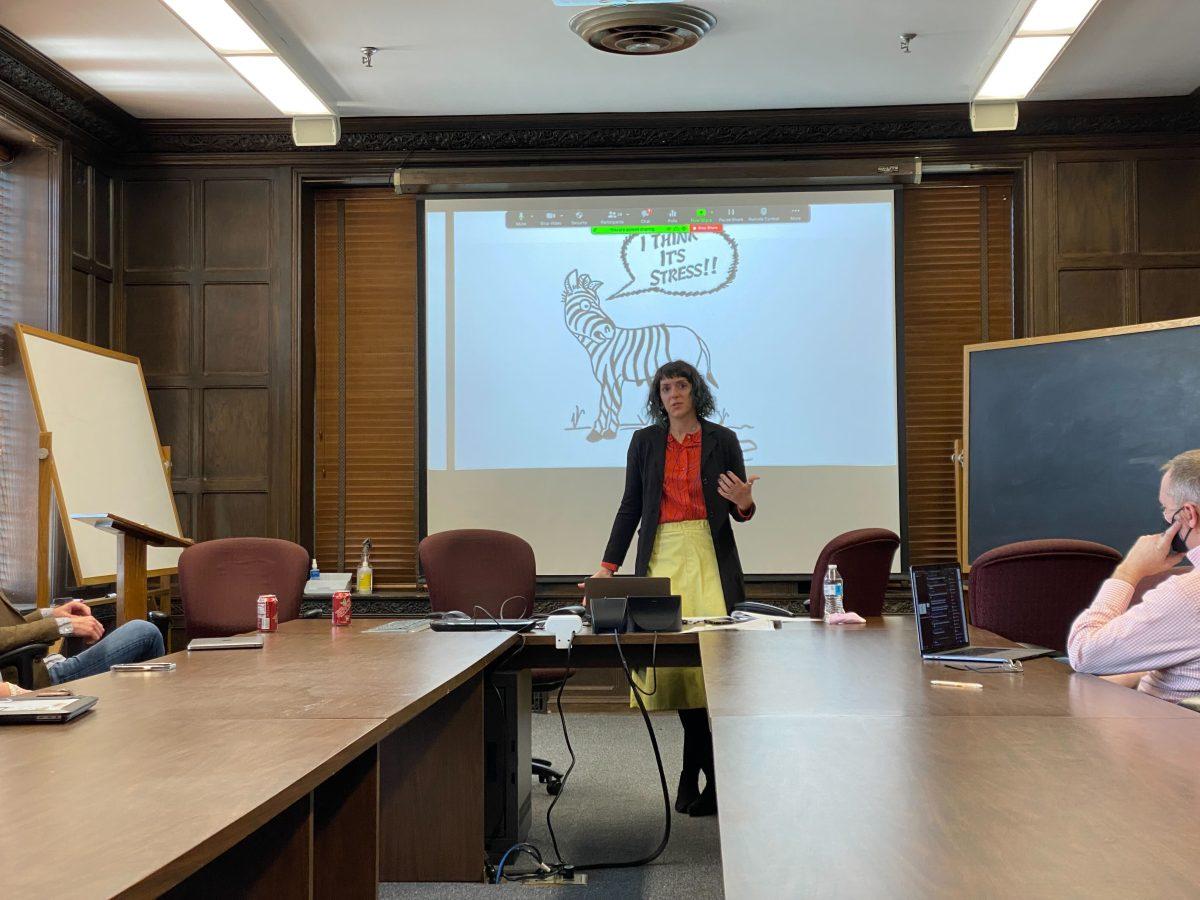
The Department of Psychology hosted Melanie Brewster, associate professor of counseling psychology at Columbia University, to give a lecture entitled “Atheists in America: The Marginalization (and Privilege) of a Growing Minority Group” on Friday afternoon in the Austin Peay Building.
Patrick Grzanka, associate professor of psychology, thanked the co-sponsor of the event, the Religious Studies Department, as the lecture has been in the works for over two years now. He previewed the topic of intersectionality that Brewster’s talk would circle around.
“Her work has really helped to agenda-set for those of us who care about doing critical psychological research on the experiences of multiple marginalized groups and she has notably used a wide range of … methods in order to probe these questions of paramount importance,” Grzanka said.
Brewster is co-founder of the Sexuality, Women, and Gender Project at Columbia University. She has written the book “Atheists in America” and owns a private counseling practice in New York City.
Her lecture focused on America’s misconceptions of atheism, how atheists’ wellbeing is challenged when they are forced to fit into a religious category and how many prominent atheists have created an exclusive, homogenous culture that makes forming community difficult.
Brewster captured the audience beginning with an anecdote from when she was a doctoral student learning about happenstance theory, which asserts that even if you plan out your life step-by-step, unexpected things may occur, and all you can do is use those opportunities to essentially adapt to a different plan.
She said that they discussed how to use planned happenstance in counseling to reassure clients when something does not go as planned. Many of her peers said they would say things like “trust in the universe” and “there’s a bigger plan for us.”
“If I were in career counseling and someone told me to trust in the universe or God has a bigger plan I would be like woah that’s not enough I need more strategies and interventions,” Brewster said.
After sharing this with the class, one of her classmates was shocked by the revelation.
“This classmate said, ‘I’m surprised to hear that, I would think you’d have to be like a ’capital A atheist’ for an intervention like that not to work and I was like oh well I guess I am a ’capital a Atheist,”” Brewster said. “Then she paused for a second and was like, what? But Melanie, you’re so nice.”
Brewster explained that people’s stereotypes of atheists are often as argumentative, hyper-intellectual and outspoken. Oftentimes, they are also men. These characteristics did not line up with her, as she described herself as a soft-spoken, community-oriented and introverted woman.
A bulk of the lecture unraveled the falsities of these preconceptions. She said people who do not believe in a god or subscribe to a religion are often much more diverse. These ideas of atheists, however, deter people from calling themselves atheists. Instead, they choose terms like “non-religious” or “non-believing.”
“When I ask people to picture a non-believer, they tend to imagine a white man who is living in Seattle at a coffee shop, very highly educated and probably younger,” Brewster said.
That being said, Brewster pointed out that the atheist community is still quite homogenous, as it is mostly made up white, male, younger, left-leaning, college-educated and higher-income people.
Brewster asserted that despite the proliferation of more privileged groups ascribing to atheism, one minority sticks out. Members of the lesbian, gay and bisexual communities are three times more likely to be atheists than heterosexual people.
“There is an element in having to think about the world differently that can come from going on a journey of discovering and coming into your sexual orientation,” Brewster said. “Maybe there’s mentions of cognitive flexibility where you start to question how you were raised, how you were brought up to think, societal structures and sometimes those things can go hand in hand.”
Ultimately, she explained that members of the LGBTQ+ community start to question their surroundings after trying so hard to be something they are not. Her explanation of this led to a greater theme of having to attempt to fit in in order to be valued, which she said is a feeling she encounters frequently among atheist people in her research.
Brewster said that although atheism is not widely accepted as a marginalized belief, her research found that atheists have experienced slander, coercion, social ostracism, denial of opportunities, goods and services and even occasional hate crimes.
“You can see some dimension of minority stress here — this idea that this dominant religious narrative is everywhere and you have to conceal parts of your identity in order to safely move through the world or you’ll potentially be ostracized,” Brewster said.
One of Brewster’s solutions for combatting this marginalization is creating community spaces for atheists. In fact, she asserted that atheists are not against community spaces like churches because they provide social services for the public and often bring a sense of community that increases wellbeing.
“Coming from a mental health provider perspective, really recognizing that nonreligious people, in particular, clients, might feel isolated and stigmatized and unable to access some of these things that religions provide is really important and is a first step in providing service for folks who are not religious,” Brewster said.
A challenge in forming these communities and making them representative of all types of people is the homogeneity of withstanding atheist communities and the bigotry of prominent atheists. She cited prominent evolutionary biologist Richard Dawkins, who has expressed his disdain for Islam, and philosopher Sam Harris who said atheism does not have as many women adherents because it does not have a “nurturing, coherence-building extra estrogen vibe.”
“When you see figures hold these really aggressive, narrow-minded views and they are the atheist people, obviously you’re not going to necessarily attract a lot of other atheist members who are more diverse,” Brewster said.
But, Brewster is an advocate for creating communities that are exponentially more open-minded than the atheist intellectuals who may immediately come to mind.
She said making space for centers of atheism can have many of the same positive side effects that religious communities have. She believes they can ultimately become places that foster community, personal transformation, social transformation, purpose finding, creativity and accountability even if many people do not understand forming a community for a non-belief.
“The example that gets tossed around is you wouldn’t have a group of non-stamp collectors,” Brewster said. “But my counterpoint to that is if 90% of the population collects stamps, probably the 10% that didn’t collect stamps would want to get together and talk about that.”