“My mother would tell you that ‘archaeology’ was one of the first multi-syllable words I ever said.”
Jan Simek’s first words foreshadowed a life-long passion for digging up secrets from the past.
Simek, UT’s interim department head of anthropology and award winner for his work on prehistoric cave paintings in Alabama, said that his love and fascination for archaeology began before he could read.
“I can still in my mind’s eye remember lying on the floor of the library going through these books about ancient Egypt and looking at the pictures,” Simek said. “I knew then that this is what I wanted to do.”
Never losing his fascination with the subject, Simek went on to study archaeology at the University of California. There he specialized in the study of how humans, from Neanderthals to Homo sapiens, came to be and grew the passion that has driven his extensive study of prehistoric artwork.
“From the beginning, I was interested in the most fundamental problem of how we all came to be the way we are,” Simek said. “How we came to intellectually be who we are … how the pieces of humanity began to congeal.”
For Simek, this broad question can be seen, studied and explored through the paintings and artwork ancient humans have left behind in cave paintings that can be found across the globe.
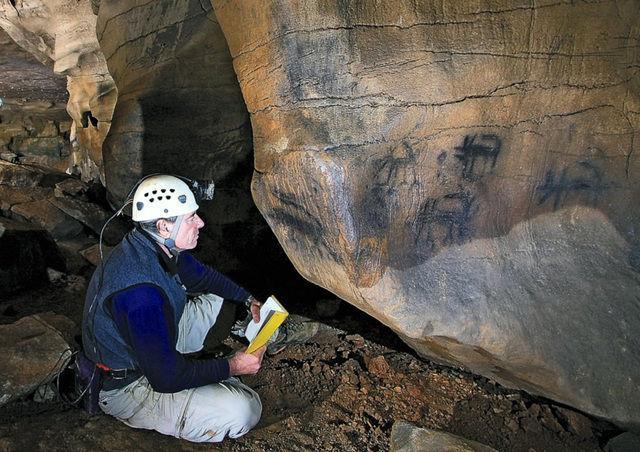
Simek initially studied and conducted field work with much older cave paintings in France, but when he came to UT in the late ’70s, a unique opportunity for similar studies had just emerged in the many cave systems in the surrounding area as the first examples of prehistoric artwork on the continent found in southeast Tennessee.
Since then, more than 75 caves containing prehistoric cave art have been discovered. Simek said he has been able to use the artwork to analyze the religions of the ancestors of the Cherokee, Choctaw and Creek Native American tribes.
The most complex and exquisitely crafted of these paintings lies in Northern Alabama, Simek said, and had not been adequately documented until he and his team examined the cave and cliff paintings in the area.
“That’s why we got this award, because it was as spectacular as it was,” said Simek. “It was a surprise that these things existed and had never been documented.”
For Simek, these paintings, among others found in Tennessee, Georgia, Alabama and Kentucky, can be used to draw conclusions about how ancient people in North America perceived the world around them.
“We have come to realize that the two kinds of artwork, one high up on the bluffs, the other down low underground, are related to each other and were made by the same people and reflect different parts of their religious system,” Simek said.
Much of the information Simek has gathered comes from the interpretation of repetitive symbols that reflect the complexity of the ancient people’s religious thought.
“Their religion was constructed of legends and stories and parables and truths that were taught from generation to generation,” Simek said. “There were rituals that were performed and maintained by priests, and engaged with that always are symbols.”
One of the more prominent symbols includes a circle with a cross through it that reflects a three-tiered universe, including an upper, middle and lower world, with priests that can move between the three.
Symbols similar to this, Simek said, appear in many unrelated cave paintings from different areas of the globe, as well as in central themes of modern religions, including Christianity.
“Understanding religion in the past suggests that people have always had belief systems about where we came from and where we are going,” Simek said. “There are characteristic issues in life and thought that characterize all of us.”
This unity in intellectual and religious development and thought, Simek said, can be found in the study of the past and should, ideally, influence the way modern people from different backgrounds or religious ideologies interact with each other.
“Regardless of how different we are in our cultures, the similarities should far outweigh the differences in how we perceive each other, and in the end that does demand tolerance of us and acceptance of each other,” Simek said.
These broad connections and unanswered questions Simek continues to investigate in his work reaffirm his love for his field and his decision to pursue archaeology from a young age.
“I never wanted to do anything else,” he said. “Never.”