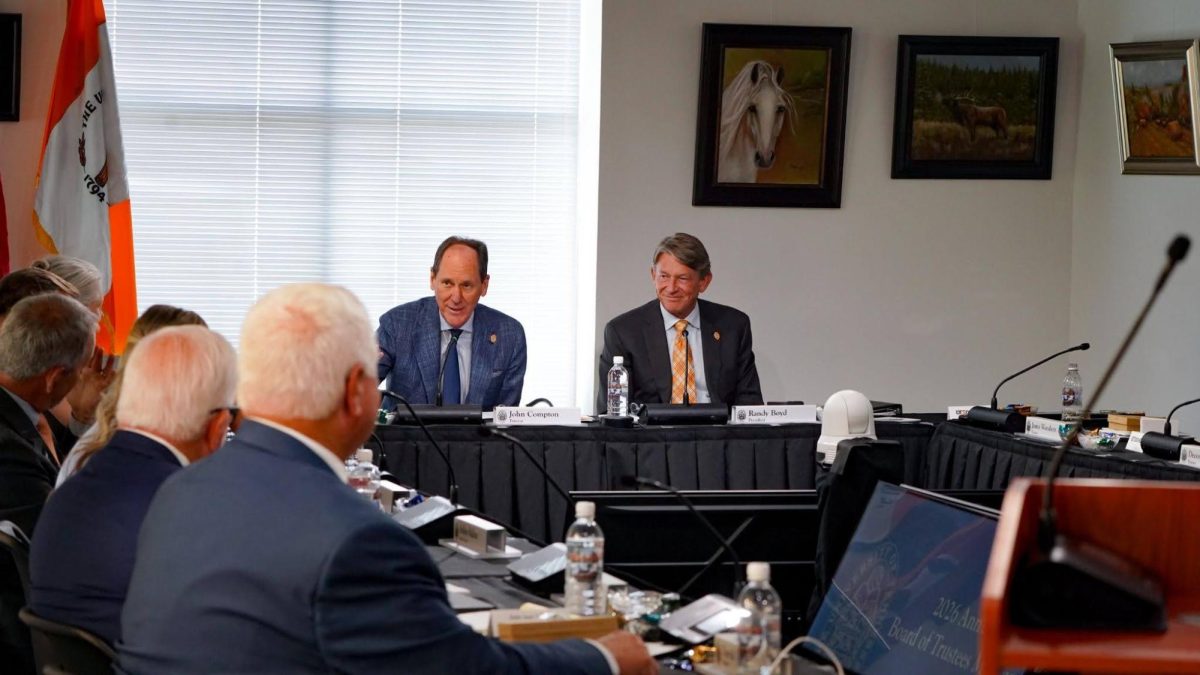
The UT Board of Trustees approved a tuition rate increase of 6 percent, nearly $500, for in-state students admitted before fall 2013.
Students admitted in fall 2013 and after are under the 15-4 tuition model and saw only a 3 percent increase; tuition for out-of-state students was unchanged.
In his annual report to the Board, UT System President Joe Dipietro attributed rises in tuition to decreasing state funds, the result of this year’s $200 million state budget shortfall and consequent cuts to higher education.
In years past, state support has accounted for most of the UT System’s revenue.
Since 2012, student tuition and fees have made up the bulk of revenue, accounting for 49 percent this year compared to 25 percent in 2001.
State funds delivered only 39 percent of funds this year, down from 2001’s 53 percent.
“This year was really pretty bad,” DiPietro said.
Acknowledging that the reduction in state funds has forced UT to become “a private-driven enterprise,” DiPietro called for statewide lobbying efforts to reverse the downward trend in state funding.
DiPietro said having strong funding for education at every level is “right for Tennessee, and … right for our children’s children.”
“We have to move forward with developing a coalition for investment in the state,” he said.
State appropriations for the UT System remained relatively flat for fiscal year 2015, increasing only $7.4 million, a 1.7 percent increase over the previous fiscal year.
The state failed to fully fund the Complete College Tennessee Act – a performance based model to allocate new funding – which would have brought $8.6 million in new funds.
Additional money to the System was also not provided in areas such as advising services, a cost of living adjustment and non-formula units – which includes the Health Science Center and Institute of Agriculture.
While the state did provide for a $39 million capital maintenance request by UT, the money was only a reallocation of funds from the Board of Regents.
The Board of Trustees also approved controversial changes to the student activities fee, which will allow students to opt-in to the fee. The change allows the creation of an employee-majority board to determine allocation of funds.
Butch Peccolo, chief financial officer for the UT System, said following the Board meeting that it was unfortunate the tuition increase could not have been smaller.
“There is no doubt in my mind that if state revenues had held up, (Haslam) would’ve provided the full $8.6 million … in additional money,” he said.
So long as the state does not fix loopholes in the state tax code or increase the sales tax rate, Peccolo said he does not expect any new funding from the state government.
Despite the tuition increase, Chancellor Jimmy Cheek said he does not believe UT will lose its best-value ranking or its affordability.
Cheek said he hopes the state will return to a funding model more favorable for higher education that would not necessitate further increases in tuition.
“We would really like the state to think about the importance of education and the Drive to 55 and try to come up with a strategy to try and fund higher education better,” Cheek said.
Administrators previously assured students under the 15-4 tuition model – which bill students for 15 credit hours rather than 12 to encourage four-year graduation- that they would try to hold the annual tuition increase to 3 percent.
However, the 3 percent increase is non-binding and may rise should state appropriates continue to dwindle.