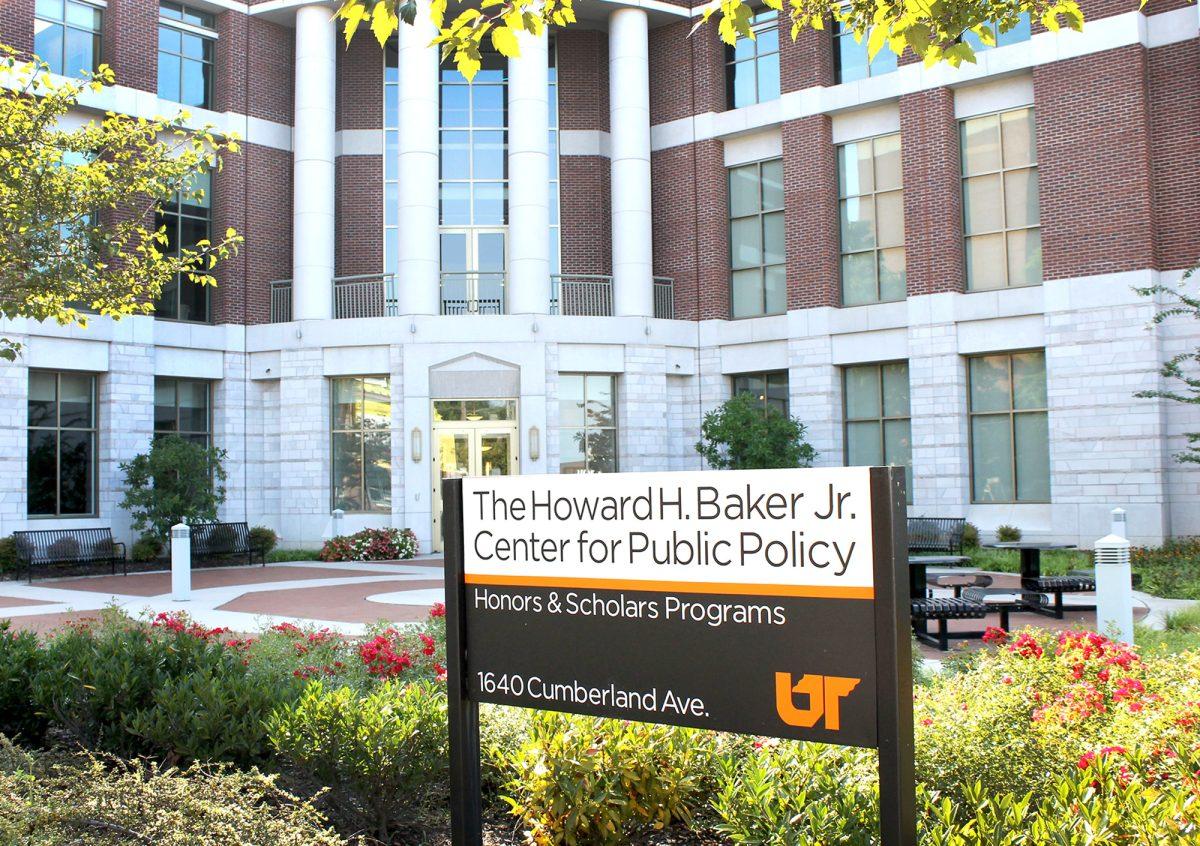
When the Howard H. Baker Jr. Center for Public Policy was created, its goal was archival research into the papers of the late senator and other prominent former Tennessee politicians. Since then, the Center transformed into one of civic engagement and outreach, along with academic research, and four years ago, it changed once again.
In 2008, the Center won a federal grant to help it on its goal of civic engagement and outreach, and expanded in that mission.
In spring 2011 though, a report recommending significant changes to the structure of the Center was issued in the Baker Center Task Force final report.
The report outlined the changes it deemed necessary for the long-term survival of the Center, including an altered mission statement and goals that students at the time feared would give less prominence to student programs and civic engagement.
The Center faced a budget problem, as once the federal grant expired in the next few years, there would be little to no money to continue its activity at the same level.
Seeing this problem, the Task Force recommended to change the Center to have a renewed focus on academic research and encouraged outside donations to ensure the building could sustain itself without drawing from the main university budget. The report also recommended focusing its outside engagement and research around topics like global security, energy and the environment.
This report also recommended the removal of all but three positions from the building, the replacement of the Howard Baker Museum with classrooms and surprised students involved in the Center at the lack of student representation on the report, causing many of them to feel left out of the process.
Matthew Murray, who arrived as director of the Baker Center after many of the changes were implemented, said he was glad he did not have to make those types of tough decisions regarding staff and the museum.
However, Murray said the Center’s main goal today should be conducting grant and contract research as a means of sustaining the building and its programs, and its obligation to serve as a source of public policy.
Despite the new focus though, he said the Center still maintains its obligations to local civic engagement, though not as its primary objective.
“I am trying to put a greater emphasis on the Baker Center establishing a national reputation than a local or regional reputation,” he said. “For the Baker Center to really be an impactful public policy center, we can’t do that by focusing solely on problems in the local community.”
The Center has still maintained a solid level of public outreach, bringing in important guest lecturers such as Secretary of Education Arne Duncan and former NBC Nightly News anchor Tom Brokaw, and last year even organized the first Policy Challenge, where students asked local businesses how to improve the Strip.
“We have moved somewhat away from (civic engagement), but we haven’t given up on it,” Murray said.
While Murray said that research is what any policy center should be doing, the Center’s focus on academic research also aligns it with the rest of the university, which is concentrated on academic research as part of its Top 25 goals.
That doesn’t mean though, that all were happy to see the changes. Eric Dixon, a 2013 graduate in philosophy, was a co-author on a student rebuttal to the Task Force’s report, one that asked the university to retain its focus on student engagement.
Dixon said the one of the main reason for the creation of a rebuttal was the lack of any students on the Task Force report.
“For all their merits, the members of the task force weren’t students and so they couldn’t fully understand or represent the Baker Center’s roles in students’ lives at that moment,” Dixon said.
Dixon said he enjoyed giving tours of the museum to local schoolchildren, giving him a unique opportunity to educate young people about the role of government.
The museum, described in the report as “underutilized space,” with few visitors, was ultimately replaced with offices for the Chancellor’s Honors Program, who had for years been in the run-down Melrose Hall, a former dormitory no longer open to residents. Many of the exhibits were distributed throughout the building and the Modern Political Archives were sent to the UT Libraries Special Collections.
While the student rebuttal claimed some of the proposals were contrary to the original mission of the Center, Margie Nichols, vice-chancellor of communications and one of the co-authors of the Task Force, said the university had the support of the late senator and that of his staff.
“This was his legacy, and we wanted him to be involved,” she said. “He was informed the whole time and approved.”
While Lisa Dicker, a 2014 graduate in political science had a staff member coordinate the syllabus and outside activities for the Baker Center Living and Learning community her freshman year, the implementation of the task force report eliminated the position. Her junior and senior year, that job fell to her.
“While I’m really grateful for that opportunity as a student, I think that it may be more beneficial for the students that are in the learning community to have full-time staff,” Dicker said.
Nichols said that the decision to cut staff and refocus the Center was ultimately a financial one.
“Those aren’t always easy decisions, and that’s not always your preference,” Nichols said, “but you have to manage according to the resources you have.”
Despite the changes, Dicker said she is glad to still see the Center’s commitment to public outreach – including that of Director Murray and Associate Director Nissa Dahlin-Brown – and is glad to have seen student programs grow during her time involved.
“I think the Baker Center has done a really great job on strapped resources, continuing all the student programs,” she said. “The Baker Ambassadors is about three times the size of when I started.”
However, Dicker added that she and other students were surprised that an “outside group” did not consult with students before making decisions, and said she wished to see greater cooperation between students and administration in the future.