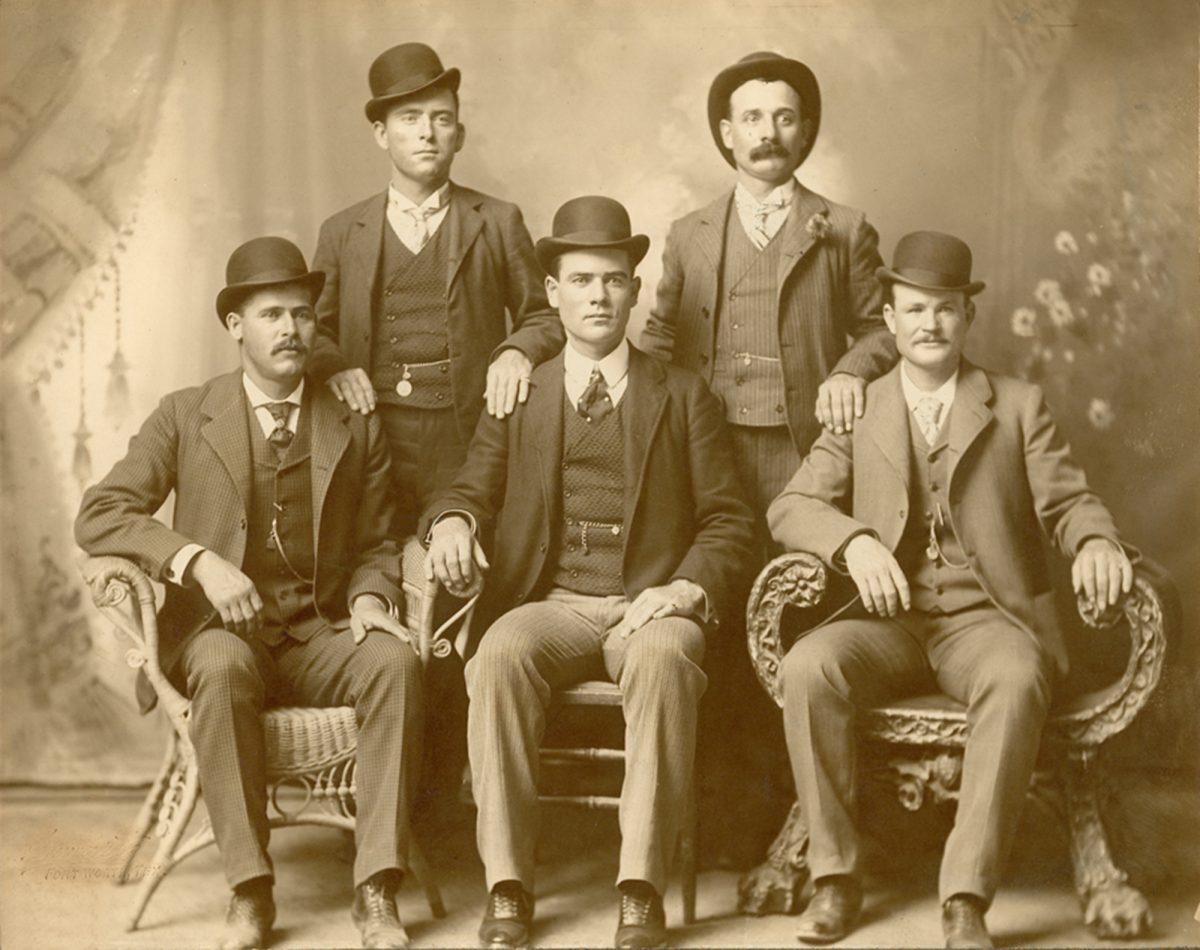
A Western outlaw, a bar brawl and a mad dash for freedom across the Gay Street bridge: these fabled elements comprise the tale of one of Knoxville’s most notorious visitors, Harvey Long.
More popularly remembered in American folklore by his alias, “Kid Curry,” Long rose to infamy as a member of Butch Cassidy’s Hole in the Wall Gang, one of the nation’s foremost outlaw troupes. The circumstances of his stay in Knoxville — and his escape — have become as mythic and muddled as the man himself.
“Unlike similar figures who wrote autobiographies, Long never got to tell anybody exactly what he was feeling or anything like that,” said Bob Hutton, UT history professor and author of “Bloody Breathitt: Politics and Violence in the Appalachian South.” “A lot of what has been said and written about Kid Curry is probably untrue.”
Allegedly the wildest and most violent member of the “Wild Bunch,” much of what is factually certain about Long’s life comes from police reports akin to those he generated in Knoxville. Our scene unfolds in a pool hall in the present-day Old City, then known as the Bowery, one December night some 113 years ago.
At the turn of the century, The Bowery was a burgeoning red light district rife with seedy bars, brothels and cocaine houses. Its proximity to the river and a Southern Railway System stop made the area both “an easy stopover for all kinds of travelers” and a “magnet for virtually every kind of undesirable element and activity imaginable,” as Sylvia Lynch wrote in her book, “Harvey Logan in Knoxville.”
As a man on the lam, Logan was in his element here. Only five months prior, he and the other members of the Hole in the Wall Gang robbed the Great Northern Express train in Montana and successfully made off with more than $40,000 of loot. After such a heist, keeping a low profile was crucial and Long had been doing just that — until his temper got in the way on the night of Dec. 13, 1901.
Stepping into Ike Jones’ Saloon, Long made an impression in his ” brown well-cut suit and soft crush blue hat,” Lynch recalled. “He swilled liquor from a shot glass and told anyone who cared to listen that he was ‘something of a man himself.'”
After getting into a quarrel over a game of pool, he initiated a brawl with two other men that attracted authorities, said local historian and journalist Jack Neely.
“Local police heard he was in a pool hall on Central, and knowing he was an infamous criminal, two cops converged to arrest him,” Neely said. “He shot them both and fled.”
Badly injured but unwilling to surrender, Logan leapt from the saloon’s back door and down some 15 feet into the First Creek ravine. He evaded capture on foot for two days before being apprehended in Jefferson City.
Upon being returned to Knoxville, Logan was greeted by the public not as a known killer and thief, but as a celebrity and a curiosity.
“Somewhere between two and three thousand people had gathered in the cold December air hoping to catch a glimpse of the infamous ‘Kid Curry,'” Lynch writes. “Police were seen actually beating men away from the wagon as they craned to see (him).”
Logan remained in Knoxville for the next 18 months as a local, while national law enforcement bickered over whose right it was to bring him to trial. During this time, Tennesseans visited Logan by the hundreds. On one day alone, nearly 1,000 visitors came to peep through his cell bars. Many of these visitors had read of Logan’s preference for cigars, and, as a result, he received an inexhaustible supply of them. Of all his visitors, Tennessee State Governor Benton McMillin was the most illustrious, spending the better part of a quarter hour cordially conversing with Long.
Although clearly enjoying his celebrity status, Long eventually decided it was time for a new scene. At approximately 4:15 p.m. on Saturday, June 27, 1903, he made his escape.
Lassoing his guard through the cell door, Long helped himself to a pistol and horse before riding off into the streets of Knoxville for a “departure almost as spectacular as his arrival,” wrote Lynch. Although many onlookers out enjoying their Saturday afternoon suspected the identity of the frantic rider, no move was made to stop him. Rather, the people of Knoxville watched in amazement as their favorite outlaw furiously galloped across the Gay Street bridge to freedom.
“He was never positively identified again,” Neely said. “Many historians are of the opinion he was the outlaw who committed suicide during a shootout in Parachute, Colorado, in 1904. Others think he might have escaped to South America, perhaps even to rejoin Butch and Sundance.”
Whatever his end, Hutton believes Long’s life story stands as a symbol of life outside the bounds of law and convention.
“I think it has special resonance, at least to the Woodstock generation,” he said. “The idea of living an unfettered life like that, outside the cubicle, outside the two-piece suit, outside of wage labor.”?