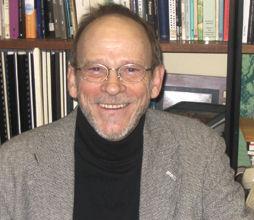
University of Tennessee poetry professor Arthur Smith knew he was going to be a poet when he was 17 years old.
In what he calls a “mystical experience,” Smith heard his high school English teacher read “Do not go gentle into that good night” by Dylan Thomas and immediately knew what he wanted to dedicate his life to.
“At the end of that poem, it was just like my head lifted up off my shoulders and it was all bright lights,” Smith said. “From that instant on, my life was altered.”
After receiving his Ph.D. from the University of Houston, Smith came to UT in 1986 — his first job out of college.
“I’ve been here a long time now,” Smith said. “I loved it at the beginning and I love it still.”
Growing up in Central Valley, California, “where all the fruits and vegetables are grown,” Smith said there weren’t many poets he could look to as role models. When Phillip Levine, a poet from Smith’s hometown of Fresno, came to a book signing, Smith jumped at the chance to see someone who had turned his dream into a long-term profession.
“I realized that here, even in this dusty, dirty place where nobody cares anything about poetry, there’s this man who really cared about it and was defending it and hollering at people who didn’t like it,” Smith said. “I just kind of watched him and said to myself ‘That’s what a poet looks like.'”
With four volumes of poetry to his name and work published in publications like the Chicago Review, The New Yorker and The Nation, now Smith himself is what a poet looks like — and it’s a description he said is not as glamorous as it sounds.
“(Poets) aren’t like wild and crazy — only in our thoughts,” Smith said. “In your personal life, you have to keep some order in it so you have the time and the calm to write.”
As a reader, Smith said he admires the work of Emily Dickinson, James Wright, Ruth Stone and Stan Rice.
“I like the honesty in them,” Smith said. “They’ll say things even if it makes them look bad. All their poems are discoveries, they start somewhere and say ‘God help me, I hope I’m on the right track here.'”
Having poets to look to as inspiration is part of Smith’s advice to new writers. He suggests finding a contemporary poet whose work you admire and imitating their style.
“That way, you learn how to read and how to write also,” Smith said. “You will know (who to imitate), because when you read them, they will move you.”
Unlike drama or fiction, poetry allows the writer to examine the self, Smith said. In that way, the act of writing alone is a form of healing and catharsis.
“My poetry focuses on how one deals with the emotional turmoil inside,” Smith said. “That’s one of the great things that poetry does — it allows us to look inside and see how we’re feeling.”
As a professor, Smith’s biggest challenge is to break students of their misconceptions of poetry, like the notion that all poetry has to rhyme.
“The poem that they’re writing isn’t something they’re doing — it’s doing something to them,” Smith said. “That’s what I try to teach. Let that poem work on you and tell you why it’s there, why it came about.
“There’s always a reason for it.”
Some of Smith’s most gratifying moments as a professor come when he starts to see his students’ poems improve. Occasionally, Smith can encourage an aspiring poet into becoming an accomplished writer.
“It makes you feel good when someone is really interested in poetry and they take several of your classes, graduate and then two years later they send you a copy of their book,” Smith said. “You think ‘Wow, they did it. I’m so proud of them.'”
In his spare time, Smith takes care of his three dogs — Koko, Kailey and Kassie — and develops his passion as a self-described film buff.
Although Smith has taken a circuitous path to poetry, he wouldn’t change a thing.
“I was supposed to be an engineer, according to my father,” Smith said. “When I failed calculus my first year of college, that kind of changed my plans. And so I thought I’d become a poet.
“Funny how that turns out.”