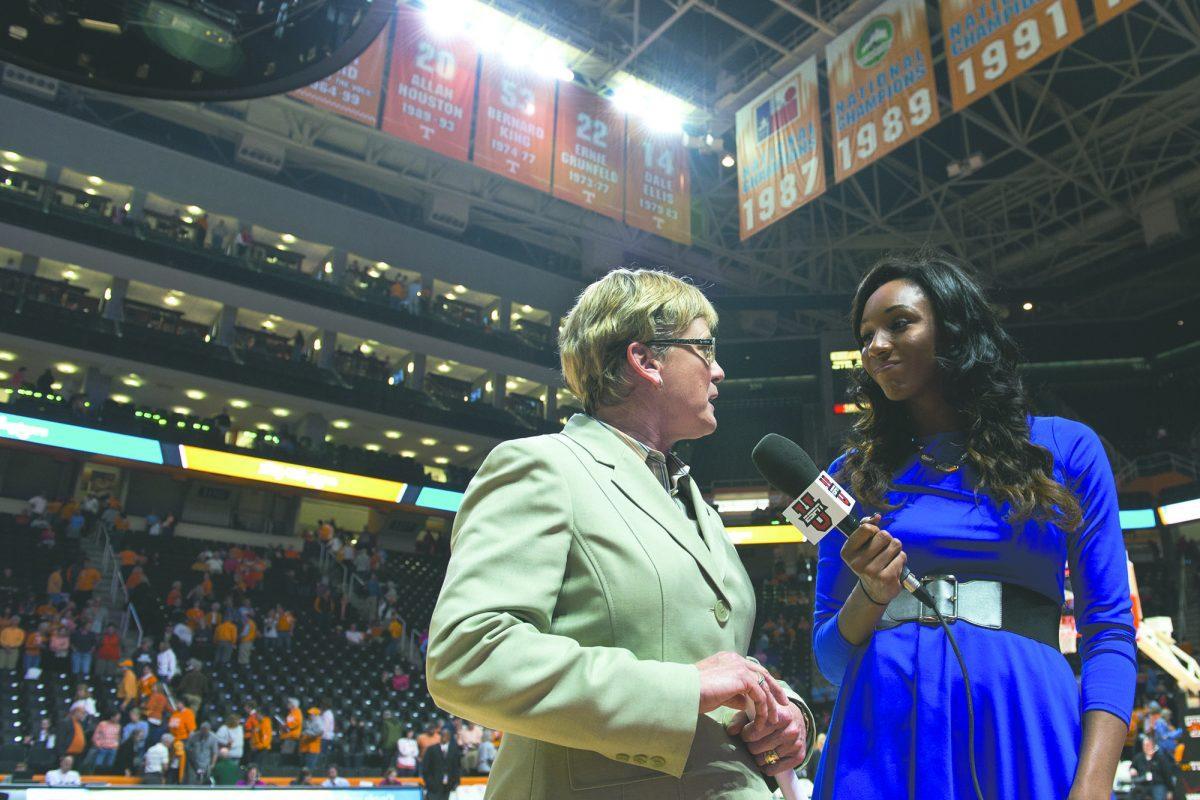
The Daily Beacon sat down with Lady Vols Basketball Coach Holly Warlick for an exclusive interview. Part two of this interview will be published next week.
DB: The first thing fans will probably notice is that this team looks very different than last year’s. There are more bodies out there and there are a few new faces wearing Lady Vol Orange, right?
HW: I think we are heavy in the guard and forward area because of experience from past years, experience with injuries and having people available.
It’s not that we just went out and signed bodies, we went out and signed kids that meet our needs. Losing Meighan (Simmons), we had to fill the role of shooting guard, and I think that Jaime Nared and Kortney Dunbar are that, and the toughness that we signed is where Alexa Middleton comes in. She’s kind of a multi-purpose player and as a bonus we got Diamond (DeShields) to just have that athleticism. She’s become a great team player. And Jannah Tucker, she’s going to add just an unbelievable dimension to us as far as a scoring threat, a big body, rebounding and just the knowledge she has for the game.
It is going to be an interesting year, but I think it’s going to be really fun.
DB: How are the new players bonding with the more experienced leaders on the team? Is the team bonding and coming together?
HW: Yes, I think so. Our goal is to do a lot of teambuilding and try to keep our team bond. Bonding is huge for us. I think we’ve got some of the best talent in the country. It’s just how we’re going to get along and how we’re going to handle all that talent and different personalities. I think it was key for us to get everyone here for the second semester, besides Cierra (Burdick) who is doing an internship. I thought it was important to get everyone here and have our upperclassmen here as well. They all live together, that’s what we want them to do. We want them to form relationships off the basketball court. You just do teambuilding things and hope they get it. When is the team more important than themselves? When you figure that out, things are just going to skyrocket.
DB: There are three seniors this year: Isabelle Harrison, Cierra Burdick and Ariel Massengale. What do you expect from them as leaders?
HW: I think that they’re seniors now, and they have to step up. They’ve got to step up and be more vocal and they’ve got to step up and be accountable. They have to take responsibility. Not everyone is going to lead the same way. Some lead by example and some lead vocally, but they have to hold themselves accountable if they are going to hold our team accountable.
DB: The competition across the board and especially in the Southeastern Conference is really jumping up right now. Personally, does that concern you, or does it fuel your fire?
HW: You know, I think it has to fuel your fire. For me, everybody’s competition and I think it is just part of the game. As much as you sit there and think you want to blow somebody out by 30 or 40, you really don’t. I just think it is healthy and makes you a better coach, makes you a better team and makes us a better conference. There are a lot of challenges throughout the year, but it builds your character. What are you about? What do you stand for? It should bring out the best in you.
DB: I know UT hasn’t officially released the schedule yet, but some other schools that Tennessee will play have, like Oregon State and Pennsylvania. Are you continuing the tradition of tough Lady Vols nonconference schedules?
HW: We play Pennsylvania, who won their conference. We play Wichita State, who won their conference. Oregon State, Stanford, we go to Notre Dame and play at Texas, so we have a tough schedule. It’s becoming harder to get people to come play us here in Thompson-Boling arena. It’s tough. The fans are into it and it is a great atmosphere.
DB: The topic of paying college athletes is a hot one right now. Do you feel that players should be paid?
HW: No. No, I don’t. The only reason why I don’t is that I don’t know what the cut off is. I understand that they need to, you’ve got some kids that do, but I don’t know where you draw the line. I look at it as they are getting an education, and that’s a lot of money, to come play. I know we’re marketing them and they help pay our salaries, but to me a scholarship is getting payment. So, I think, probably, if you’re looking at laundry money or things like that, then yes. But when we start paying athletes for their services, we’ll no longer be amateur athletes. I mean, we have an opportunity fund, which I think is great that if a kid has some needs, or has a relative that dies. Kids come here with no money, and I did the same thing. I don’t know what the answer is but I don’t want it to get out of control.