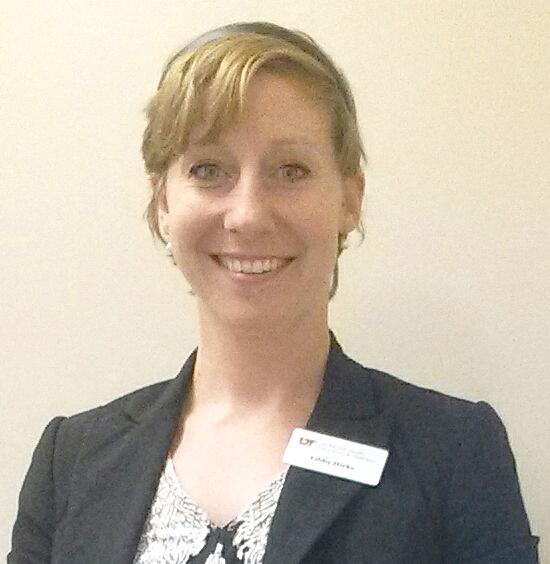
Libby Hicks has dedicated her life to improving sexual health on college campuses, and she’s brought her dedication to UT.
As the new wellness coordinator at the Center for Health Education and Wellness, Hicks knows what it’s like to confront issues that people shy away from discussing and hopes to encourage students to do the same.
“It takes practice, especially if you’ve been raised with this mindset to turn the other cheek or just smile and nod,” Hicks said. “It takes practice to recognize that initial reaction you have, that gut feeling, when you feel like something isn’t right and then acting on it.”
After graduating from San Diego State University with a degree in biology, Hicks returned to her Missouri home and accepted a position at the State Public Health Laboratory. Though this piqued her interest in public health, she said running samples in a lab coat just wasn’t enough.
“I was missing that component of working with people and educating them about health, missing that interface with the patients,” Hicks said. “I was just in that weird gray area where I had nothing to do with treatment, but I also nothing to do with education either.”
Inspired to make an impact on sexual health policy, Hicks decided to pursue a master’s degree of public health at the University of Missouri in Columbia.
Hicks, mentored by Heather Eastman-Mueller, a health educator at Missouri’s Public Health program, arranged a campus campaign for sexually transmitted infection testing, combining resources from the state of Missouri and RAIN of Central Missouri, a non-profit, community testing agency.
“Libby worked really well with the students in the (Sexual Health Advocate Peer Education) program,” Eastman-Muller said. “As the outreach coordinator, she changed the climate and culture specifically related to dispelling myths and improving access to sexually transmitted infections.”
Last spring, Hick’s campaign at Missouri tested 333 individuals for gonorrhea and chlamydia during the course of five consecutive weeks of Monday screenings. As part of a referendum, this campaign will continue on the University of Missouri’s campus and provide free treatment for individuals testing positive for sexually transmitted disease.
According to Hick’s latest report, 300 individuals were tested in September.
Now as an official Volunteer, Hicks hopes to foster the “community of care” attitude on a campus and is working to launch a similar STI screening campaign on UT’s campus in spring semester.
She hopes to increase awareness for sexual health on campus by collaborating with several groups such as Sexual Empowerment and Awareness at Tennessee, Sexual Health Advocacy Group and the OutReach Center, in addition to “Get Yourself Tested,” a national campaign geared toward STI testing for men.
Just a month into her position, Hicks has focused on sexual health and sexual violence prevention through student-targeted programming like Volunteers Speak Up and Vols 2 Vols, a program provided by the Peer Health Educators.
She is also helping to develop 20 new programs, including the center’s “Healthy Relationships” which will focus on the qualities of healthy versus unhealthy relationships and the proper communication tools necessary for productive dialogue between couples.
“It’s really looking more at all relationships and practicing assertive communication,” Hicks said. “How you participate as a person in relationship, how do prefer to be communicated with, what kind of needs to you have and how does that vary from relationship to relationship?”
Hick also oversees SPEAKologist training for interested members of the UT community, equipping the program’s participants as active bystanders and instilling in them the confidence to “Speak Up” when they witness any threat or danger to another student’s safety.
“For campus to be safe, we need to recognize that even though we’re strangers, we’re still volunteers and we’re still on this campus together,” Hicks said. “It’s this whole mantra of Vols help Vols, regardless of who you are, who am I, we’re still a part of this campus community and we care about each other.”