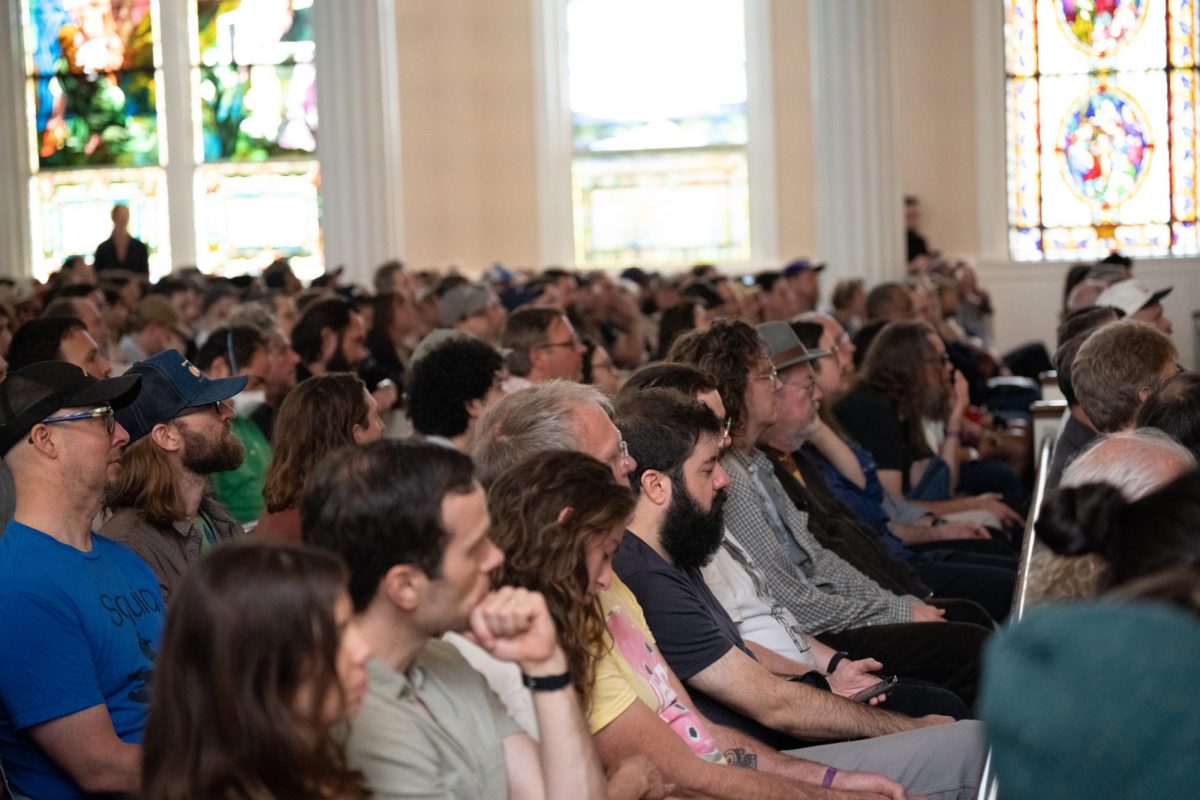
With a newly established music business minor and a growing School of Music, UT students are flocking to learn about the music industry from its top professionals.
WUTK hosted Del Bryant, former president and CEO of Broadcast Music Inc. to talk with students and faculty Thursday afternoon about music, radio and tactics to make it in the multi-million dollar music industry.
For Bryant, music is nothing new. After all, his parents are Boudleaux and Felice Bryant, the couple that penned “Rocky Top,” UT’s beloved anthem. During his talk, Bryant reminisced about the importance of the song’s legacy.
“I’m most pleased that song was embraced by the university,” Bryant said, “and that a piece of my family’s history is a part of the school.”
As he spoke, Bryant warned that the music industry currently has a whole new layout to consider. With advancements in technology and the Internet, people constantly have free music at their fingertips. Bryant discussed how record and licensing companies still continue to make a profit even considering these factors.
International business, cable, radio and live performances, while advanced, have still had to make major renovations. Bryant used radio as an example of a medium that has changed over the decades as it has competed with television and the Internet in terms of how consumers listen to music. While in the act of trying to compete and stay fresh, radio has fallen victim to central programming.
“When squeezing for better profit, you diminish the station’s personality, and you are left with a strange corporate zombie,” Bryant said. “It needs to become a part of the community. There are no more disc jockeys locked in a room to play what they want.”
Bryant also talked about the importance of copyrights and licensing today and how they are being ignored. Copyrights provide the creator or artist with the rights to legally own the work they produce while licensing, if granted, can ensure usage of the music. When these are thrown aside, it leaves artists with less control over the distribution of their work. Apps and personalized radios like Pandora, Spotify and iTunes Radio play a large role in the avoidance of licensing.
“It sends a message that copyright doesn’t matter,” Bryant said. “If it’s free, good-bye to a good product.”
To finish his talk, Bryant discussed methods for making an impact with art and smart approaches to breaking into the music industry. He stressed the importance of letting ideas flow and said it’s okay to “sit down and look at a blank page.” Bryant made a point, however, to emphasize the importance of education, which allows an aspiring music business professional to “stick your foot in the door.”
“Be sincere and work hard,” Bryant encouraged. “You have to do more than show up. Really want it.”
Miles Collins, a junior in journalism and electronic media, was pleased with Bryant’s words of wisdom.
“How often can you sit down and ask questions with a CEO of a major corporation?” Collins said. “I got to ask the questions I wanted to ask, and he was really nice. I think it’s great that he is a songwriter, and he hasn’t forgotten about his roots.”