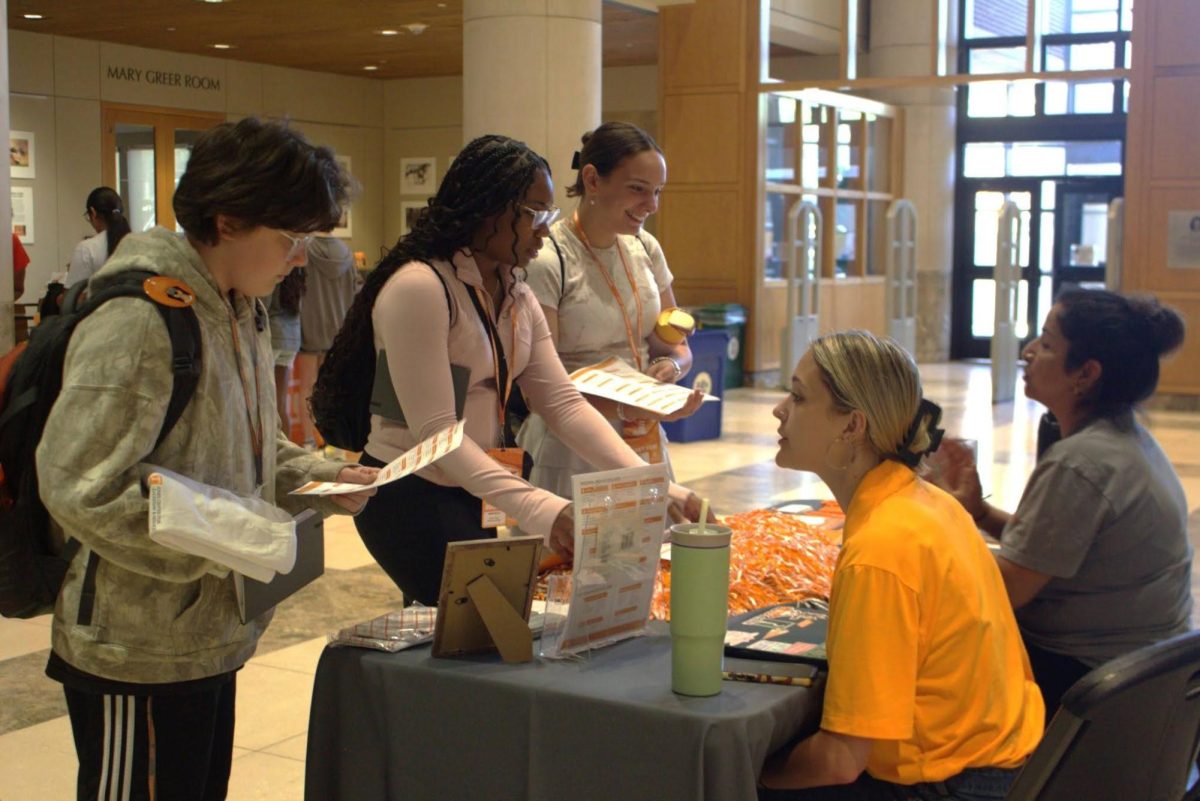
Girls wearing multicolored hijabs in various styles, or no hijabs at all, travel from class to class, just more fish in a sea of college students.
Men in jeans and t-shirts study for exams or hang out on The Strip, indistinguishable from the masses save for their occasional transition from English to Arabic.
All students, all Knoxvillians and all Muslims. Each of these individuals must face the realities of living in a post-9/11 world filled with fear and misunderstanding.
Knoxville native Abdalla Husain is one such individual. As a teenager, he was one of only two or three Muslims at his local high school, with the exception of his sisters.
While he played sports, hung out with friends and graduated as the valedictorian of his class, pervasive stereotypes followed him in the form of questions both benign and aggressive, from friends and strangers alike. In one particular instance, a close friend asked him, “Why do all Muslims want to kill Americans?” Similar questions included “When did you learn to speak English?” Others inquired about human sacrifice, animal torture or whether everyone gets 70 virgins in heaven.
“Honestly, I think it’s purely ignorance,” Husain said. “They just don’t know. That’s why I don’t get offended. They’re just asking a genuine question.”
Taking the time to answer these questions gives Husain the opportunity to dispel such myths and teach people the truth about Islam.
Amany Alshibli, a freshman in chemical engineering, recalls being asked similar questions, mostly pertaining to her hijab. Like Husain, Alshibli not only excuses the questions, but encourages them.
“As much as some people are scared of a question sounding stupid, there aren’t really any stupid questions,” Alshibli said. “I would rather answer it than them go to other outlets where they may not be getting a good, accurate representation.”
Husain views the average American’s lack of exposure to Arabic culture and religion, combined with constant news coverage of violence in the Middle East, as leading to the formation of preconceived ideas and misunderstandings about Islam that misrepresent a diverse and universal religion.
“If they don’t understand the language, and don’t understand the culture, and don’t understand the religion, then it’s so easy (for others) to manipulate their beliefs,” Husain said.
Alshibli echoed this concern.
“A lot of people who don’t know Muslims personally, all they know about the faith is what is being broadcast on the news,” Alshibli said. “Muslims, or anything related to Islam, is only in the news when it’s something happening overseas.”
News coverage of Muslims focuses almost exclusively on the Middle East, but 20.1 percent of all Muslims live there. Of those who live there, the extremists covered by the media make up only a fraction of the overall population.
“The .001 percent of Muslims who are extremist are given 100 percent of the news coverage,” Husain said.
Alshibli and Husain, both members of the Muslim Student Association, feel these misconceptions have forced them to grow up under constant scrutiny, and have made them ambassadors for the majority of Muslim moderates.
“Because of all the stereotypes around our faith, we have to stand upright and show through our actions what Islam really is,” Husain said.
Abdelrahman Murphy, director of the Muslim youth group “Roots” and the first Muslim chaplain at the University of Tennessee, believes that by humanizing Islam “a lot of the stigma is dropped and people can really see it for what it is.”
Murphy said the best way to accomplish this is to simply talk to one another as students, friends and human beings.
“People are very curious, and once they learn about what we believe, they don’t hold it against us,” Murphy said. “Share some food with each other, and get to know one another.”