Hands up – don’t shoot.
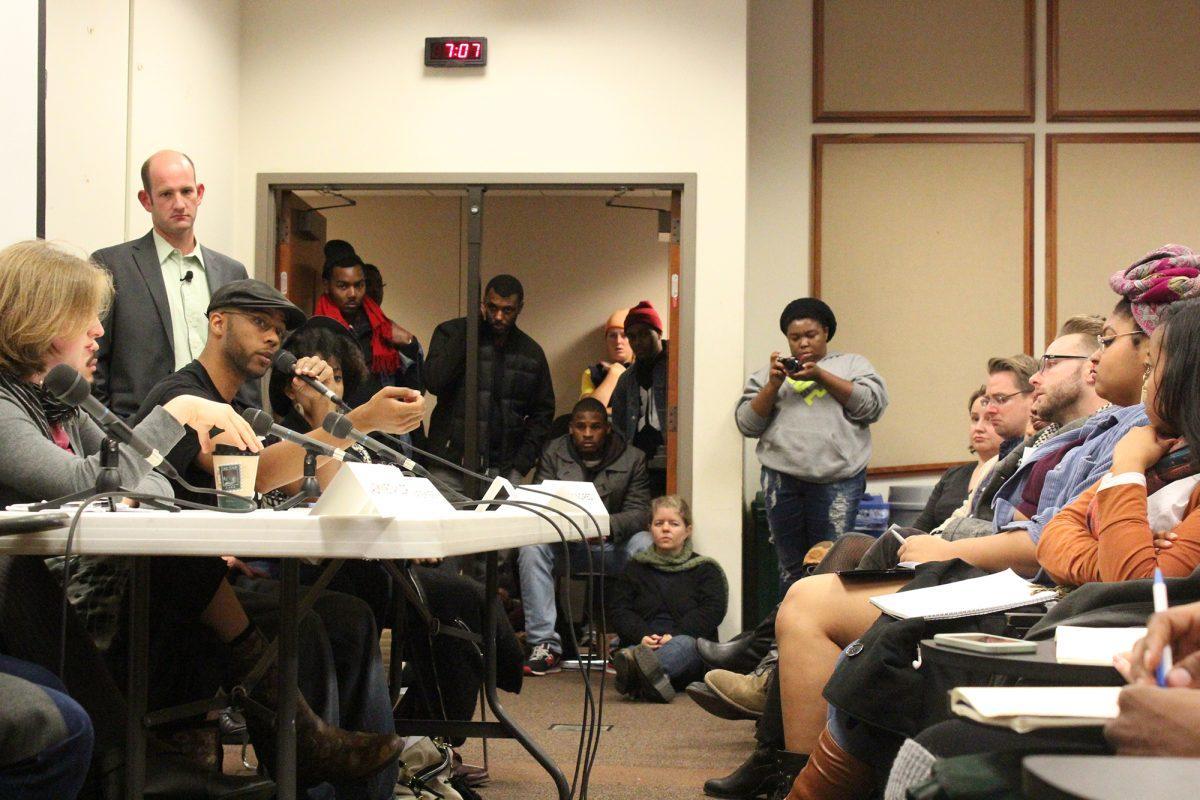
Wednesday evening, students and staff packed into a lecture hall in the Alumni Memorial Building, filling every seat and lining the walls, to hear the experiences of six Knoxvillians who recently traveled to Ferguson, Missouri.
The group drove seven hours to the St. Louis suburb to take part in the social movement protesting the death of Michael Brown, an 18-year-old black man who was killed, unarmed, by a white police officer Aug. 9.
Josh Inwood, associate professor of geography and one of the event’s organizers, said the underlying economic, racial and social causes of poverty and violence are grossly under-scrutinized in the U.S.
“Rarely, if ever, do any of these broader structures of violence register in the politically-infused, media-driven agenda,” Inwood said. “A legacy of racism, prejudice, intolerance and discrimination pales in comparison to the vivid video images of ‘rampaging African-Americans.'”
Coy Kindred, the executive director at The FLOW, a grassroots organization dedicated to changing the perception of hip-hop, said the constant presence of protesters in Ferguson was impressive and she wished she could have stayed longer.
“These people were sleeping in the streets,” Kindred said. “They were going non-stop. When we got there, they had been there, camped out, fighting every day, spending more time in jail than Darren Wilson.”
Jasmine Taylor, junior in political science, the opportunity to meet and protest alongside Ferguson natives still grieving over Michael Brown’s death was a powerful experience.
“Hearing his mother at the front of the crowd, talking about how she was looking forward to her son being a success … and how that was just shot down in the middle of the street and how devastating that was for the community – it humbled me as an organizer,” Taylor said.
For sophomore Katie Myers, who grew up in an affluent suburb in Maryland, said she decided to go to Ferguson to “look for the truth” about police brutality and social inequity.
“When I went there, and I heard the stories, I realized that I had been lied to all my life about how the world was,” Myers said. “And that made me really, really angry.”
In Ferguson, protesters are caught between the anger they long to express and the peaceful response they believe will prove more effective long-term.
Taylor described one situation she witnessed in front of the police station in which protesters were peacefully voicing their concerns to officers. One woman was “beside herself,” Taylor said, and the protesters became concerned her anger would get out of hand.
“There was a moment when everyone was like, ‘let her voice how she feels, she has the right to do that’,” Taylor said. “But then it became a question of the integrity of the movement if she took too far, if she got too close to a police officer’s face.”
André Canty, a UT graduate who now works at the Highlander Center, said he was moved by the resiliency of the protesters he encountered during the trip.
“People were calm,” Canty said. “And I think it’s because they’d been through a lot worse before we came down there. When you’re facing rubber bullets, mace and pepper spray and being beat down, a little guy with a megaphone is nothing.”
Despite the snipers placed atop the buildings above the non-violent protest and occasional provocation from outsiders, Myers said the participants in the movement knew their ultimate goal could only be achieved through peace.
“People understood what was at stake,” Myers said. “They understood that if something was provoked that police reaction would be stronger and that would lead to violence.”
Kindred said the trip offered a chance to step outside her comfort zone and bring her findings back to Knoxville.
“We kind of live in these bubbles, and until something happens to us, it doesn’t matter,” Kindred said. “I felt like I had the opportunity to go and make a difference. And even if it was just my body being there, I had to believe that it meant something.”
Ultimately, Taylor said the experience proved to her activism does not need to be put off until graduation.
“What I would take back from Ferguson is that Millennial activism does exist,” Taylor said. “The youth do care and are engaged.”