Josh Richardson’s swagger on the basketball court is undeniable.
The senior guard averaged 19.3 points per game in the NCAA tournament last year and is the only returning starter for UT’s basketball team this season.
“He plays with confidence,” first-year head coach Donnie Tyndall said during a preseason media availability in October.
Richardson’s confidence, however, isn’t solely used against SEC opponents. It also translates to his personal style on campus – an aesthetic he summarizes in a single word.
“Versatile,” Richardson said. “I wear a lot of Vans, Converse, then I might turn around and wear Jordans or some crazy colored Nikes. I wear skinny jeans or joggers one day, and then another day I’ll wear sweatpants, just a lot of different stuff.”
But not every student athlete puts as much thought into their sartorial decisions as Richardson. Some admit it is hard to maintain a unique style when they’re part of an SEC team on a campus like the University of Tennessee.
For most players on UT’s 18 NCAA-sanctioned teams, the decision of what to wear is based on a combination of convenience and practicality. It’s not an obligation but a habitual choice for players to reach for team-issued gear before heading to class. Their apparel, typically orange and white with the power T stitched on the chest, provides the players with pride and exclusivity as a part of a Tennessee team.
Student athletes receive team-issued gear at the start of every year and can be distinguished from other students by the apparel they sport. Soccer players in gray sweat suits, baseball players in matching orange polo shirts and football players with tags on their backpacks indicating their name and number on the team.
Opportunities like the Vol Walk and the Volscars allow student athletes to display their individual style in more formal settings, but for Richardson, dressing uniformly with the team – even when uniformity limits his personal expression – is good for the game.
“It keeps you as a team; it doesn’t let anyone go off as an individual,” Richardson said. “Nobody thinks that they’re better than anybody. It keeps a focus in a lot of ways.”
Although there isn’t a formal dress code, student athletes are required to wear team-issued gear at practices, before games and at special events.
But more often than not, on a daily basis, they reach for their practice sweats as a default outfit.
Richardson’s teammate Armani Moore said the culture of being an athlete makes it challenging not to look exactly the same as his teammates on a regular basis.
“The people that I’m around each and every day, other than the people that I’m in classrooms with, are athletes,” he said. “When I go to eat, I’m around athletes. When I go to practice, I’m around athletes. When I go to study hall, I’m around athletes.
“So everybody dresses the same way, you know?”
When Justin Worley enters one of his graduate-level courses, he wears a pair of khaki pants and a polo shirt – not unlike his fellow classmates.
“I don’t think my style directly reflects me being an athlete,” senior quarterback Justin Worley said. “I’m not trying to go out there and show who I am at times, so I’ll put on whatever I feel like wearing that day.
“I just try to be a normal guy.”
Arguably one of the most recognizable faces in UT athletics, Worley said he does not identify with being an athlete style-wise. That’s not to say he – like other student athletes — doesn’t sport his Tennessee gear frequently out of sheer convenience and pride.
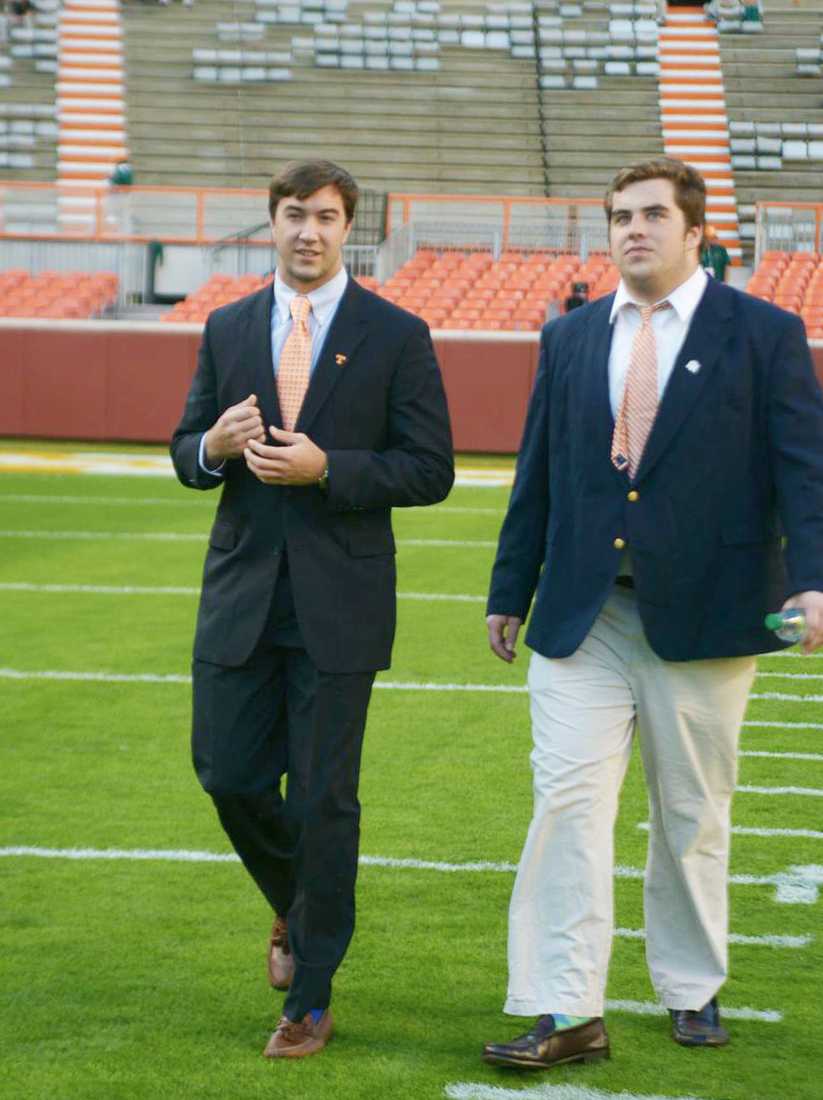
At home games, football players participate in the Vol Walk a few hours before kickoff. Each athlete, as they climb off coach buses and begin their trek from Circle Park to Shields-Watkins Field in Neyland Stadium, is clad in formal menswear attire.
On Saturdays, players style their dress clothes as they see fit. Curt Maggitt wears combat boots, Josh Dobbs chooses bow ties emblazoned with the Tennessee emblem, A.J. Johnson goes for a suit and tie, Steve Madden shoes and some earrings for the special occasion. And his orange-dyed dread locks complement the Power T pinned to his lapel.
Johnson contends that campus isn’t necessarily the best place to showcase style for athletes. He, for example, will dress up to go out on the weekends but not for class. When it comes to defining the team’s overall style, he said the most important element of expression is what wearing the Tennessee jersey signifies on the field.
“It’s hard to define a team as one,” he said of the team comprising 96 students. “We define ourselves as one unit when we’re on the field, but style wise, you can’t define just one team because everyone has their own style. So that’s the unique part of our personalities.”
The fact that many student athletes wear Tennessee gear is not so much a decision but a natural inclination. They are proud of their involvement with their teams and they want to covey that through the clothing they wear.
Orange and white apparel doesn’t hinder self-expression but rather showcases pride for the specific team and its program, said Lady Vols basketball guard Ariel Massengale.
“We’re still individuals, we’re still our own people,” Massengale said. “For the most part, we choose to wear our Tennessee gear. It’s never something we’re forced to do.
“But I think that when we do wear it, we wear it proudly.”
Similar to the Lady Vols basketball team, the soccer team coordinates uniforms and outfits according to the team’s schedule. The older players, typically team captains, send teammates uniform guidelines to streamline the team’s look with matching clothing.
“People on other teams, guys and girls, will wear whatever they want, and if they have good fashion and good style, good for them,” senior captain Julie Eckel said. “But for a lot of us, it’s easiest to put on what you’re going to wear to practice that day and go to class.”
Convenience is a primary factor for most teams. Softball players Cheyanne Tarango and Annie Aldrete, as well as volleyball players Lexi Dempsey and Shealyn Kolosky, all agreed that when life revolves around your sport, your style is a byproduct of that.
Student athletes must attend morning workouts, but because their practice starts in the afternoon, players must schedule classes before a certain time so there are no schedule conflicts. Some teams have off days, but those are more rest days than occasions to dress up.
“If I don’t have to dress up and look cute,” Tarango said, “I’m not going to.”
But team-issued gear does provide student athletes with a sense of exclusivity. It’s a reminder of how hard they work to achieve their goals, and it gives them a sense of identity on a campus with more than 27,000 students.
Just like any student who is part of any other organization or club on campus.
“I think we all have a lot of pride to be on the volleyball team,” Dempsey said, “and it’s nice to be able to put on the shirt because you know that only 16 girls in the whole school can.”
Recruits often visit UT and participate in special events with the teams. While these types of events require wearing a Tennessee jersey, Aldrete said she and her teammates dress nicely in jeans, sweaters and boots.
Still, it’s more common to see student athletes on campus dressed in team-issued gear than in jeans and a T-shirt. This is true even for the newest of Vols, including freshman catcher Benito Santiago of the baseball team.
Originally a native of South Florida, Santiago’s mother recently traveled to Knoxville to visit and bring him casual clothes for his first year on Rocky Top.
But Santiago said his mother’s effort ultimately wasn’t worth it.
“There was no point in even bringing me those clothes,” Santiago said. “My whole closet is orange.”