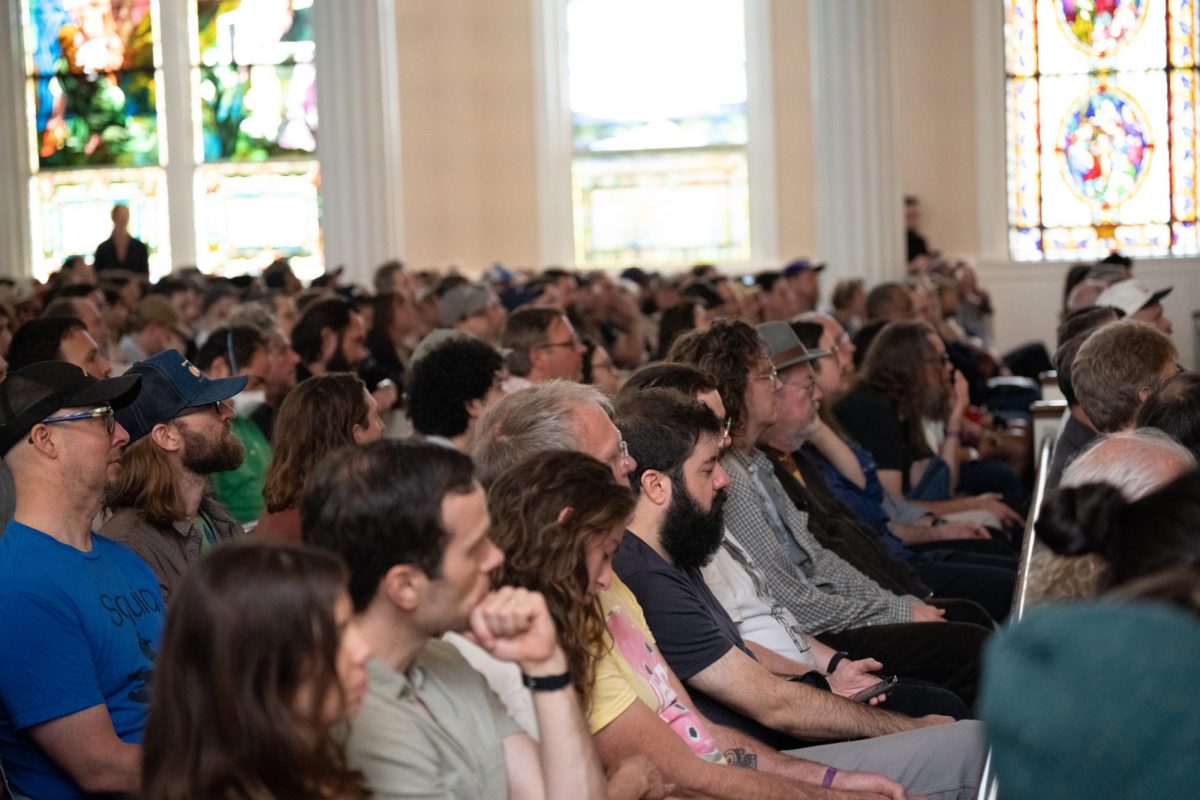
A brave group weathered the cold and gathered in Lindsay Young Auditorium on Monday night to hear author David James Poissant speak during the semester’s final “Writers in the Library.”
The finale to the lecture series was sponsored by writer and graduate student Matt Brock. Brock said the first story he read by Poissant was “Lizard Man,” and that it is a terrific piece.
“Poissant is an amazing young southern writer,” Brock said.
After discovering Poissant, Brock shared one of his own stories with the author, which is how they came into contact. Brock mentioned to Poissant that he should do a reading at the University of Tennessee because it would be a great experience, thus leading to Monday’s reading.
Poissant is the author of “The Heaven of Animals” and many other published essays. His writing has become increasingly popular, and his essays have appeared in The New York Times, The Atlantic, The Chicago Tribune and various other outlets. Poissant has also been awarded The Matt Clark Prize and the George Garret Fiction Award.
Yet with all the acclaim for his previous works, Poissant decided to stray from his more popular works and read two new essays along with one short story from his short story collection “The Heaven of Animals.”
His first essay was called “Nathan,” which will be published this winter. Poissant explained that he based the story off a bet he made with his friend, and it chronicles a man’s life and how he happens to always have good fortune despite the disapproval of some of his actions by his family. David’s reading of this story demonstrated his ability to shock with the introduction of an unexpected narrator at the end of the piece.
He then read “What the Wolf Wants” from “The Heaven of Animals,” a piece about how hospitality isn’t always returned. Stephanie Dugger, a graduate student in English, found the story to be the most appealing reading of the night.
“This story was my favorite one that he read,” Dugger said, “and it is a fantastic piece.”
To close the evening, Poissant read “The Story of the Year,” a tale about the events that took place over the past year of his life. The story is about a family and all the daily tasks that they go through each day and discusses love, faith, mortality and loss. The story proved to be a stark contrast to the first reading focusing on perpetual luck, as opposed to the final one exploring everyday misfortunes.
Despite the hard lessons Poissant sometimes shared from his works, there were many laughs in the crowd as he read his works.
“I was always attracted to funny stuff, and I like to make people laugh,” Poissant said.
David chose the three pieces he thought were on the weirder side, and he explained .he writes the weirder stories as a release valve, allowing a less controlled prose to emerge.
“Poissant’s diction was very poetic,” Dugger said, “and that it was in some way magical.”