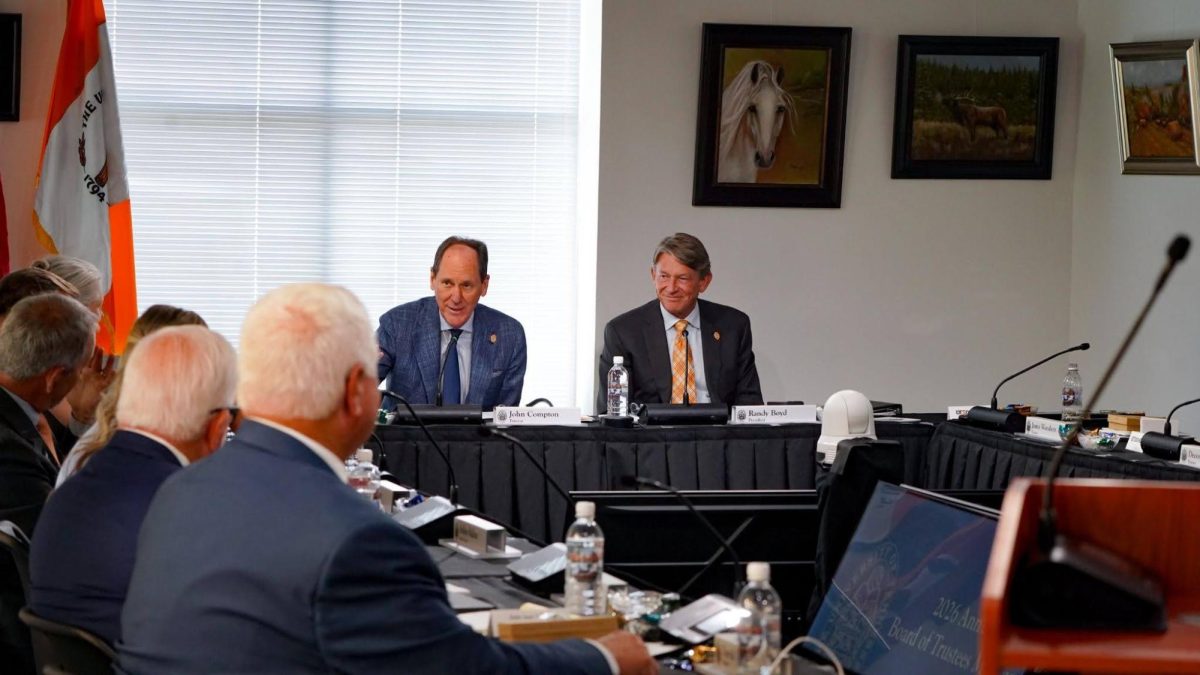
Not one, not two, but three Tennessee governors were the guests of honor at the Baker Center as they discussed civility in politics on Thursday night.
A massive crowd turned out to the Howard H. Baker Jr. Center for Public Policy to hear governors Bill Haslam, Phil Bredesen and Don Sundquist have a panel discussion on how civility works in politics and how it has declined. It was the third and final part of the Tennessee Bar Association’s “Balancing Civility and Free Expression” series.
The Baker Center was packed long before the event even started at 5:30 p.m., with an estimated 330 people attending the panel, including the Center’s namesake, Sen. Howard Baker Jr., himself. Once the Toyota Auditorium had filled up, new audience members were seated before a livestream of the event in the Rotunda and in additional rooms upstairs.
Bill Haltom, a Memphis lawyer, Tennessee alumnus and column writer, was the moderator for the event. He introduced the panel and expressed the significance of the event.
“Tonight we have an incredible panel. We’re calling it the three tenor governors, and I’m the conductor!” Haltom joked at the start of the discussion.
Such was the mood for most of the discussion between the three governors. While there were moments of solemn reflection and concern for the future of politics in such an uncivilized time, humor still abounded from the gregarious crew. They all sprinkled their own anecdotes and jokes throughout the entire presentation.
Each governor had their own unique perspective on civility in politics. Sundquist, being both governor of Tennessee and a representative in the U.S. Congress, was able to comment not only on the civility of local politics but also on civility on the national level.
Bredesen’s contribution came from the angle of being a Democratic governor who worked with a Democratic majority in the state Legislature during his first term and then a Republican majority during his second.
Tennessee’s current governor, Haslam, was questioned much about the current supermajority in Tennessee’s Congress and how Haslam has publicly discussed that he does not want the supermajority to be used to steamroll in GOP backed legislation.
A recurring theme throughout the evening was attributing the civility discussion back to Baker. All three governors had stories of encountering Baker during his many years as a U.S. Congressman and White House Chief of Staff under Ronald Reagan.
One of the major issues brought up to the panel was how politics, especially on the national level, were not only lacking civil discussion and compromise, but how such conduct has become a negative thing for a politician to do.
“We’re in a culture where civility is regarded as a weakness,” Haltom posited to the governors.
Sundquist took issue with those who think civility and compromise are negative characteristics to have in politics and in fact believed that it was a necessity for good legislation.
“Let’s be clear, compromise is not a failure of principles, it’s the only way to govern,” Sundquist said. “And some people think that compromise is a failure of your principles, but it’s not. It’s civility.”
When asked about civility during his time as a U.S. Congressman, Sundquist recalled how he and other Republicans would have a monthly meal with fellow Democrats, where they would eat, have cocktails and tell jokes. Sundquist said that such interactions don’t happen in Washington anymore, and he contributed that lack of personal connection between politicians as a leading cause in the lack of civility and working together.
“You’re less likely to attack another member (of Congress) if you know his family or know him socially,” Sundquist said.
Bredesen recalled his efforts as mayor of Nashville to reform education and how those efforts were soon taken apart once he left the office because they were “Bredesen’s education reform.” The point being, Bredesen explained, was that compromise was necessary in order to create policy that would benefit everyone and have a long lasting effect.
“I just think it’s really important as a matter of governance to make sure that you have a broad enough platform for the major things so that they’ve got some legs and they can stay … and have the time they need to solve the big problems,” Bredesen said.
Haslam agreed that civility and compromise are necessary for good governance, and he believed that doing so made for “a better process” when drafting legislation.
Haslam also contributed the rise in incivility and lack of bipartisanship, both among politicians and voters, to the amount of media outlets that are available. Haslam believed that people tend to choose where they get their information and only choose sources they want to hear rather than news that they may disagree with, thus solidifying the divide.
“Now we can all choose where we get our information from so specifically,” Haslam said. “So you can say ‘oh I’m only going to watch Fox News or I’m only going to watch MSNBC or whatever.’ … You can specifically choose the filter you want (and that) changes things.”
But the one thing that all three governors agreed on was that while national politics in Washington, D.C., might be very contentious and stalemated, Tennessee politics has always been civil, and its politicians have always tried to work together.