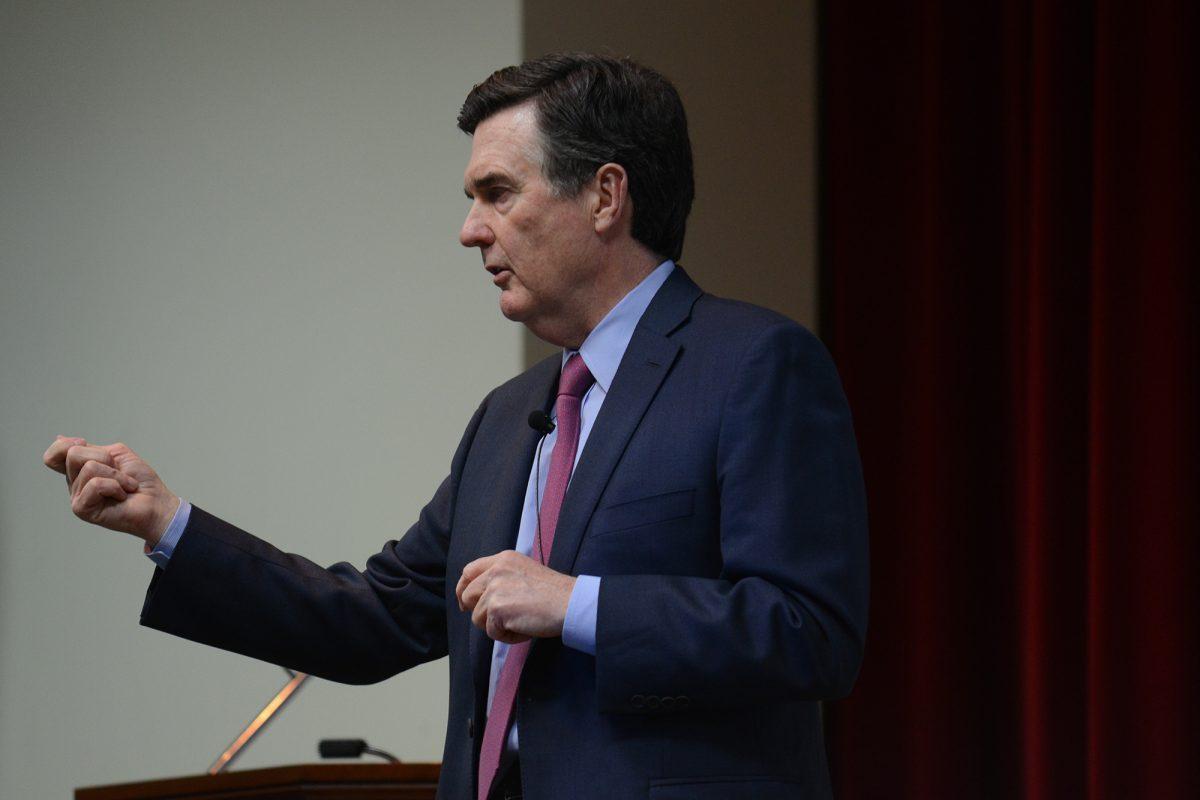
The president of the Federal Reserve Bank of Atlanta, Dennis Lockhart, used broad stokes to paint a picture of “steady, not accelerated” jobs growth Monday evening in the UC Auditorium.
Lockhart, who works with Federal Reserve Chairman Ben Bernanke on the Federal Open Markets Committee, was deliberate in his prognosis.
“I speak only for myself, not the Federal Reserve,” he said. “For 2013, I expect GDP growth to come in between two, two-and-half percent.”
While jobs growth may be encouraging, Lockhart was careful to show the holistic approach taken by his staff to gauge the market.
“Relying on a single measure like the unemployment rate is simplistic,” he said. “My staff has developed a graphical tool to track labor market developments.”
He showed the audience a chart that resembled a spider web, with each separate variable occupying a specific area of the web. Each variable’s respective value was measured by radial distance from the center of the plot. The statistic measuring shifts out of involuntary part-time employment to full-time employment were particularly low relative to pre-recession values.
Overall, though, the plot seemed to indicate weak market improvement.
“I sense some rising optimism in the public’s sense of economic progress,” Lockhart said.
As president of the Federal Reserve Bank of Atlanta, Lockhart serves as a rotating voting member on the FOMC. He is one of the 12 federal bank presidents that contribute to policy decisions affecting the federal funds rate and thus American monetary policy.
Hannah Bailey, vice-chair of the Issues Committee, was pleased with her committee’s choice of speaker.
“Dennis Lockhart was the ideal speaker to give students a look into how the Federal Reserve functions and into our nation’s economic progress,” she said in a statement.
She believes Lockhart made the event accessible for everyone in attendance while still conveying his own opinions.
“The event permitted students who were already knowledgeable on the subject and those who knew very little about monetary policy to learn how the United States is reviving itself, and Mr. Lockhart provided an optimistic yet very realistic view as to what we can expect,” she said.
After Lockhart finished speaking, several members of the audience addressed questions to the president. Lockhart took time to answer each query but was careful not to broach political issues. He declined to comment on the potential effects of an increase in minimum wage and shied away from analyzing the impacts of deregulation on bank failure in 2008.
Despite the lecture’s hefty subject matter, Lockhart managed to keep the discussion lighthearted.
“When I was your age I was probably not devoting my evenings to monetary policy,” he said.