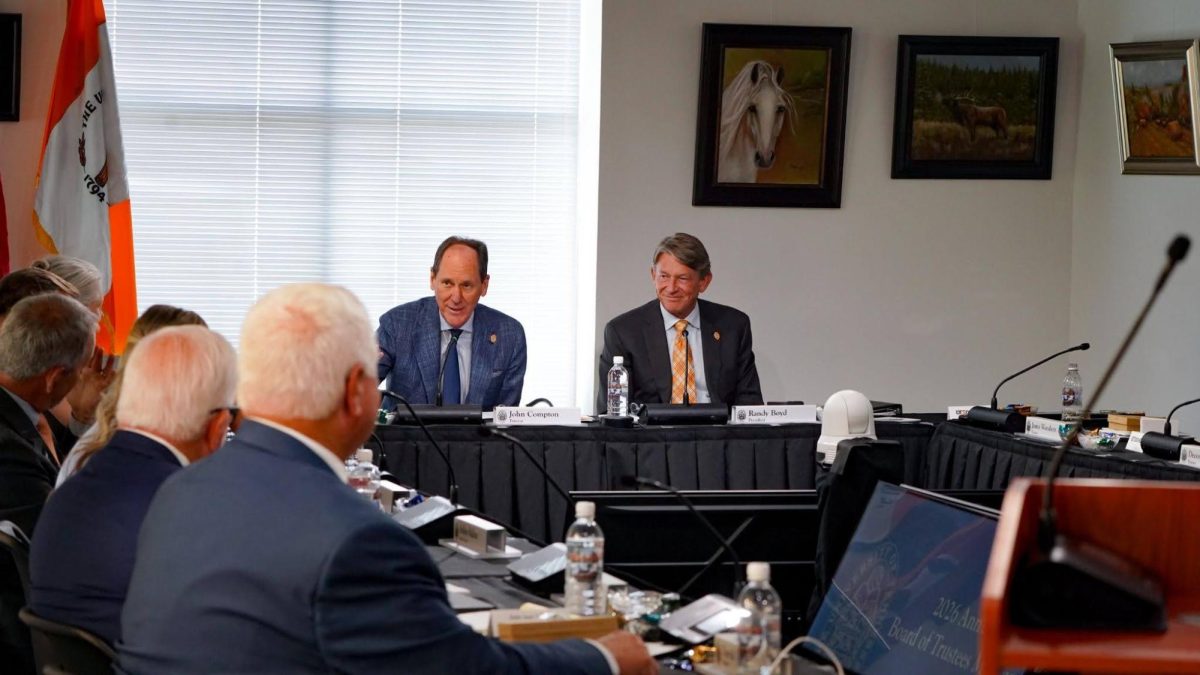
Given the rare chance to engage in some unscripted Q-and-A with Chancellor Jimmy Cheek, honors students convened in the Baker Center on Thursday. They were focused on administrative policy and the university’s direction, as Cheek reminded them about the importance of dreams.
“I don’t think we dream big enough, we tend to look at boundaries that we’ve got and can’t think past that,” Cheek said. “I say to our faculty all the time, we’ve got to work harder and better and be a better faculty member … if you don’t have fun doing it, then we might out to go somewhere else and do something else, so I think we just need to dream, it goes back to those dreams.”
The setting on Thursday was intimate, with around thirty students circled in the Toyota Auditorium to present their concerns to the chancellor.
“I think I’ll just speak from here … I feel more comfortable doing that,” Cheek said, declining the podium to stand amongst the students. “It amazes me, being chancellor, of the accomplishments of our students and of our faculty and our staff.”
The chancellor provided an update on the Top 25 initiative.
“The Top 25 is really an ambitious goal for us … one that my friends and colleagues that are presidents and chancellors at other colleges say, ‘why would you agree to something like this?’ … And I said, ‘Well volunteers believe in setting very high goals, and I am a volunteer now, and I believe in setting high goals and I believe if you dream and work hard enough you can accomplish what it is you want to accomplish … This journey that we are on is a tough journey,” Cheek said.
Daniel Aycock, a senior in accounting, facilitated the discussion and gave a brief update on the honors program.
“We are, in fairly short order I believe, going to be naming a new director of the Chancellor’s Honors and Haslam Scholars Programs,” he said. “I am not exaggerating when I say that is an exciting time to be a student at UT … especially an honors student at UT.”
When the floor was opened for questions, Julia Ross, a sophomore in political science and microbiology, asked the chancellor what he would most wish for honors students, given an unlimited budget.
“If you were looking to improve the quality of our educational experience as honors students over the next year, and if resources maybe magically weren’t an issue, where would you focus in order to make the quality of our educational experience better?” Ross asked.
Cheek said that was a “real good question.”
“I would make sure we treat you as trainer treats an athlete … they push you extremely hard … We need to be getting the most out of you as we can, and sometimes you may not like that, and sometimes we may push you too hard, or almost too hard. But we got to think in terms of making sure you realize your full potential … I would cause you to dream more, and to think about the world and what needs to be changed for the better.”
Eric Dixon, a senior in economics and philosophy, was curious about the administration’s emphasis on service learning.
“How can we move in the direction of creating an institution that focuses on civic engagement … and integrating that into our curriculum?” he asked.
“I think we need to set a strategic objective in producing society ready graduates who understand our culture and the way our government works … I think we need to challenge faculty and deans to say there has got to be a way to do this, let’s try to figure out a way to do this … Sometimes I don’t think we dream big enough,” Cheek answered.
“The honors program is very important to us … our objective is to have a much larger honors program over time than we have today,” he said. “We would like to attract more of the very highest caliber students.”