Over 100 years ago, the 19th Amendment was passed and ratified, officially codifying women’s suffrage into law after a long struggle spanning back to the country’s founding. Many know of the women’s suffrage movement, but it’s a colorful part of history that many classes don’t linger on for too long, leading to forgotten stories.
This is why Knoxville’s very own Suffrage Coalition is working to create and curate a new museum to better tell the story of women’s suffrage in the United States, with a focus on Tennessee’s pivotal role in the fight.
The spark that started it all
The tale of the Women’s Suffrage Museum started when Wanda Sobieski, a local lawyer and president of the Suffrage Coalition, founded the coalition in 1995 after being on Tennessee’s Commemorative Women’s Suffrage Commission.
Sobieski said she realized that nowhere in Tennessee were there any statues or memorials commemorating the movement and hoped that participating in the commission would change that.
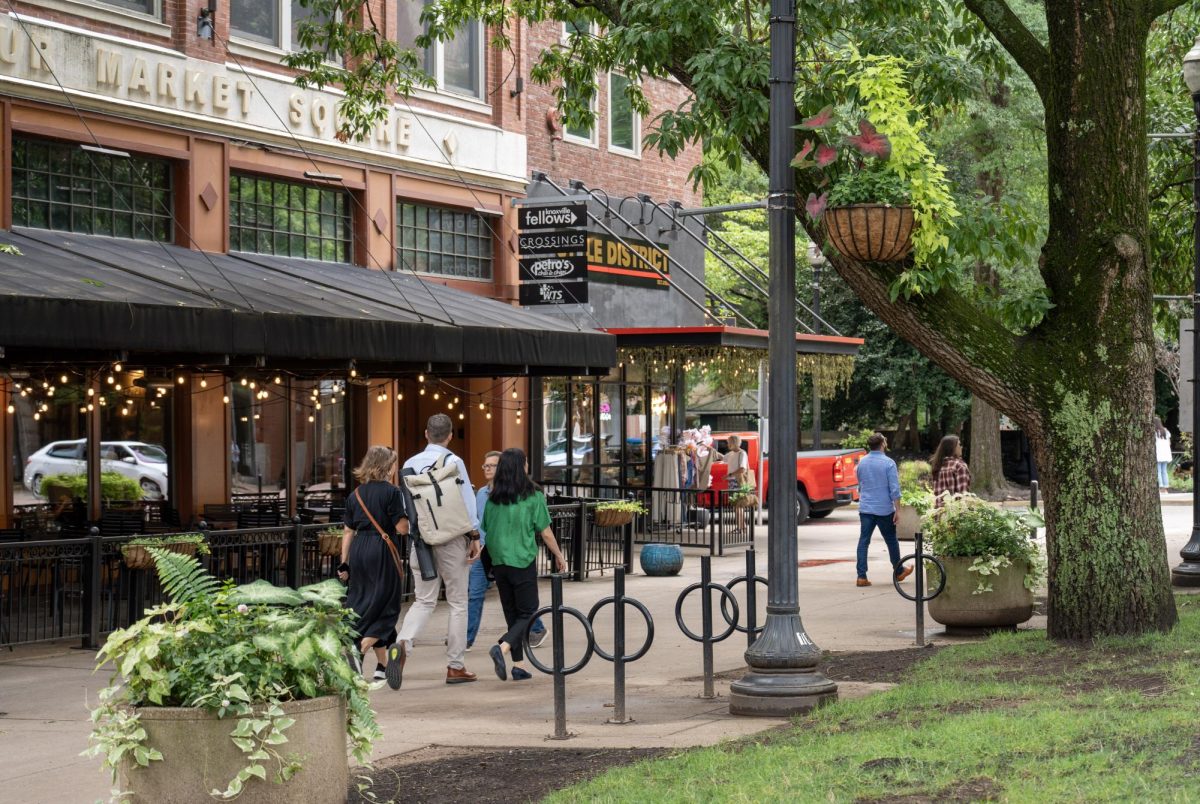
Unfortunately, the state commission didn’t end up erecting any monuments, so Sobieski and the Suffrage Coalition did it themselves. The women’s suffrage memorial statue in Market Square was set up and funded by the Suffrage Coalition.
What began talk about creating the Women’s Suffrage Museum was in part Sobieski’s own interest in suffragist history and the lack of historical resources on the subject.
“It became obvious that the materials and information were not readily available in Tennessee,” she said. “[Our mission has] always been to locate and preserve women’s history in Tennessee. We want to make it available for schools, scout troops [and] anyone that wants to learn about the story.”
Fighting the good fight
The story of women’s suffrage in the U.S. isn’t as neat and clear-cut as it’s portrayed in history books. Jessie Wilkerson, associate professor of history at the University of Tennessee, explained how suffragists were treated on a broad scale.
Many suffragists were treated as if they were “shrill, irrational people,” Wilkerson said. Opponents of women’s suffrage felt as if women were stepping outside the boundaries and societal expectations assigned to them. “It was contending with cultural values that women should not be seen or heard,” she said.
Anti-suffragists were not the only challenges the movement faced, however. Within the suffrage movement itself, it was common for “moderate” suffragists to clash with “radical” ones. The main difference between them was strategy.
Wilkerson explained how those in the moderate wing of the movement thought that it was better to expand suffrage state by state first before going national. The more militant, radical wing of the movement thought it best to pursue a constitutional amendment immediately.
The militant wing of the suffrage movement was famous for displays of civil disobedience and were often victims of police violence.
Wilkerson also mentioned the movement had an unofficial “third wing.” This wing consisted primarily of black women pushing suffragists to support racial and educational justice reforms alongside suffrage.
The suffrage movement received a major boom with the onset of World War One. While most men were fighting overseas, women were left to maintain domestic production and support the war effort. “Somehow, when there’s a war, women become capable of doing things, and the government expected them to,” Wilkerson said.
Finally, a year after the Great War ended, Congress passed the 19th Amendment on June 4, 1919, and sent it off to the states for approval.
By August 1920, the 19th Amendment needed one more vote to become official. Tennessee became the last state to ratify the 19th Amendment by a one-vote margin, codifying women’s right to vote into law.
Putting the pieces together
With so much history to cover, the Women’s Suffrage Museum has a formidable task ahead. Luckily, Sobieski and the Suffrage Coalition are already in the process of planning exhibits, gathering artifacts and acquiring space.
Sobieski says she’s acquired over 1,000 artifacts related to the suffrage movement, including pro- and anti-suffrage pamphlets, jewelry and pieces of clothing. She listed her favorite artifacts as original volumes of pro-suffrage books written by Susan B. Anthony.
The Women’s Suffrage Museum won’t be like any other museum, however.
When asked about plans for exhibits, Sobieski said that, while she can’t discuss some of the details currently, many of them will be interactive. “I wouldn’t be surprised if you could talk to some of the suffragists,” she said. “We want it to be a museum that’s much more interactive and much more of an attraction than a normal museum.”
Recently, the Suffrage Coalition was able to acquire 706 Gay Street for the museum, but Sobieski says they would like to extend it to 708 Gay Street as well.
As of this article’s publication, the museum has raised almost $549, 100 of its $2.9 million goal for the building. If successful, this would make Knoxville home to the largest women’s suffrage museum in the country.
Looking to the future
While the Women’s Suffrage Museum tells the stories of brave suffragists, it will also serve as a testament to the perseverance, determination and spirit of all activists through the ages.
“We want to tell not just the big story,” Sobieski said, “but more about the everyday people who made it possible. It was the power of everyday people that made it happen.”
“They fought for decades, but many never saw the fruits of their labor,” Wilkerson said. “My hope is that [with museums like this] … people think about what it means to vote in this country.”
To support the Women’s Suffrage Museum, visit the museum’s website or the Suffrage Coalition’s website. The Suffrage Coalition currently plans for the museum to open during Women’s History Month in March 2028.