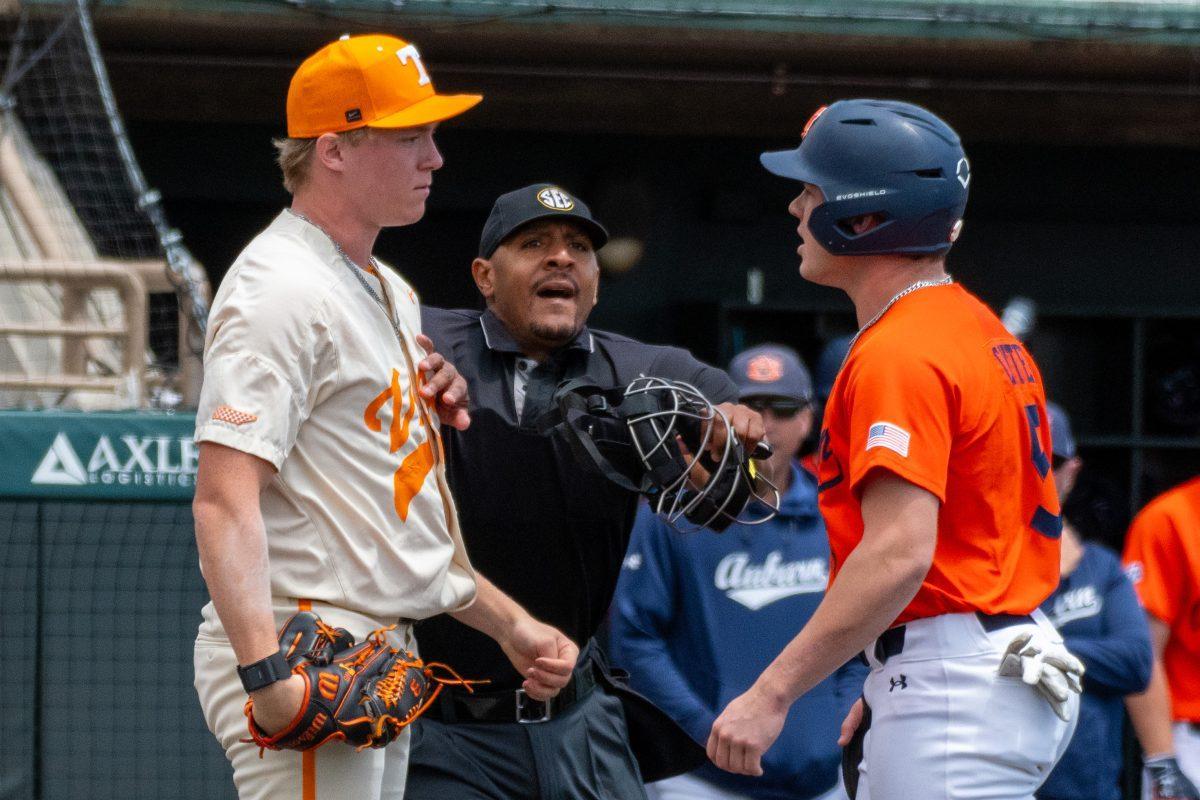
Ja’Kobi Gillespie brought the ball down the floor, looked to his left and fired the ball away.
A blue jersey stood in the pathway — Collin Chandler jumped the passing lane, and Otega Oweh took it the opposite direction for the layup through contact by a trailing Gillespie.
“I thought Nate was open, and he wasn’t,” Gillespie said. “I threw it, and I shouldn’t have thrown that. So yeah, I mean it’s just a bad decision.”
Tennessee basketball dropped in agony, 80-78, to Kentucky. It led 38:41 minutes of the way. But the underlying point guard problem revealed itself in the loudest way it could.
The Vols were not quiet. And the game-defining play ensued. It had been like reading a book for the Cardiac ‘Cats (12-6, 3-2 SEC).
“I heard the play that they were running,” Chandler said. “They kind of telegraphed it a little bit. So when he came off the screen, I had a lane to go steal it.”
Gillespie’s late-game mistake changed the course of his 24-point afternoon. But the turnover bug has defined him — and the No. 24 Vols (12-6, 2-3), who are all but certain to end a 90-week streak in the AP Poll come Monday — this season. It has surpassed reason for concern, becoming the totality of demise.
The lack of a true point guard has, and will continue to haunt Tennessee. But Rick Barnes still trusts his guy.
“It’s just getting organized and being efficient,” Barnes said.
Gillespie went the entire first half without committing a turnover. He picked up his second foul with 4:35 remaining in the first half, when Tennessee held a 38-24 lead. He did not play the remainder of the half, but the Vols still carried an 11-point lead into the break.
He dished out four assists across his 14 minutes on the court in the first half while the remainder of the offense limited itself to four turnovers.
Things did not go as smoothly in the second half, and that goes for the team. Tennessee committed seven turnovers in the final 20 and collapsed defensively.
The Wildcats went from zero points off turnovers to 15 in the second half. They improved shooting marks to 50% from the field and 60% from deep en route to 49 points. They chipped away from what had been a 17-point deficit without a lead to be seen.
Until Chandler jumped the passing lane for the feed to Oweh. The final 34 seconds were the only time Kentucky held a lead.
“You’ve got to play for 40 minutes,” Barnes said. “… the question is, why didn’t we do it? I don’t know why.”
“You can’t really point to much besides just a lack of effort,” Nate Ament said. “… To lose to Kentucky and taste the defeat like this is going to hurt. So, if we don’t want to feel this again, then we got to have better effort than we did tonight.”
Turnover problems are still looking for a resolution, though there is Improvement is in the numbers. Tennessee’s 12 turnovers are the fewest in a game since it committed 10 against South Carolina State on Dec. 30, 2025.
The issue is how the turnovers happened. Tennessee had none through the first 10 minutes of the game, and two in the first 16 minutes. Then a trio compounded, and the Vols ended the half with five.
In the second half, the ball spewed out of control. Ethan Burg earned a minuscule run of play — relieving Gillespie’s hefty minutes load. At 15:12 of the first half, Burg checked in. At the 13:47 mark, he meandered back to the bench after throwing a ball to the sideline.
Gillespie checked back in, and his clean day derailed itself. Gillespie turned the ball over four times in the final 12 minutes.
It featured Oweh taking a giveaway for a fast-break score with 4:10 to go. Tennessee’s six-point lead turned to four when a clean possession could’ve broken the game open. It happened again when Gillespie let an errant pass fly that led to the losing score.
“You can’t throw the pick-sixes and especially late in the game,” Barnes said. “You can’t turn the ball over at any point in time. But last four minutes, it’s double trouble when you do that.”
Barnes attributed Gillespie’s collapse to minutes. The senior guard refuted the claim.
Whichever way it is diced, the Vols’ lack of true ball handling has been a cost this season. Barnes has tried turnover balloons. He has sent players on stair climbs. His voice echoes in distress through practice.
But the game results have not changed. And getting that message through will continue to be a focal point.
“I think being brutally honest,” Barnes said. “I mean, we show it to them on tape. You can’t sugarcoat it.”
“We even went back and looked at all our turnovers and said, What can we do to help them?’” Barnes said. “I can only tell you what I told them. We can’t because the passes you’re throwing, we can’t pull those passes back. We can’t.”
For the visitors, it has become a way of life. Kentucky’s final-minute win is nothing extraordinary for the team that needed a full-court heave to overcome LSU earlier in the week.
“It’s the Kentucky way right now,” Mark Pope said.
For the home team, it’s despair for a team that has now dropped three of its first five conference games.
“By now, we should understand what goes into losing,” Barnes said.