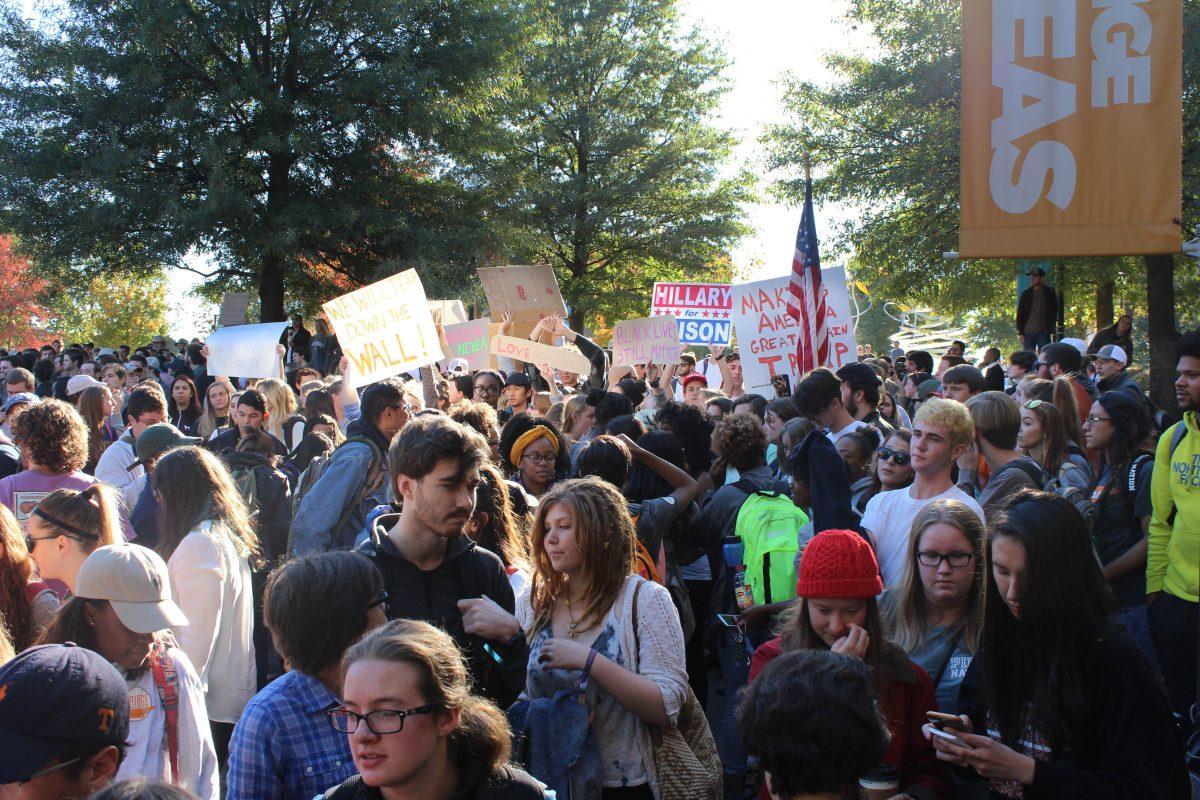
UT students and faculty took to Pedestrian Walkway Thursday, Nov. 10 to chant phrases like “the people united will never be divided” and “no Trump, no KKK, no fascist USA,” as part of a “Not My President” protest following Donald Trump’s presidential win on Nov. 8.
The protesters blocked the center of Pedestrian Walkway in front of Hodges Library, many holding signs saying, “Not My President,” “Stand Against Hate,” “Black Lives Matter,” “Love Trumps Hate” and “America was never great.”
The “Not My President” demonstrators were made up of a diverse group of students, all condemning Trump’s plans to build a wall on the Mexican-American border to control immigration, deport Muslims and establish a flat tax rate for all Americans. There were also many female students and faculty present protesting Trump’s derogatory comments about women.
“I’m a little bit upset that someone who’s supported by the KKK, by the American Nazi party, and preaches phobia and bigotry and misogyny has been elected,” Anthony Sherriff, senior in neuroscience and psychology, said.
After the demonstrators blocked Pedestrian Walkway, declaring their anxiety over what a Trump win signifies for minority groups on campus, counter-protesters supporting Trump began to gather around the circle of seated “Not My President” protesters.
Mickey Shelton, a Trump supporter who does not attend UT, showed up to the protest dressed as Donald Trump and carrying an American flag.

Students stood on Pedestrian Walkway protesting the election of Donald Trump on Nov. 10, 2016.
“We need to open that dialogue. We need to make deals. We need stand up to our enemies. At the end of the day we’re all Americans; We just think there are different solutions to the same problem,” Shelton said.
UT is not the only campus experiencing divide. Similar protests have erupted nationwide, including at the University of Texas at Austin and in Chicago.
Early Wednesday morning, Nov. 9, after the presidential election results were announced the night before, a flag was desecrated at the Howard H. Baker Jr Center for Public Policy and a physical altercation broke out later that day at the Rock between Trump supporters and students involved with the Multicultural Mentoring Program.
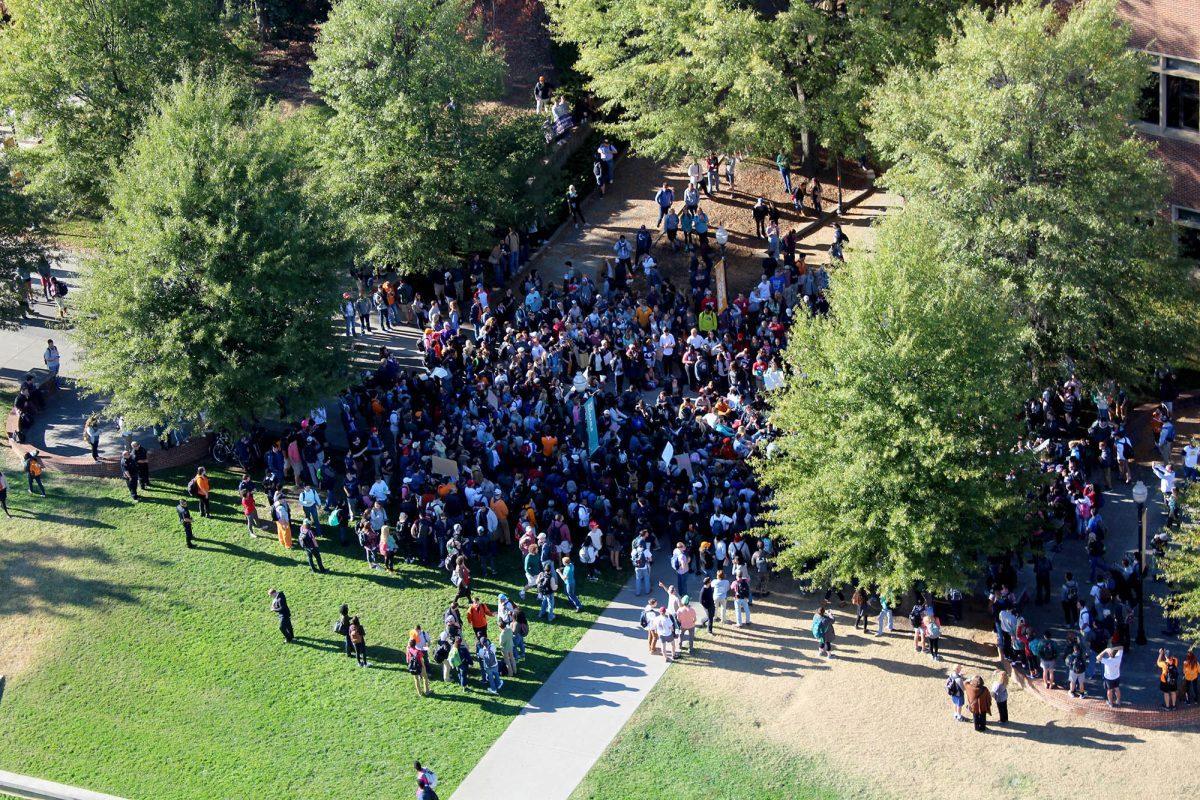
Students began protesting the election of Donald Trump on Nov. 10, 2016.
“I don’t want to stand by in silence while a narrative full of hate and violence is so prevalent in our country,” Tina Shepardson, professor in religious studies, said. “I want to be part of a community that’s standing up to that and saying that we will not accept racism as part of our national program, and we will not accept sexism and misogyny and violence against the LGBT community and against immigrants and against religious minorities.”
Though there were only four police officers surveying the protest at the beginning, as the two groups became more aggressive, several more officers were called to the scene.
Three hours into the protest, the Trump supporters began playing the national anthem, Bruce Springsteen songs and Dixie to drown out the noise of those chanting. Pins and posters supporting Trump were also distributed among the Trump supporters, and a Trump flag was thrown on the ground and stomped on as the conflict escalated.
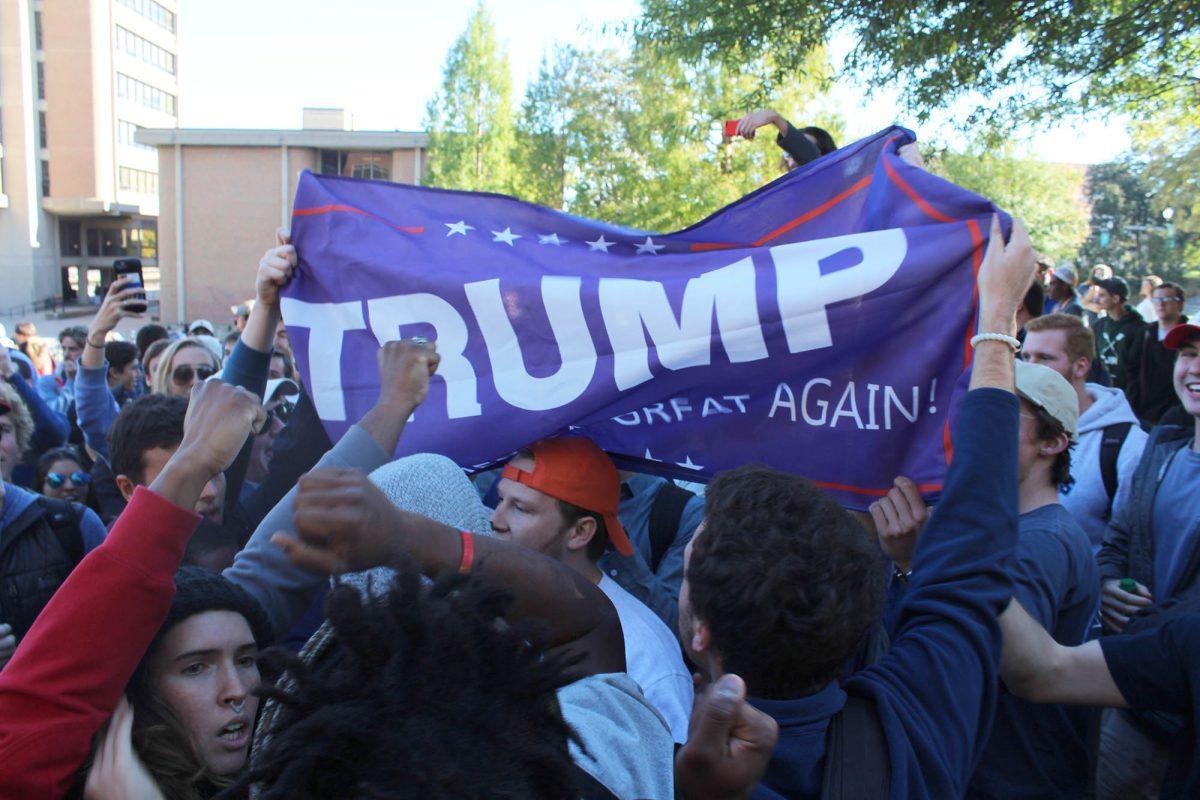
Counter protesters came to Pedestrian Walkway in order to support Donald Trump.
“There’s no need. You already won. Go home,” Jeff Gallagher, sophomore in English, said. “There’s no need to get in the faces of the people who are actually going to be affected by him … I’m just afraid somebody is going to attack them (minority groups) for their views or their sexual orientation.”
In response to the growing crowd of Trump supporters, “Not My President” protesters formed an “ally wall” around their group by standing and linking hands. Some stepped outside the “wall” and attempted to physically block the Trump supporters by using their signs and their bodies as barriers.
One Trump supporter filed a police report against one of the “Not My President” protesters after he allegedly pushed her to the ground.
“I was pushed to the ground for simply holding my flag,” Danielle Shepherd, freshman in pre-pharmacy, said. “My flag was stolen, and I was shoved to the ground.”
Shepherd was escorted to the police station and said she intends to press charges.
Eventually, the opposing crowds merged into one when multiple, individual arguments developed and the seated “Not My President” protesters stood to join the crowd.
Several physical altercations occurred between the opposing groups, and at least one fight broke out between them. Police quickly stepped in and broke up the fight before both protesters involved fled the scene.

Students stood on Pedestrian Walkway protesting the election of Donald Trump on Nov. 10, 2016.
The protest attracted a crowd of spectators that extended into the HSS amphitheatre, up Pedestrian Walkway and the path leading to Hodges Library. Several UT administrators from the Division of Student Life appeared sporadically throughout the afternoon but did not address the crowd.
Some students said they thought the protest was largely ineffective.
“I’m glad that I’m here, and I completely support all of these voices and this cause. However, I don’t think it’s going to be producing any conducive change … It needs to be more of a dialogue amongst our communities, a therapeutic, constructive conversation,” Doug Kievit, senior in psychology and communications, said.
The protest lasted almost five hours and saw a turnout of more than 100 students and faculty.
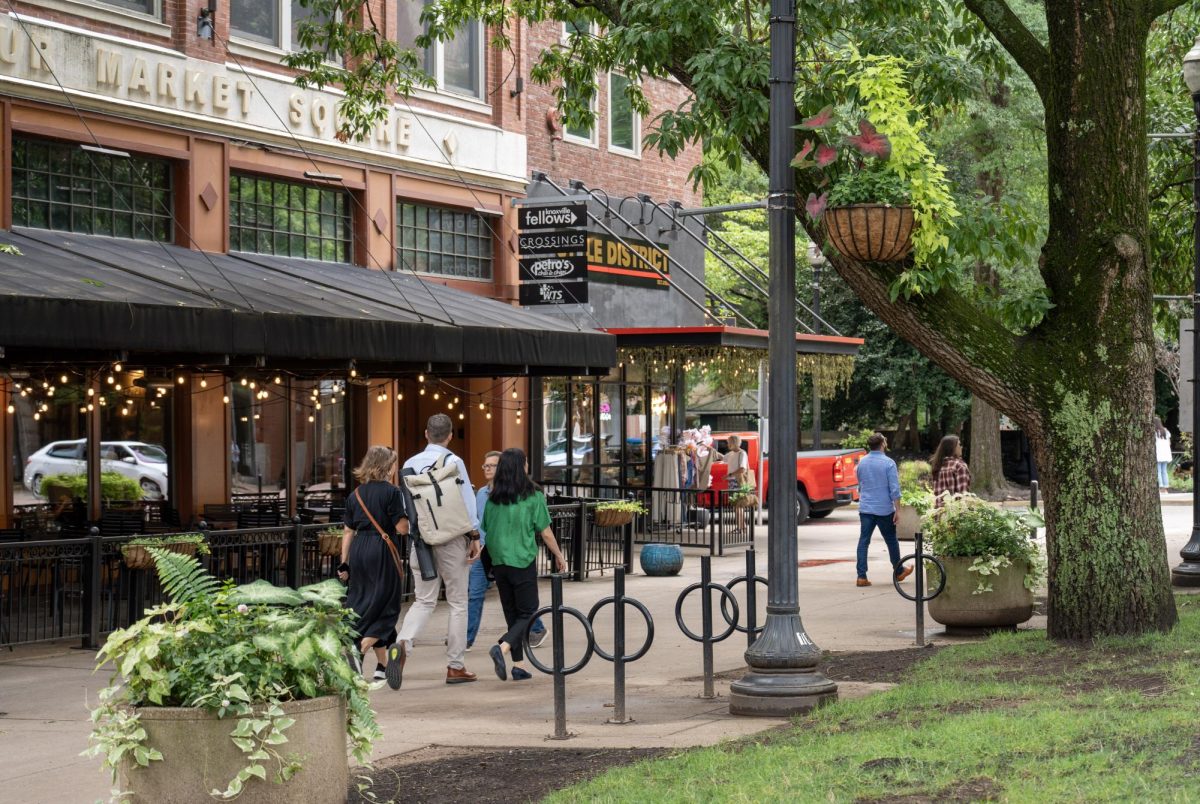
Another “Not my President” protest is scheduled at 8:30 p.m. at Market Square on Thursday, Nov. 10.
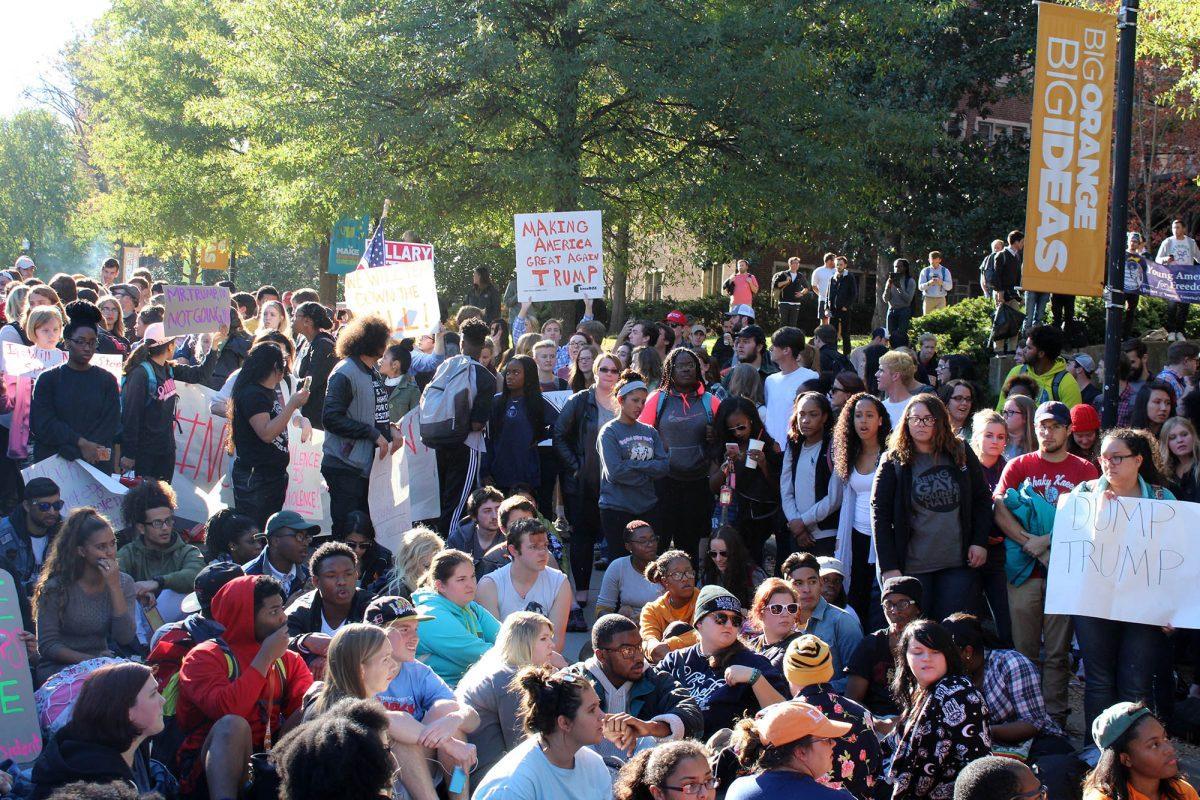
Students stood on Pedestrian Walkway protesting the election of Donald Trump on Nov. 10, 2016.