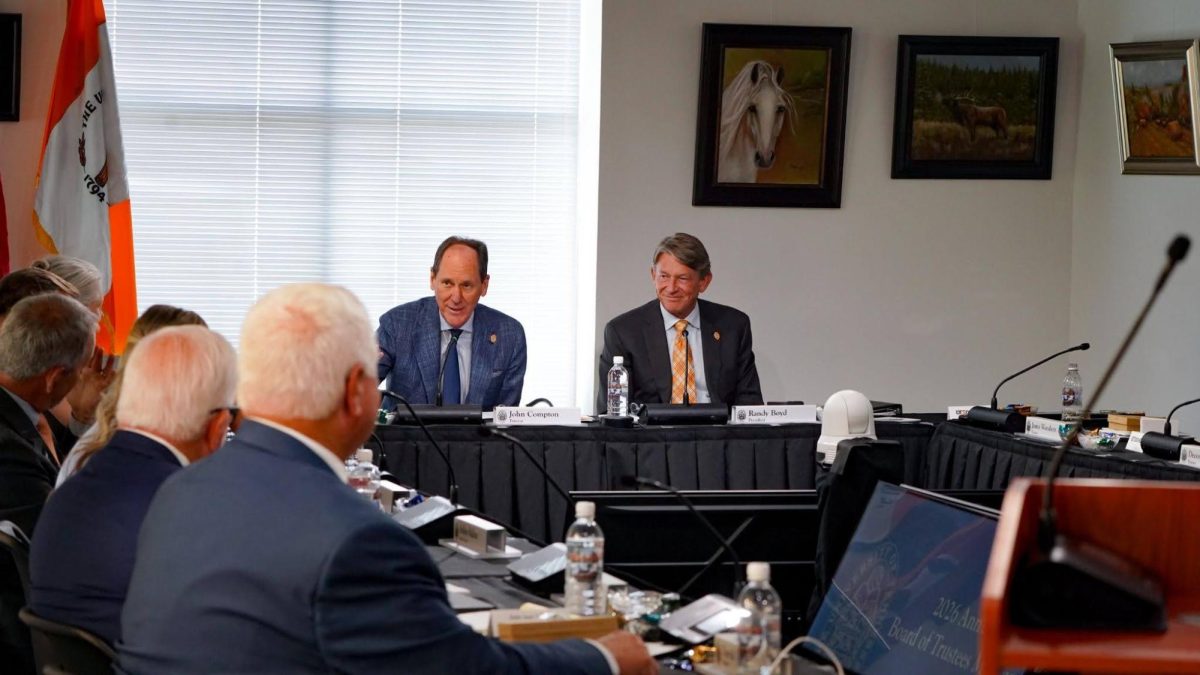
Students, faculty and the public were on hand this week for UT’s Science Forum featuring Dr. Larry Townsend.
Townsend spoke at the weekly forum on the impact of the destruction of the Fukushima nuclear power plant and the impact it has had on the regulatory practices in the United States.
“On March 11, 2011, at 2:46 p.m. local time, there was a magnitude 9.0 earthquake,” Townsend said. “This was the fifth largest earthquake in the recorded history of the world and the largest earthquake in recorded history of Japan.”
The earthquake was so large, it caused Japan to move about 10 feet closer to the United States and sent waves up to 10 kilometers inland.
Fukushima Daiichi was designed to withstand an 8.0- to 8.2-magnitude earthquake and a 19-foot tsunami.
In the area where the Fukushima plant was located, the waves generated by the earthquake were approximately 47-49 feet high.
“There were seven waves that hit the power plant,” Townsend said. “The first wave was stopped by the sea wall, the second wave breached the sea wall. After that, things got really interesting.”
After the sea wall was crushed by the tsunami waves, the water rushed up and around the four reactor buildings.
“After the magnitude 9.0 earthquake occurred, all the reactors were essentially shut down,” Townsend said. “The chain reaction stopped, but the reactor power doesn’t completely shut down. The power coasts down.”
Because of the tsunami, the steam generators that powered the coasting cool down shut off, leaving only battery power to help it cool down.
“What we have now is a complete station blackout,” Townsend said. “There is no power in the station.”
The only thing officials had to rely on were the features, such as submerged spent fuel, to protect the power plant from a complete meltdown.
Eventually, steam was vented from the reactor buildings to relieve some of the pressure from the buildings. There was hydrogen mixed in with the steam and the four buildings blew up their upper 25 percent.
Because of the explosion, the spent fuel was exposed to the air, and populations within 30 miles of the plant were evacuated.
“The radiation released from Fukushima were about 10 percent of what was released from Chernobyl,” Townsend said. “The exposure at Chernobyl was 9-10 times greater than what was delivered here.”
Few of the residents were evacuated, and there was virtually no contamination of any streams around the area.
What happened to the Fukushima Daiichi caused the United States to examine what could happen to their nuclear power plants in the case of a natural disaster.
“The people that operate plants are now required to reevaluate and upgrade as necessary,” Townsend said.
Essentially, the owners are to go back, examine what their earthquake and tsunami ratings are and determine whether or not they should upgrade these to higher levels.
Another aspect that was examined was what happens when the plant is experiencing a blackout.
Now, there are reserve power generators some distance away that will solely give energy to the power plant in order to move steam and help the spent fuel stay under the cooling water.
Although the U.S. has imposed these improvements, some feel that there are other aspects they could examine.
“I think that most of (Townsend’s) points are great, like the suggestion to extend regulations in case of something severe,” Matt Price, junior in mechanical engineering, said. “The waste is also clearly an issue; but this is also a problem in other power plants. Kingston, Tenn. can attest to coal plant waste also being very destructive.”