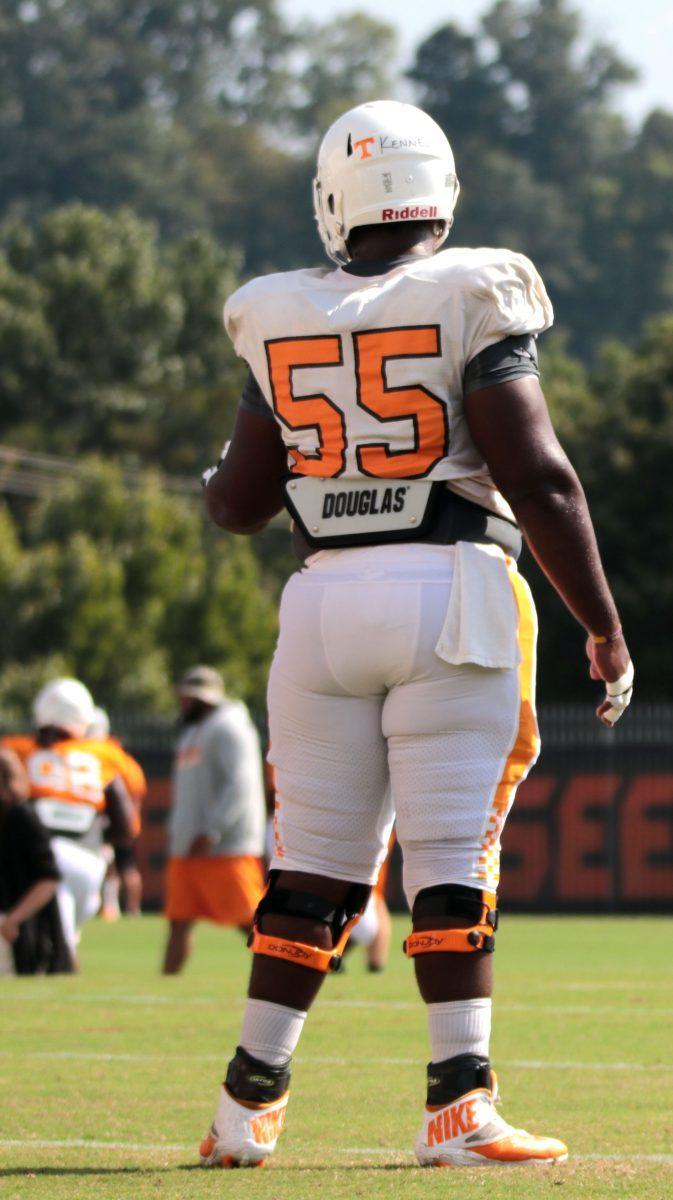
It was not too long ago that graduate transfer offensive lineman Brandon Kennedy found himself at the center of a controversy that led to rule changes in the SEC.
It was not a position that Kennedy particularly wanted to be in, at least initially.
“I’m not a big media guy,” Kennedy said. “So it was kind of hard for me. But I feel like I adjusted to it well and took everything in stride.”
Kennedy, who still has two years to play for Tennessee, graduated from in-conference rival Alabama in December after serving as a backup center for the Crimson Tide.
When Kennedy announced his transfer, Alabama head coach Nick Saban immediately decided to block his transfer to Tennessee, a school Kennedy had shown interest in, as well as Auburn, another of Alabama’s biggest rivals.
Saban had attempted that type of move before, and it was perfectly within his jurisdiction to do so again. Under the old rule system, Kennedy could have appealed this block to the SEC, but he instead bided his time.
Due to this unique situation, the SEC decided to take another look at the rules it had in place. These rules stated that to move intra-conference, a graduate transfer needed a waiver from the SEC to play immediately at the school to which they transferred.
Essentially, Kennedy’s destinations could be limited by Alabama and their administration by rule. However, in June, the SEC voted to change the rules so that a waiver would not be required, and a player transferring intraconference would be eligible to play immediately.
The vote passed, meaning Kennedy was free to choose his own destiny. Shortly thereafter, Kennedy announced his decision to transfer to Tennessee.
It was a huge addition for Tennessee as Kennedy comes from a team that is very familiar with success.
“I just want to push them,” Kennedy said. “Because I’m coming from a championship team, so I want to bring that leadership here.”
Kennedy had already formed a relationship with Tennessee head coach Jeremy Pruitt while they were both at Alabama. With that and with players constantly reaching out to him, Kennedy has quickly acclimated to his new football program.
“I was a little nervous at first,” Kennedy said. “But as I got here, people came around me, and they all accepted me, and I feel like I gained their trust pretty quick.”
Tennessee’s offensive line has been widely questioned due to its poor performance last season when it allowed 35 total sacks. The mark ranked among the worst in the SEC and around the nation.
Though Kennedy spent his time at Alabama as a backup, he’s stepping into a very thin Tennessee offensive line in which he will immediately be one of the more seasoned members. He projects to start at center on Sept. 1 in Tennessee’s season opener against West Virginia.
With the addition of Kennedy and the return of tackle Trey Smith, the weak point of Tennessee’s offense could now turn into one of its strengths.
“I think he has quickly earned the respect of his teammates by the way he practices,” Pruitt said. “I think everybody in our program is excited that he’s here.”