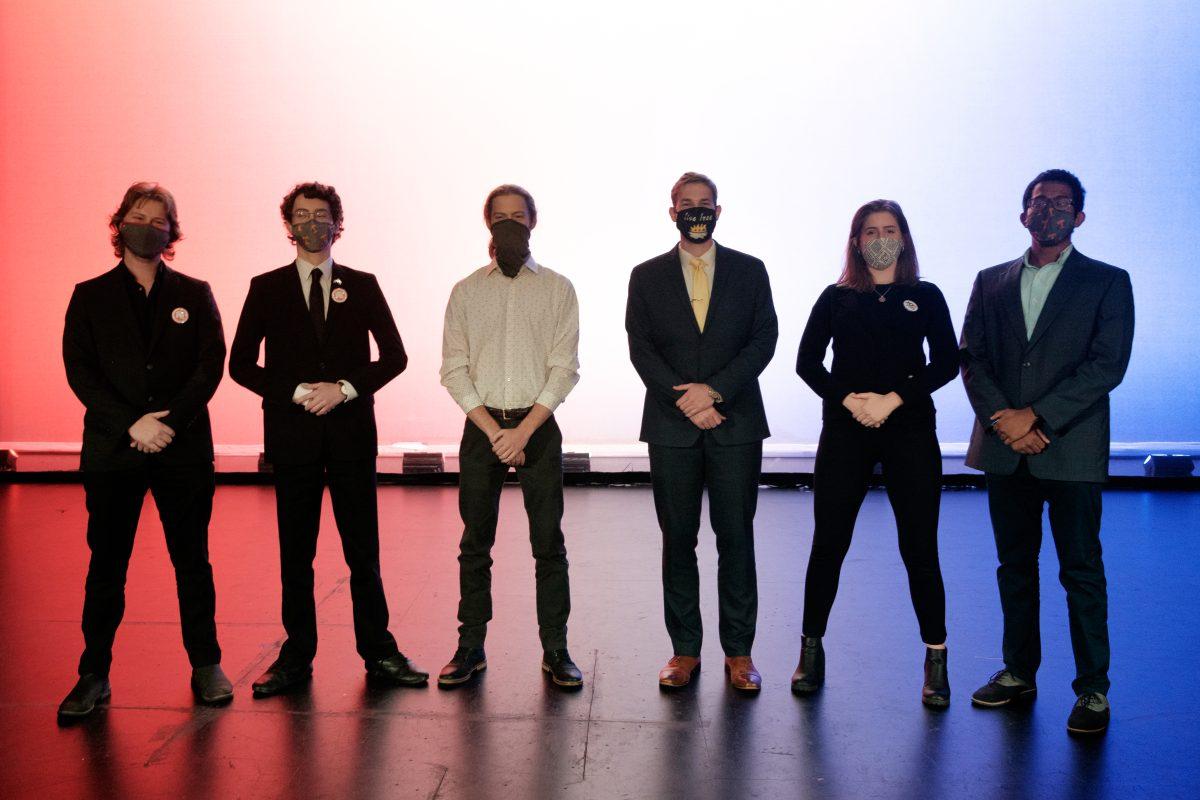
A week before Election Day, representatives of UT’s chapters of College Democrats, College Libertarians and College Republicans engaged in a debate that was more substantive and outwardly civil than the presidential debates of this election season, yet still showed strong disagreements between parties.
The debate took place Monday night in the Student Union auditorium and was moderated by Ryan Egly, president and CEO of the Lawrence County Chamber of Commerce, who provided the two student representatives from each of the three parties a three-minute response to questions, as well as a short time for rebuttals.
The night’s topics of discussion were racial justice, healthcare, energy dependence and the environment, social media censorship and the 2020 presidential election. Notably missing from the debate was any mention of the COVID-19 health crisis and the Trump administration’s response, which has been the central focus of this year’s presidential and vice presidential debates.
The College Democrats, represented by Amanda Taylor, president of UT College Dems, and Jeevan Kypa, senior studying kinesiology and neuroscience and communication director for UT College Dems, were the first to speak on the topic of racial justice and police reform.
The two were quick to say that they did not support the abolition or the defunding of the police, two policy demands made by many liberals across the nation following the killing of George Floyd at the hands of police officers and the subsequent protests over racial injustice.
They did, however, voice support for the Black Lives Matter movement and for various checks on police power, such as mandatory license renewal and bias training.
Caleb Weaver, sophomore studying electrical engineering and one of the representatives of the College Libertarians, pivoted the discussion of racial injustice to the so-called “war on drugs,” calling for the decriminalization of drugs and the demilitarization of the police.
“Drugs are victimless crimes and any man’s vice doesn’t deserve punishment; it deserves help,” Weaver said.
Throughout the night, Weaver and Austin Tallent, junior studying business administration and finance, provided a third-party perspective as they argued for a small-government, pro-civil rights approach to governance.
Though College Republicans disagreed with the libertarians’ characterization of drug offenses as “victimless,” they also said that the three parties agreed on more than they disagreed when it came to racial justice, especially in the area of criminal justice and policing reform.
Caesar Schanzenbach, sophomore studying political science and pre-law, chairman of the UT Conservative Coalition and a representative of the College Republicans, said that the burden to answer questions of racial injustice fell mostly on him and his fellow College Republican representative Max Hawkins, junior studying political science and vice president of UT’s chapter of Turning Point USA, since they do not believe the justice system itself is inherently flawed.
Schanzenbach also turned the conversation in a more ideological direction as he addressed the College Dems’ claim that President Trump wanted to end bias training. As Schanzenbach correctly pointed out, Trump has spoken out against racial bias training that is based in critical race theory, an approach that the College Republicans see as being rooted in racial falsehoods.
“[Critical race theory] is based on an ideology of white privilege, which we flatly deny. We don’t think that exists,” Schanzenbach said. “We think that’s a racist concept because no person [based on] the color of their skin has more privilege or standing in society over one another.”
The College Republicans’ denial of white privilege provoked a strong response from the College Dems, with Taylor giving an impassioned call for acknowledgment of inherent racial advantages.
“White privilege is very real,” Taylor said. “While yes, white people still suffer in different ways, I will never suffer because of the color of my skin. I will never be oppressed because of the color of my skin. I will never be discriminated against because of the color of my skin. And I think it is up to us as white people and as a predominantly white group on this stage to acknowledge that.”
On the second topic, the three groups answered the question of healthcare financing in predictable ways, with the College Republicans and Libertarians arguing for increased privatization of health services and College Democrats arguing for either the public option espoused by Democratic presidential candidate Joe Biden or single-payer healthcare.
Schanzenbach said that healthcare ought to be left to individual states rather than the federal government.
“The federal government, like on many other issues, doesn’t know the needs of the people living in Barrow, Alaska, compared to the needs of people living in Key West, Florida,” Schanzenbach said. “It just shouldn’t be referred to the federal government to always have to address the issue of healthcare and other big social issues.”
Hawkins put the issue more succinctly than his fellow Republican.
“I don’t want the people who run the DMV to be in charge of my healthcare,” Hawkins said.
The College Dems took issue with the idea that privatized healthcare has been working well, citing the number of uninsured Americans and the high price of prescription drugs. Taylor critiqued the Republican and Libertarian plans for what she sees as a prioritization of cost efficiency over the well-being of patients.
“Being sick is not a crime, frankly,” Taylor said. “When children do poorly in school, we don’t send them out of school, we try and help them. And saying that people shouldn’t use healthcare … it’s kind of immoral to say they shouldn’t utilize this resource to help themselves become better.”
In a reflection of the sharp disagreement between presidential candidates Trump and Biden and their parties, the three groups argued for different levels of urgency when addressing the problems of clean energy and climate change.
Hawkins critiqued Biden’s plans to end oil subsidies and quickly transition to clean energy, saying that they amounted to a banning of traditional energy sources.
“We are not for banning our oil, banning fossil fuels at this time because there is no replacement for it that is as reliable,” Hawkins said. “We do not think it’s responsible for the country to be banning things right now without a way to move forward.”
Tallent, always prepared to disrupt the binary arguments of the Republican and Democratic sides, said that we need to look to our past in order to find answers for the future and argued for an end to restrictions on nuclear energy.
“The future was here about half a century ago, whenever we started to develop nuclear power,” Tallent said. “We would be in favor of removing those inhibitors to the progression of nuclear power.”
The argument between the parties consisted less in a disagreement over whether climate change was a problem or if the U.S. should transition to clean energy, and more in a disagreement over how fast the transition could occur.
The College Republicans expressed concern that Democratic climate change goals were unrealistic and too costly to taxpayers.
“We cannot set unreasonable standards for ourselves. Obviously, we’re not gonna reach carbon neutrality by 2035,” Schanzenbach said. “However, we can still invest in nuclear energy, and wind energy and solar energy and, like the Libertarians said, we should be helping the states do that.”
Taylor turned President Trump’s operating principle of “America First” against the Republican Party as she called for a more urgent response to climate change.
“America should be first. We should be first in leading the charge internationally on transitioning away from coal and fossil fuels,” Taylor said. “The goal is that we are transitioning away from it, it is preventative, to go ahead and start investing in wind, solar, nuclear that have been proven to be efficient and work just as well as coal and oil.”
A surprise topic of debate, one that has been largely absent from the presidential and vice presidential debates though it has been widely covered by the media, was that of big tech companies and free speech.
The question of social media censorship came as recent reports revealed that Twitter and Facebook had suppressed a potentially damaging story about the foreign business dealings of Joe Biden’s youngest son Hunter.
College Democrats and Republicans agreed that biased algorithms used by social media platforms needed to be further scrutinized by the government, while College Libertarians argued for a complete separation between big tech and government and said that companies should be allowed to regulate their site’s content.
Kypa expressed a common Democratic belief that while free speech is important, the safety of U.S. citizens ought to remain a top priority, even if that safety comes at the cost of selective censorship.
“Social media platforms allow for the amplification of dangerous ideas and conspiracy theories, as well as providing a safe space for hate groups,” Kypa said. “When we start to have radical beliefs like this transitioning from an online platform into real life, we start to have real consequences and people dying as a result.”
In the last section of the debate centered around the 2020 presidential candidates, the College Democrats and Libertarians praised their party’s candidates and denounced their opponents, while the College Republicans said almost nothing about President Trump and chose instead to emphasize the importance of civility and positivity, two qualities for which their candidate is not well known.
The College Libertarians, for their part, took the opportunity to strongly condemn both the Republican and Democratic candidates for president.
“The libertarians view both these candidates as people who will interfere and lie and cheat and steal,” Tallent said. “They could steal your money and they could steal your rights to speak freely.”
The Libertarians promoted their candidate, businesswoman Jo Jorgenson, as an alternative to Trump and Biden. Weaver argued that the rights of Americans are on the line no matter which of the two main parties comes to power.
“I think that either of the two parties that are gonna be elected, it’s going to be more authoritarianism and your rights are going to be taken away; it just depends on which ones you want to be taken away first and how fast,” Weaver said.
As early voting starts on campus and tens of millions of Americans have already cast their ballots, Taylor gave a comprehensive pitch for why Biden should be elected.
“We want Joe Biden to win, mainly because we believe that he will support educators and students, he will tackle climate change, he will help strengthen our relationship with our native tribes, he will promote racial and economic equity, he will empower and protect women,” Taylor said. “We also want to restore American leadership abroad … because, frankly, right now we are the laughingstock of the world.”
Kypa also suggested that a Biden victory would improve America’s standing on the national stage and touted Biden’s detailed policy plans which are published on his campaign website.
“The world’s been missing a leader for the last four years since Trump’s stepped into office,” Kypa said. “They’re missing a nation that calls out injustice abroad rather than letting it run rampant.”
The College Republicans did not take the opportunity to show support for Trump specifically, but instead opted to use their time to temper the strongly-worded answers of their Democratic and Libertarian opponents.
Schanzenbach in particular repudiated the College Dems’ assertion that Trump would lead America towards becoming a pseudo-fascist state if elected to a second term.
“We wouldn’t be here if we were descending into a fascistic state,” Schanzenbach said. “We’re still here today and we’re still having this election and no matter what Joe Biden or Donald Trump says, the sun will come up in the morning.”
As if bracing for a second round of protests should Trump win reelection, Schanzenbach and Hawkins closed out the debate by calling students towards a vision of a united electorate.
Just minutes before Justice Amy Coney Barrett was confirmed to the Supreme Court after a process that laid bare the deep divisions roiling the nation, the College Republicans painted an altogether different picture of America’s future.
“Conservatives, we need liberals, liberals need conservative people so that we can compromise and find a good way to move forward,” Hawkins said. “Us talking right now is a beautiful way of showing how the world should work.”