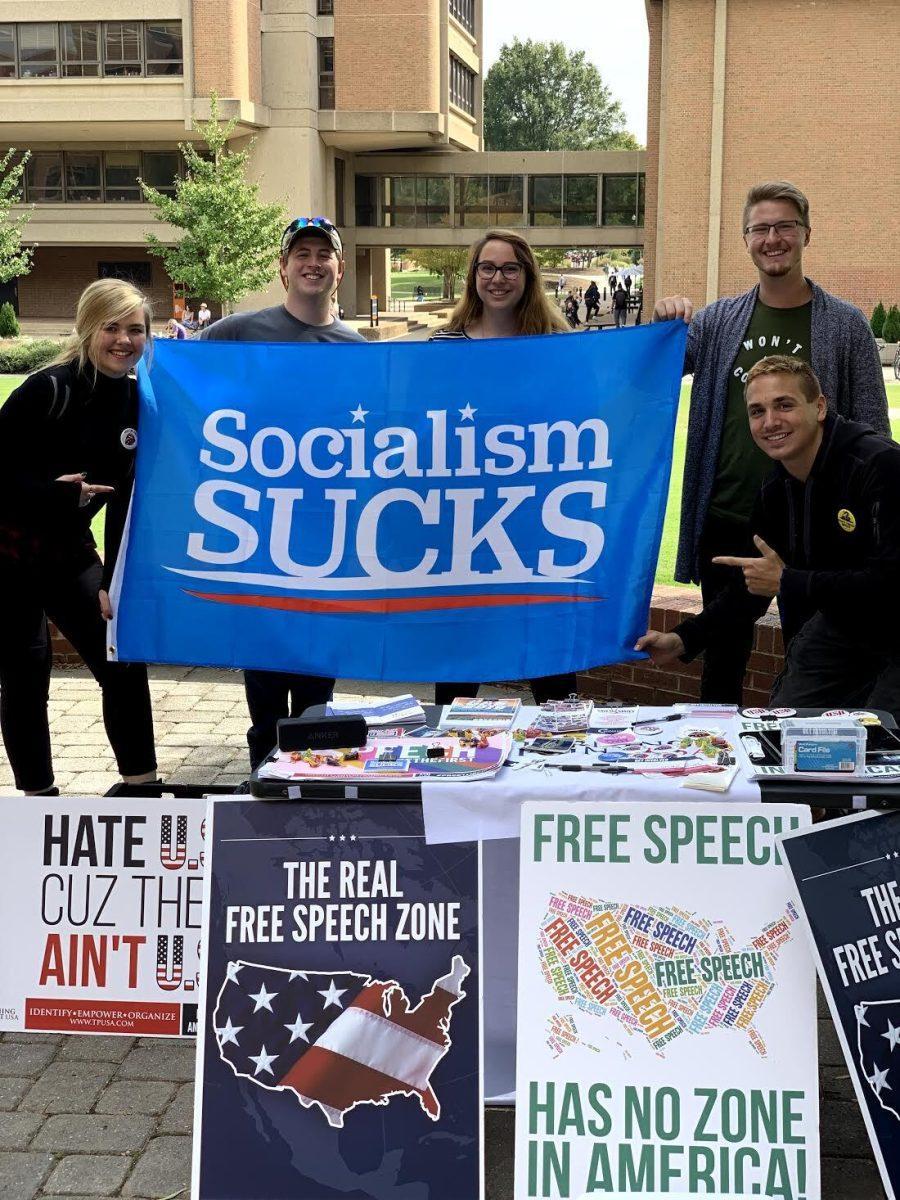
The members of Turning Point USA make no secret about what they believe. When the UT chapter of the national organization sets up a table on Ped Walkway, it is replete with signs that read “Socialism Sucks,” “Capitalism Cures,” “Taxation is Theft,” “Big Government Sucks” and “America Is The Best Country On Earth. Period.”
Started by conservative activist Charlie Kirk in 2012 as a reaction against the rise of “free speech zones” and other perceived threats to freedom of expression on American college campuses, the nonprofit organization seeks to train and educate students on conservative principles.
Turning Point USA, more commonly called Turning Point, is known by many people for its “Professor Watchlist,” a published list of college professors who are said to have discriminated against conservative students or to have aggressively promoted liberalism in the classroom.
The organization, which also has a presence in the United Kingdom, is unwaveringly pro-America and pro-First Amendment, a group dedicated to freedom of speech and expression.
It has also become a nuisance to many liberals, with its merchandise specifically aimed at dismantling the tenets of the American left and its digital content, including memes and videos, that often portray liberal students and leaders as entitled or uneducated.
Though it promotes small-government conservative ideals and has a clear distaste for liberalism, Turning Point is in fact a 501(c)(3) nonprofit organization and is therefore nonpartisan and cannot support any political candidates.
David Cowell, president of UT’s chapter, says that just because Turning Point may have a clear ideological bent doesn’t mean that the group must support a GOP platform.
“On the ideological spectrum, I like to say that we’re definitely conservatarian, if you will, so conservative libertarian,” Cowell said. “That doesn’t necessarily mean, as you know, that we have to directly align with the Republican Party.”
During an election season, its nonpartisan status means that Turning Point cannot endorse a candidate or contribute to any campaigns, though the group and its founder have long been closely associated with the Trump administration.
Cowell, a sophomore studying political science and history, says that members of Turning Point come from many ideological backgrounds, despite a common perception that they are narrowly conservative.
“It’s been amazing to see the amount of intellectual diversity that is within Turning Point,” Cowell said. “There’s a national perception of what Turning Point is, what Turning Point does and who really is involved in Turning Point, and then the more and more you get involved with it, you start to realize that’s not always the case. The perception doesn’t always suit the reality.”
For Cowell and many other students involved in Turning Point, the central message of the organization is freedom, an ideal that does not have to be tied solely to the Republican Party.
William Ogles, the chapter’s community outreach director, says that Turning Point functions to educate and engage students and is less interested in winning them over to the Republican or Libertarian party.
“We have people from all sides of the political spectrum who believe in things like free speech, free markets, things like that. We’re really more of an informational arm,” Ogles said. “We’re informing people on political ideas, but we’re not telling them who to support.”
Turning Point members often discuss so-called “cancel culture” in their criticism of liberals, citing several incidents when speakers have had events canceled due to protests on college campuses or when students have been shutdown for their remarks on social media.
“We don’t cancel people, we don’t go after people because they say something wrong,” Ogles said. “We really work hard to promote a marketplace of ideas where people can say things that we disagree with, but we respect their right to say those things.”
According to Ogles, a sophomore studying political science and history, this “marketplace of ideas” can also serve as a home for conservative students on UT’s campus who feel ostracized for their beliefs.
“People will quite often say things about Republicans or conservative people being, you know, add -ist to anything, and that’s how we get labeled quite frequently, and that makes people uncomfortable to share a lot of their ideas,” Ogles said. “Having a place where you can express your opinion is very important and we like to provide that home for people.”
One possible reason for Turning Point’s success, with a presence on over 1,000 campuses and millions of dollars in annual revenue, is its creation of a space for conservative students who feel marginalized on liberal campuses. Even though UT’s student body is relatively conservative, Cowell believes that liberal students have a disproportionate share of the cultural influence on campus.
“The leftist students on campus are the ones that are speaking up over the conservatives,” Cowell said. “They’re being heard, you know, way before we are, and/or they’re being recognized cause they make themselves stand out a lot.”
Cowell evokes the language of a “silent majority” when speaking of conservative students at UT and his goals with Turning Point.
“My main plan, and our plan in general, is to really try to motivate the silent majority on campus, which is in my opinion the conservatives on campus, and give them a space, or really anyone a space to come and discuss pressing issues whether they be political or social and really provide a forum for freedom of speech and expression going forward,” Cowell said.
The phrase “silent majority” was often used in 2016 to describe the demographic that elected Donald Trump to the presidency, a group seen as being on the outside of the elites that dominate the national media.
Cowell, who emphasized that he does not speak for all of Turning Point, says he believes that this same majority will hand re-election to Trump, even if his victory is not as decisive as it was four years ago.
“If you look at the energy behind Joe Biden, there is no energy. If you look at videos of his rallies, nobody shows up,” Cowell said. “I do think that there is a possibility we lose, but I do think that Trump wins not by a landslide but by a slim margin.”
To this end, Turning Point has been encouraging members at both the national and chapter level to vote, even if it cannot tell them for whom exactly they should vote.