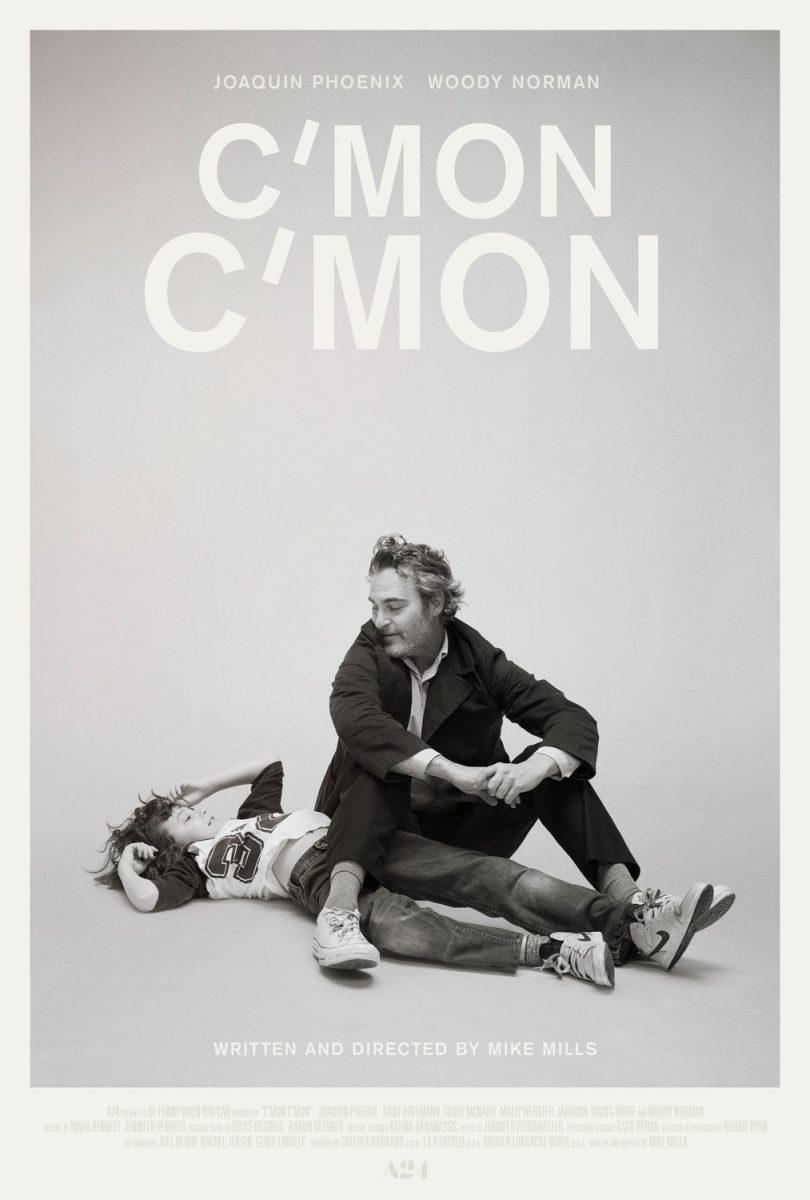
Familial ties hold us together, but they can also bring us to a better understanding of the world around us.
“C’mon C’mon” is a family drama written and directed by Mike Mills, who also wrote and directed 2016’s “20th Century Women.” It was distributed by A24.
The film follows radio journalist Johnny as he travels across the country to different cities to interview kids about the future. In the midst of his travels, Johnny stops to take care of his nephew Jesse while his sister Viv needs to handle a family matter. But because of work, Johnny takes Jessie with him across the country for more interviews.
“C’mon C’mon” is an intimate and often beautiful film about the minutia of growing up, both from the child’s perspective as well as the parental figure’s guiding hand.
Joaquin Phoenix plays Johnny, with Woody Norman playing his nephew Jesse. Both perform incredibly over the duration of the film, with Phoenix providing a human and unknowing quality within his role. They both have great chemistry, even when they’re a little awkward at times — their characters are naturally awkward. They bring some of the heart and soul of the film as they learn and grow together.
In a sense, the film is about learning and living life. This is true from Jesse’s point of view, as he’s a 9-year-old inheriting a messed-up world familiarly and literally. He is trying to navigate through the world during complex moments in time, ultimately to a point that is infinitely formative but might be utterly forgotten except for the underlying experiences.
In the same way, Johnny is new to parenting, even though he’s just an uncle. All of this life, the tantrums, energy, routines and boundless ideas, are unbeknownst to him. He tries his best to be a guide and parental figure while Jesse’s mom is away, although he has no idea what he’s doing. The film becomes equally about Johnny’s exploration into this newer parental figure role as it is Jesse’s experience growing up and obtaining knowledge about the world.
The film represents this with its beautiful black and white cinematography, subtly switching focus on characters as they speak and quietly zooming in during moments that need it. The film presents several close-ups with the camera and the characters to begin dissecting their place in the world. It contains a plethora of gray tones, matching the gray areas of conversation and knowledge specifically in relation to relaying those gray ideas and topics to a child.
In that way, the film becomes a wonderful exploration of these themes: of defining who you are, of what your role in the world is, of how you interpret and play and consume the world around you. It’s an underlying and incredible notion that exists within these moments of the blah blah blahs and the c’mon c’mon c’mons.
It accomplishes this further through its slower pace and unnoticeable editing. It spends the time that it needs to explore these characters and the moments surrounding them, rather than trying to rush to the next point or the next working day. The film doesn’t become dreamlike, but it does reflect an almost child-like mentality of the day-to-day activities.
Along with that, the film is divided by both locations and readings, as Johnny takes a moment to read a story or a quote, which is then cited on screen. It helps provide both a clearer understanding of the characters within the film by what they read as well as cement Johnny’s parental figure status as he reads to the audience, like a father — or uncle — reading to their son — or nephew — before bed.
Finally, the film establishes character and tone further through the music and score that’s played throughout. There is a score that plays occasionally, which is broken up with classical music and other songs. But everything is used to divulge character details — Jesse blares classical music on Saturdays — as well as establish a setting, like for New York City, or a tone for the sequence. It works beautifully.
“C’mon C’mon” presents the burgeoning understanding of life, childhood and understanding as a whole within the context of both young and old humans. It does this within a fantastic film filled with incredible performances and gorgeous cinematography that match those thematic elements.
It’s a film rich with humanity and the awkwardness of describing incredibly complex situations to a child while they live through those exact situations. As a result, it works as a tale of growth for everyone involved regardless of the familial status.
It’s not emotionally manipulative or dishonest in its representation. In fact, it focuses on the reality of those situations and how honesty and clarity help children grow, especially as they face the harsh reality of the world that they will need to cultivate. That understanding of people’s inexperience and how they change over time is what makes this movie special.
Hopefully, “C’mon C’mon” won’t get overshadowed by everything else surrounding it — especially the big, exciting blockbusters with vague promises of entertainment. There’s a sense of flourishing growth within this film that should be given the opportunity to experience. Even if it might not be for everyone, it’s about everyone.

4.5 of 5 Torches