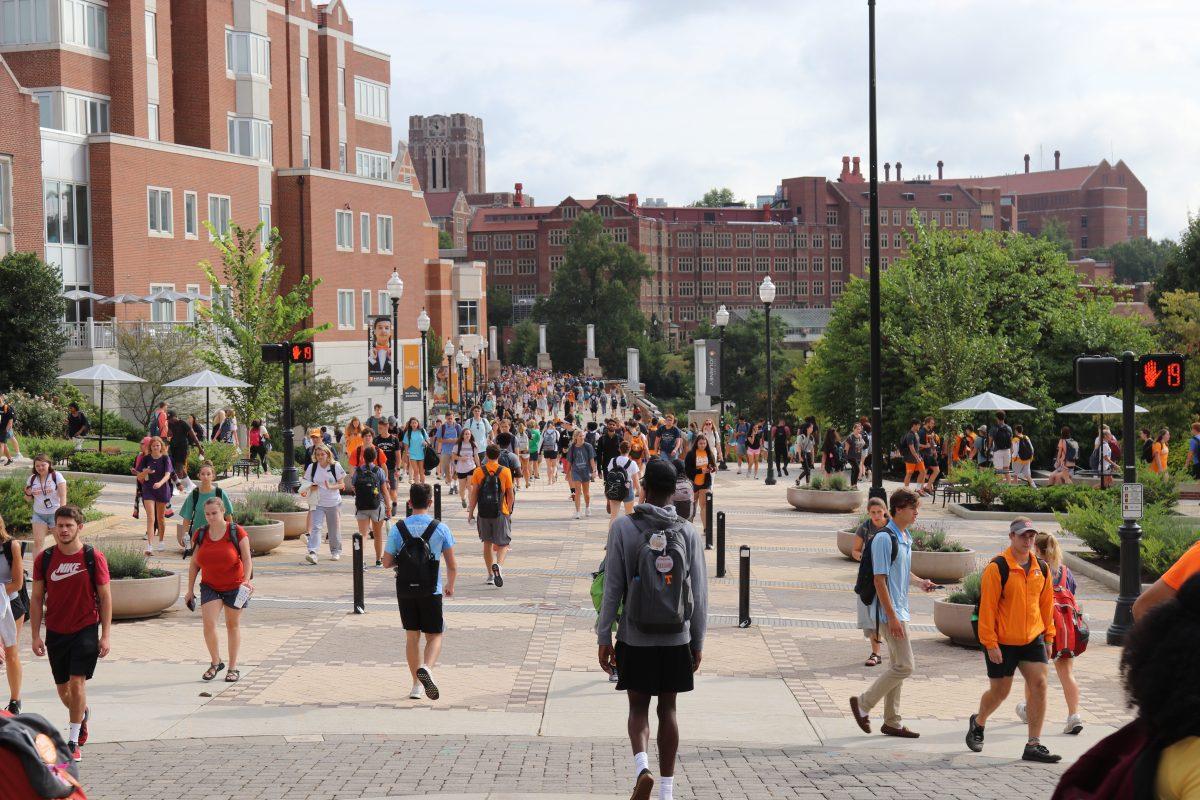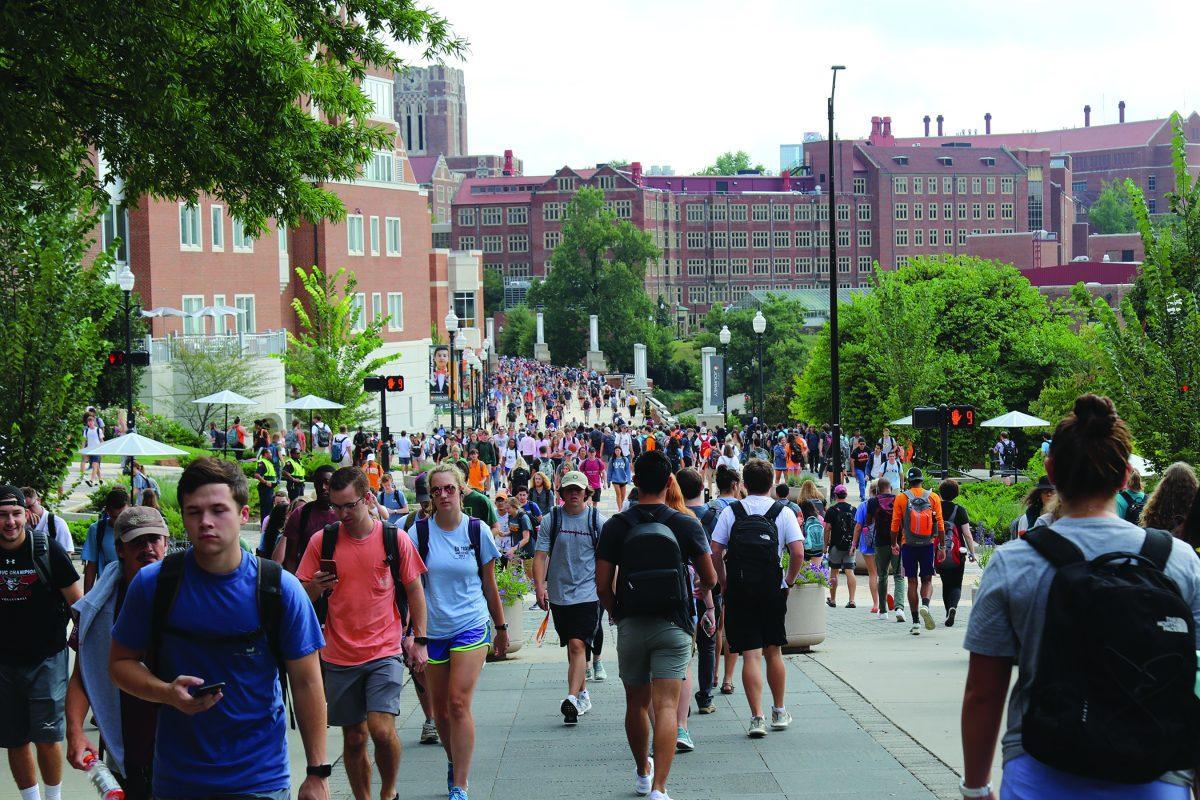
Despite the ongoing pandemic, enrollment at the University of Tennessee actually increased during the fall 2020 semester. 24,254 undergraduate and 6,305 graduate students enrolled, up from 21,678 and 5,822, respectively, during the spring 2020 semester. Total enrollment exceeded 30,000 for the first time in several decades, and the freshman class of 5,512 was record breaking.
Retention rates for the 2019 freshman class were high, too, at 88.6%, the highest since 2010.
Because of the unprecedented changes associated with the pandemic, students have had a variety of unique educational experiences throughout the last year. During the fall semester, 20.5% of undergraduates and 10.9% of graduate students had a fully online schedule.
Nick D’Alessandro, a junior majoring in accounting, attended fully online school through UTK during both the spring and fall semesters of 2020. However, he will be attending class on campus for the first time during the spring 2021 semester.
Although the pandemic certainly presented many people with challenges, the desire to complete his education remained central to D’Alessandro.
“I don’t think there was anything that was more important than getting an education,” D’Alessandro said. “Even though COVID was here, it was still a good time to be in school and get things done.”
D’Alessandro is looking forward to the more hands-on learning process that can be harder to come by through fully online classes.
“I’m really passionate about the major that I’m in, and it will be really good to physically be here and learn from the teachers and have the ease of access to ask questions or do as I need to enhance my learning experience, because sometimes it’s more or less inconvenient to interrupt over Zoom or have to write an email and then go back and forth over several hours,” D’Alessandro said.
Anticipating the transition to in-person learning, D’Alessandro has several concerns about the current COVID-19 situation on campus.
“I’m a little nervous, because UT has been a little not that great at handling COVID and communicating with the students,” D’Alessandro said. “I know that they send out emails to the students on their student email, but there are so many students that don’t check those. … There were lots of problems with testing and the sororities and fraternities spreading (COVID-19) and businesses near campus being problems and Knoxville in general, so those were the only real sources of being nervous.”
D’Alessandro hopes to see UT adjust its initiatives, perhaps by communicating more with students about contact tracing and placing more restrictions on students who are refusing to be tested.
“It’s double-sided, because if we restrict more, students probably aren’t going to get tested, now that I think of it,” D’Alessandro said. “I don’t know. I really don’t know what the school can do, because it’s a two-way effort. The students have to be as willing as the school, and I don’t think the students are a variable that we can change.”
Overall, D’Alessandro said that his worries have been eased by the rollout of COVID-19 vaccines, as well as the upcoming transition to a new presidential administration.
Freshman student Ethan Douglas has a different perspective, however. Last semester was Douglas’ first on campus, and he lived in a residence hall. At the beginning of the semester, 80% of the freshman class lived on campus, with residence halls just under an 84% capacity.
Like D’Alessandro, he has been disappointed with UT’s response to the pandemic and even considered staying in his hometown during the fall 2020 semester.
“I have friends from other universities, too, who do get tested randomly, and we do, but it’s a lot less frequent, and it’s kind of confusing on how you get your testing,” Douglas said.
Douglas said that when his next door neighbor got COVID-19, he was surprised that the university didn’t inform him of the positive case — and even more surprised when the student was apparently released from self-isolation earlier than expected.
Douglas also hoped that students in general would be more conscious of the pandemic, a concern which, in combination with the university’s response, prompted Douglas to decide to transfer out of UTK starting fall 2021. This spring, he will be taking fully online classes and splitting his time between the university and his hometown.
Douglas has his eye on University of Maryland, a school he says has had a better response to the pandemic. He’d like to see UTK change several aspects of its pandemic response, including advertising more about testing prior to breaks, doing more randomized individual tests and sending out a newsletter with more COVID-19 updates.
“They absolutely need to have the amount of tests that they’re doing in their weekly updates. … I kind of felt like they were hiding it a little bit,” Douglas said. “I don’t know. That’s maybe conspiracy stuff. It kind of felt like it was something they weren’t trying to give away easily.”
This spring, UTK is increasing its testing efforts. All students living in on-campus housing, including residence halls and Greek housing, will be required to participate in weekly saliva tests. Off-campus students are encouraged to participate as well, and prizes will be awarded to certain participating students.
Clayton Alexander, associate director of freshmen recruitment, said that it has been more difficult to recruit new students during the pandemic.
“Because of the pandemic, we also can’t host students on our campus, the way we normally do, and conduct our regional events and programs that bring the excitement and traditions of Rocky Top to the student’s backyard. You just can’t replicate that in a virtual event,” Alexander said. “For as long as I can remember, the primary method of recruitment has always been face-to-face/in-person. We dedicate countless hours traveling to visit high schools, participating in college fairs, delivering presentations and sitting on panels to answer questions about UT or the planning for college process.”
Despite the lack of high-fives and chats over coffee, virtual recruitment has had its benefits, Alexander said. For example, virtual recruiting has given UTK the opportunity to speak with students in parts of the country that recruiters would not normally visit in person.
“When the pandemic goes away and we are able to return to an in-person recruitment mode, I don’t see our virtual methods of recruitment going away,” Alexander said. “We now know there is another way to connect, and when the distance is a factor, we can use virtual platforms and experiences to engage in meaningful ways, thus spreading the word about UT.”