In order to see the horror, you must make your way downtown.
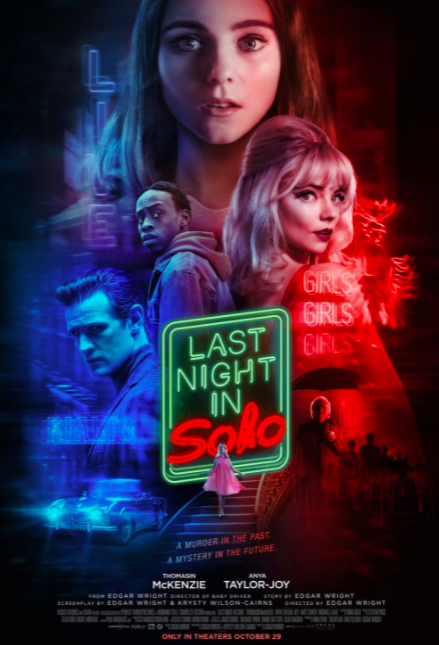
“Last Night in Soho” is a psychological horror film by Edgar Wright, known for his musically driven “Baby Driver” and the documentary “The Sparks Brothers.” It was directed by Edgar Wright, who wrote it alongside Krysty Wilson-Cairns.
In the present day, Eloise “Ellie” Turner wants to become a fashion designer, so she moves to London to attend fashion school. However, Ellie has a special power: she can see visions. These visions transport her to 1960s London as she follows Sandie, a wannabe singer who will do anything to become the headliner. But things begin to go awry over time as the disgusting nature of the city overtakes them both.
“Last Night in Soho” is an ode to the past, utilizing several aspects from the 60s era of media to tell its story. As the film progresses, the slow burn horror begins to unravel, creating a memorable experience that fits alongside the films it was inspired by.
Side note, this film discusses mental illness and some of the darker elements of it. To coincide with the movie’s message of talking to someone about this, the hotline for the Substance Abuse and Mental Health Services Administration is 1-800-662-4357.
The film has three primary leads. Thomasin McKenzie plays Ellie, and she delivers a great performance. She starts out timid and naïve, wanting to make sure that she succeeds without getting ahead of herself. But she slowly begins to break in her sanity, becoming more delusional overtime. McKenzie does an excellent job in leading the film as she carries the audience with her down the downtown rabbit hole.
Opposite of her, Anya Taylor-Joy plays Sandie. She is sultry and confident, aware of her own capabilities and what she can do to get what she wants. However, she begins to resent that sultriness as she gets taken advantage of as the story progresses. Taylor-Joy does an equally impressive job as the film develops, even taking the focus away from McKenzie sometimes.
Finally, Matt Smith plays Sandie’s manager Jack. The film uses him well as he goes from being supportive to a scumbag, detailing how manipulative he is. He is made to look both trusting and untrustworthy, which Smith portrays well.
That’s one of the strengths of the movie. The film begins to break apart the characters and the story as information is revealed overtime. They naturally change over the course of the film, matching the information and horror that gets unveiled.
The horror elements in this film are handled expertly. It’s a true slow burn, as the film takes its time to crack away at the character’s psyche and what really happened in Soho 60 years ago. But once it gets there, the film doesn’t take its foot off the gas, with several inventive horror techniques and a great sense of dreadful helplessness.
The film does an excellent job at questioning the reality of the story, from both the character and the audience’s perspective. This drives home a lot of the terror, as the unreliability seeps through and information becomes distorted as the twists and turns occur. All this is to say that the film builds up to an incredibly insane final act, which works because the rest of the movie works in tandem.
This development can also be found within the filmmaking. It starts off relatively normal, with some conventional camera work and the sorts. But everything begins to match the stylistic nature of the horror.
This can be seen in the cinematography. The film uses some interesting angles, powerful zooms and purposeful placement to tell the story and begin to dissect the horror. It works incredibly well because it ramps up naturally with the story and horror elements.
The framing portrays an incredible use of the camera, as it precisely shows certain characters and objects in the frame to show information and sow in the scares.
Along with the lighting and the stark usage of the color red, the film is a visual love letter to classic horror, both from Britain and from Europe, mostly the Italian “giallo” side of horror. It does this through the nature of the story with its twists and the horror, as it blends together some of the horror sub-genres throughout the film. It’s a great homage to these stylings.
The film also accomplishes this through smart editing, which works beautifully in the background. There are clever transitions, detailed scene construction and a consistent rhythm throughout the movie. It works subtly, as it relies on the background movements of the film to work. It also isn’t as flashy as some of Wright’s other films, which works in this movie’s benefit.
A perfect example of the blending of the camera work with the editing is in the middle of the film. There’s a dance sequence that switches between Ellie and Sandie seamlessly. It’s one of the strongest sequences in the film and it shows how seemingly effortless Edgar Wright is able to make this movie despite how complex it is.
Another incredible technical aspect is the sound. There are several small moments that use the sound perfectly, like when it switches from the music in Ellie’s headphones to the party going on around her. The audio channels and mixing are masterful.
Another wonderful addition to the film is the usage of music. The soundtrack is comprised of songs from the 60s, along with some new renditions by Anya Taylor-Joy. It helps create the atmosphere of the film both in the present and in the past. Along with that, there is a sparse and sinister score that works as the undercurrent to the sinister story.
This specific use of classic music serves as the introduction to the glamorization of the past, which slowly gets built upon in the film. It starts as a wistful look back to a “better” time, but the film begins to divulge in the pervasive seediness that existed then and now. It doesn’t hold any punches in discussing how equally bad a lot of things in London were and still continue to be.
“Last Night in Soho” is an excellent psychological thriller that ramps up naturally to its terrifying conclusion. Its subtly smart technical execution and great character progression match the tone and development of the film, ultimately creating a worthwhile horror experience.
For a minute, this film didn’t feel like an Edgar Wright film. It’s not as flashy or whipping like a Wright film typically is. It doesn’t have the crazy conceptional concepts and execution like “Baby Driver” or “Scott Pilgrim vs. the World” have.
But the subtle and subdued nature that lets the film gradually build to its stylistic finale is something only Edgar Wright and a few others could do. It shows his versatility as an artist, not only diving into a genre that he hasn’t formally touched on before — at least in a long time — but doing so by utilizing his techniques in a new way.
Essentially, if he had made this film like some of his other work, it wouldn’t function right. The stylistic nature would distract from the intention of the film. That’s why the reserved nature works in this movie’s benefit, especially as it naturally becomes more stylistic over time. He makes it look easy, which is an accomplishment by itself.
This film is a nice breather in terms of Wright’s filmography, but it will have audiences holding their breaths, especially by the end. It’s definitely one of the better horror films of the year.

Rating: 4 out of 5.