It’s difficult to nail down a single definition of what intersectionality is. The concept itself is at once a critical research framework and also a trendy term used by social justice advocates online, who splash it across social media pages and slap it onto laptops and water bottles in a variety of colorful fonts.
But what exactly is intersectionality, and what can it tell us about Black history? The most popular definition of the term holds that it’s an acknowledgment of the ways in which overlapping identities, such as race and sexuality, inform and compound each other to create social inequities.
Patrick Grzanka, an associate professor of psychology and the chair of the women, gender and sexuality program at UT, has been researching intersectionality for much of his academic career. He says that the emergent focus on identity in conversations about intersectionality is probably too simplistic. His own working definition is predictably complex.
“What I always say is that it’s not so much that intersectionality is not a theory of identity, but it’s that intersectionality is not foremost a theory of identity,” Grzanka said. “I generally offer it as an analytic framework for critiquing the ways that systems of inequality co-produce each other to create and sustain complex inequalities.”
Intersectionality is an important component of Black history not simply because it helps researchers understand how intersecting systems have worked together to marginalize Black Americans and other minority groups, but also because the concept was developed by Black women.
The coinage of the term is attributed to a pioneering class of Black female scholars in the late 1980s and early 90s, a group which included legal scholar Kimberlé Williams Crenshaw and sociologist Patricia Hill Collins.
This group of women developed the concept as a structural critique of legal and political systems that were not equipped to address the problems facing Black women in America. When the legal and political fields wanted to study the problems of Black Americans, they studied Black men and when they wanted to study women, they studied white women.
Grzanka first encountered intersectionality as an undergraduate student at the University of Maryland, an institution which came to be known for its work in intersectionality and gender studies while Grzanka was there for graduate school researching under Bonnie Thornton Dill, whose name is often included in lists with Crenshaw and Collins.
He argues that, though the word was coined recently, the concept has been developing for over a century thanks to the contributions of Black women like Sojourner Truth, Anna Julia Cooper, Ida B. Wells and Zora Neale Hurston.
“Intersectionality’s origins are not academic per se,” Grzanka said. “These people were writing and thinking not necessarily in the context of academia, but doing the intellectual work to articulate Black women’s struggles in the United States, to organize Black women and other marginalized groups in the interest of social justice.”
Grzanka has argued for years that intersectionality ought to be taken more seriously by social scientists and humanities researchers, by which he means that it should be treated as a robust and complex framework for research. To not take it seriously, he argues, is to fall into the racist historical pattern of not taking the contributions of Black female scholars and writers seriously.
“To reduce intersectionality to the observation that people are more than one thing at the same time is a gross understatement of its theoretical and methodological challenge to social science and humanities scholarship today,” Grzanka said. “To reduce intersectionality to that actually has the functional effect of minimizing the contribution of Black women’s scholarship. Because of course we already know that people are more than one thing at the same time.”
Broadly speaking, there are two mistreatments of intersectionality in critical psychology. One is to treat it as the simple observation that social research should be multifaceted and thus minimize its importance. The other is to be intimidated by the demands of intersectional research and thus avoid it altogether.
“What I’m trying to do here is not so much police intersectionality’s usage, but really kind of encourage psychologists to think about what intersectionality is beyond multivariate statistics, that is, as a normative justice framework,” Grzanka said. “Intersectionality is about co-constitution. That’s the varying of things as a function of another thing, like what sexual racism means, what gendered racism means, what hegemonic masculinity is when it manifests across racialized settings.”
What Grzanka is ultimately arguing for is a foundational change in the way that psychologists approach their research. In Grzanka’s vision, there would no longer be race-blind studies on gender, for example, since such studies have a way of overlooking how race specifically informs the way that women of color experience the world.
“We don’t leave our houses in the morning and say, today I’m just a white guy, or today I’m just a guy, or tomorrow my whiteness is going to matter more than my gender, or today my class is the most salient thing,” Grzanka said. “That’s not actually the way that people experience the social world. They experience all of those things about themselves at the same time in shifting and dynamic ways that are going to vary widely across context. So to take that seriously is rethinking the terms of psychology quite a bit, I’d say.”
Taking intersectionality seriously does not just affect how research is conducted or how sociopolitical issues are conceptualized. It can also change the way that history is told or leadership is practiced.
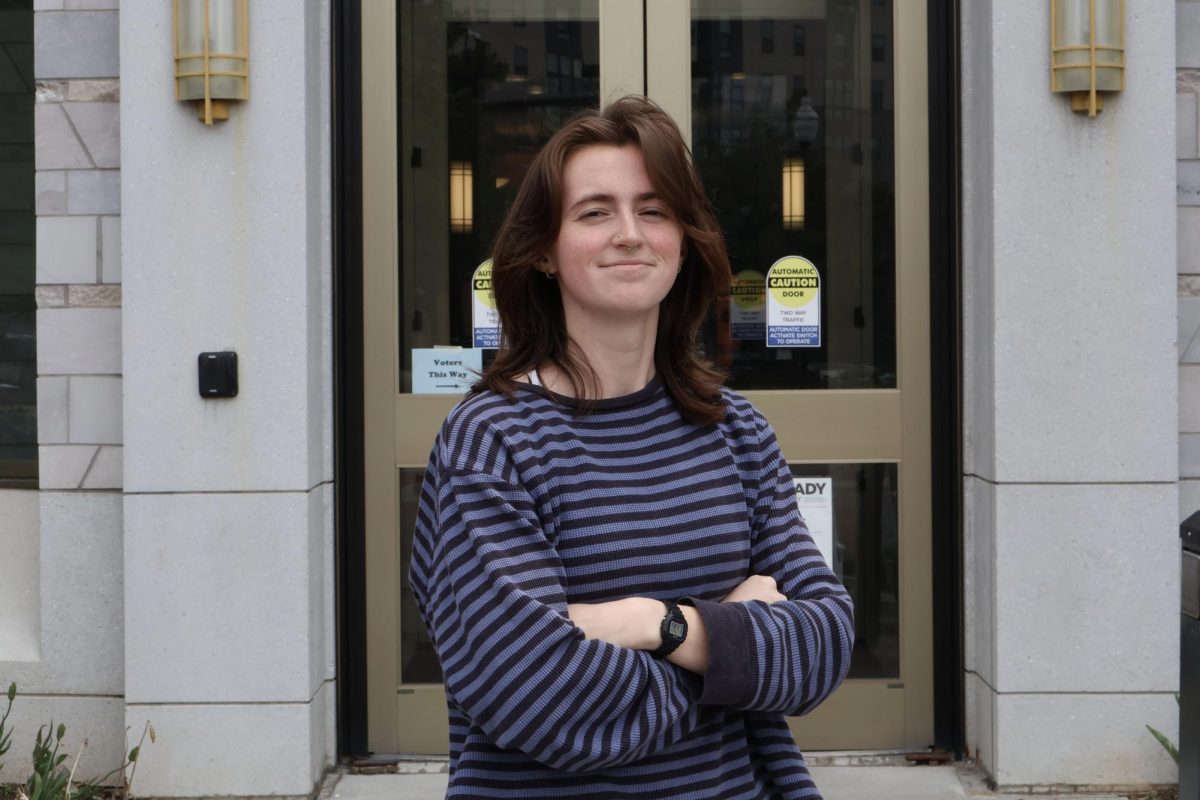
Karmen Jones, Student Government Association student body president, has used intersectionality as a framework for leading both the SGA Diversity Affairs committee her junior year and the entire organization now as a senior. Rather than seeing the concept as a way of understanding co-creating systems of inequality, however, she sees it as a way of understanding the specific strengths that leaders bring to organizations.
“I take pride in myself being Black and being a woman, and so I would hope people would feel the same way,” Jones said. “I look at intersectionality as a strength rather than something some people can think of as a weakness or some strikes against you in society.”
In leading the most diverse coalition in SGA’s history, Jones has been careful to make certain that every student feels represented, regardless of the societal discrimination they may face.
“If I’m making a statement that addresses something that is pertaining to the LGBTQ+ community, I know that I identify as straight, and so I know naturally that there is strength in saying, hey, this isn’t my identity, but I know that I have been intentional about selecting members on my cabinet that can give me their subjectivity and they can take the lead on making sure that things are done properly,” Jones said.
Jones sees intersectionality as a framework through which to create a strong web of diverse student leaders, who are prepared to tackle every problem because they have collectively dealt with every problem.
“We know who’s the expert and who has had the lived experience and we never question each other’s intersectionality or our lived experiences,” Jones said. “And so when you build that team of people together, right, and you have people from different identities and different walks of life, it makes you so much stronger because you have a holistic view of what everybody feels … it’s not even about tokenization because we’re students working on behalf of students.”
As the first Black female student body president, Jones knows the importance of Black history because she herself has written it. She sees room for improvement in the way that UT celebrates Black History Month, specifically with creating a visibility for Black issues on campus that goes beyond tokenization.
“I have mixed thoughts on Black History Month,” Jones said. “I don’t think our history can be condensed into one single month, especially not the shortest month of the year, but I get the need for recognition.”
As a white man, Grzanka sees himself as a steward of the Black history that informs his research rather than a writer of it. He, too, sees room for improvement in how Black History Month is typically celebrated. If it were celebrated through an intersectional framework, he argues, it would tell the story of more than just the “nice Black men who wanted everyone to get along.”
An intersectional Black History Month would tell the stories of Black activists and writers who broke out of the white, heteronormative standards of their day, standards which still dictate how white people falsely try to control Black history, Grzanka said.
“No one controls where intersectionality travels,” Grzanka said.