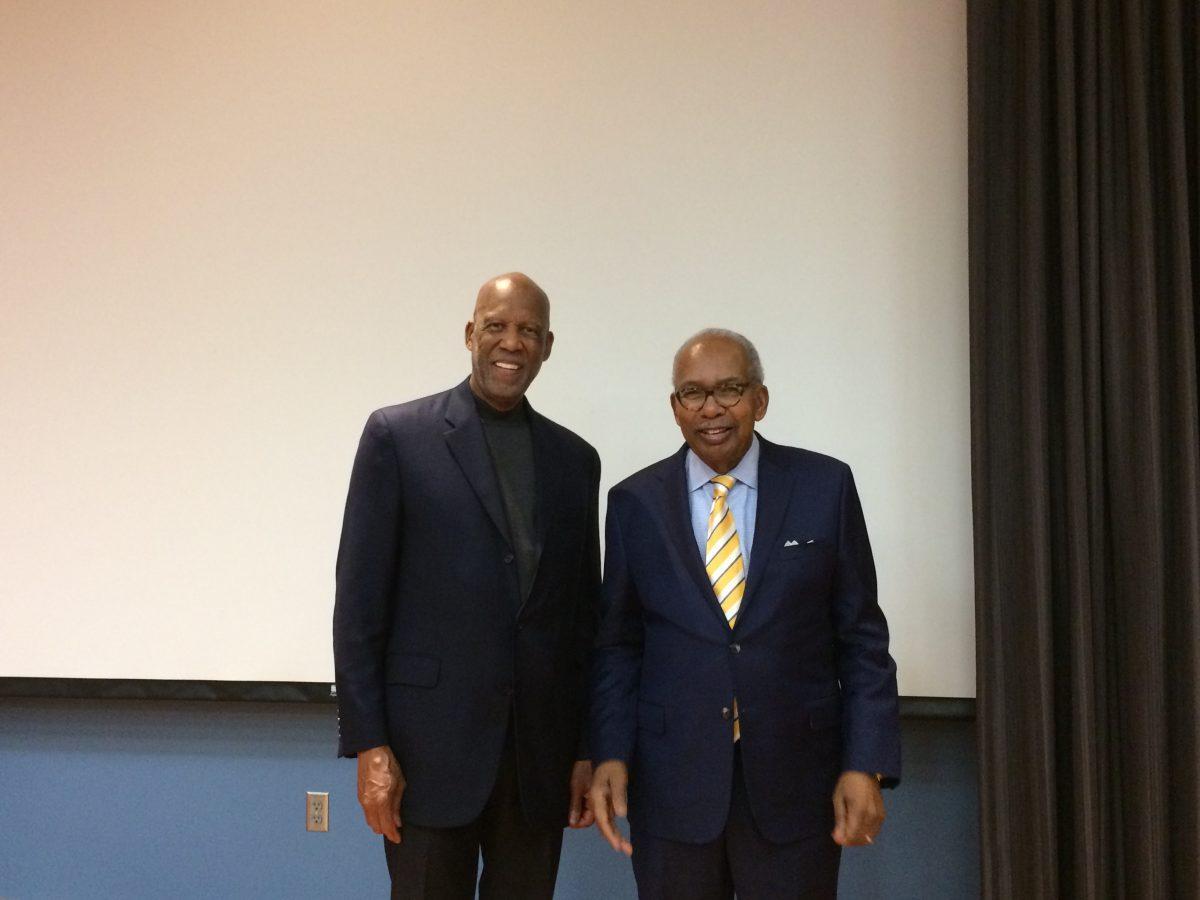
Ernest Green and Terrence Roberts, two members of the Little Rock Nine—a group of nine African American students who first integrated Central High School in Little Rock, Arkansas in 1957—visited UT Monday evening.
Their joint lecture was organized by the Black Cultural Programming Committee (BCPC) as part of the Dr. Martin Luther King Celebration series.
After a short introduction from representatives of the BCPC, Ernest Green opened the lecture with a brief, but pointed speech, emphasizing the need for the same spirit of action that characterized his time at Central High School and the rest of the Civil Rights movement.
“At times it feels as though history is a boomerang … seemingly moving forward only to ricochet back the way it started … progress is not a single action or moment … it’s the small, mundane, everyday action,” Green said. “We need young lawyers ready to follow people like Thurgood Marshall. We need community activists … to continue to engage and challenge our public officials.”
The oldest of the Little Rock Nine, Green was the first African-American student to graduate from Central High in 1957. The following year, Arkansas’ governor Orville Faubus forced the closing of all four public high schools in Little Rock, halting the process of desegregation.
Green would continue on to notable positions in government and law, including a stint as the Assistant Secretary of Labor under the Carter administration. In 1985, Green began work as a managing director at Lehman Brothers.
Roberts’ talk followed, touching on many of the same themes, but especially emphasizing personal responsibility.
Roberts observed that human beings don’t really have the power to create or destroy anything.
“If you can’t create and you can’t destroy, you are left with the power of choice: using that power wisely is the one thing you need to master right away,” Roberts said.
Roberts also recalled his time at Central High as a school year characterized by fear and intimidation, but despite the fear, he took it upon himself to learn and be in control of his future.
“I’ve never been that afraid in my life … and yet, somehow, we were able to get through that,” Roberts said. “I learned that the fear that I felt was my fear.”
The Little Rock school system was closed before Roberts could get a chance to graduate—however, he walked across that stage at Los Angeles High School in California.
Roberts entered the field of psychology, earning his PhD at Southern Illinois University. As well as teaching at various universities, Roberts owns his own consulting firm, Terrence Roberts Consulting, and has published a memoir entitled “Lessons from Little Rock.”
A thirty-minute Q&A followed the two talks, after which Roberts and Green remained to take pictures with the audience and the members of the BCPC who organized the event.
Kayla McCracken, a sophomore in the interdisciplinary program concentrated in neuroscience, spearheaded the planning of the lecture.
McCracken and the rest of the BCPC used the MLK Celebration event series as a way to represent King’s life and his work. Green and Roberts were, McCracken says, a natural fit for the series.
McCracken gleaned major lessons from the two members of the Nine.
“The main (message that I took away) was: don’t let people stigmatize your surroundings … It’s all about what you make (of your surroundings) … be the change that you want to be and be the change that you want to see,” McCracken said.
The BCPC is planning further events throughout the semester, including a Cultural Movie Night featuring “If Beale Street Could Talk” (2018).

The lecture was organized by the Black Cultural Programming Committee as part of the Dr. Martin Luther King Celebration series.