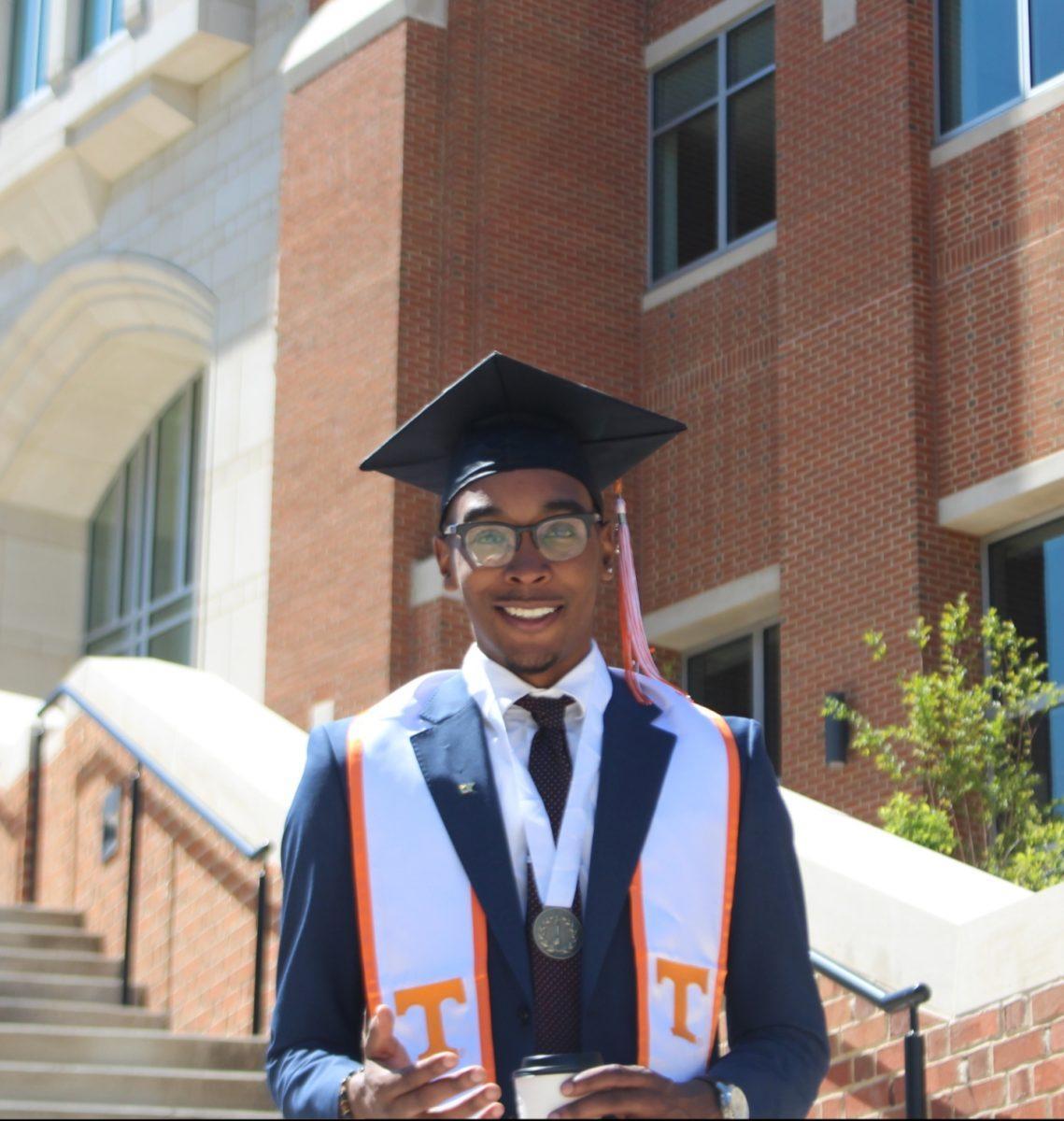
When UT senior Therrin Wilson realized that he no longer identified with the Baptist Christian religion that had been engrained into his belief system for his entire life, he experienced a great deal of turmoil in his personal life.
Now, years later, Wilson is an enormous advocate for atheists—literally enormous. His picture and words are featured on a billboard for the Freedom From Religion Foundation (FFRF), a non-profit organization that advocates for the separation of church and state, near the ramp onto I-275 off of Henley St. downtown.
The billboard reads, “I’m as proud to be an atheist as I am to be an African American.”
Wilson began questioning his understanding of the Christian faith when he was 14. As a biochemistry major, future optometrist and scientific thinker, Wilson put religion to the test of science. And upon doing so, he discovered that his religious beliefs did not align with his understanding of science.
However, for Wilson, an African American man from Memphis, religion was a central part of the community that he was raised in, and rejecting it was seen as abominable by many of his fellow community members. He explained that being an atheist African American comes with a very individualized set of difficulties.
“I would say that it is a unique struggle, because as an African American, of course we’re predominantly Christian, and if not Christian, religious, so for me to, I guess, say come out of the closet as an atheist is to my community in a sense disrespectful,” Wilson said.
After he told his family and friends that he no longer identified as a Baptist Christian, Wilson was met with a great deal of criticism. His friends assumed his lack of belief was just a phase. However, his family reacted even more harshly; half of them disowned him, and half of them constantly fought with him over the subject of religion.
Nowadays, Wilson and his family have repaired their relationship, are on good terms and rarely discuss religion anymore. However, after arriving at UT, Wilson discovered that there was not a community for African American atheists in his hometown nor in his college town.
In order to address that lack of support, Wilson started the Secular Student Alliance at UT in 2016. However, the club only lasted two years before it fell apart due to low membership rates and interest. Wilson believes that this demonstrates how few atheists there are on UT’s campus.
Wilson also noted that it’s hard for atheist students, especially black atheists, to get in contact with each other and organizations that support them due to the fear of judgement from others.
“A lot of us that are atheists find it hard to actually announce that we are atheist because our community is so predominantly Christian, and we’ll be attacked pretty much, not physically but metaphorically attacked for coming out of the closet,” Wilson said.
Wilson hopes that his fellow students will confide in him about their beliefs after seeing the billboard, and he hopes that the sign will help fellow atheists feel more accepted in general.
“I hope it carries to especially African American atheists but atheists in general that they don’t have to be afraid to come out of the closet, they don’t have to be afraid to announce their beliefs and who they are as a person,” Wilson said. “This is a free country, so if you’re feeling a certain type of way, just know that you’re not alone.”
FFRF offers essay scholarships for college students, and Wilson applied several times throughout high school and college.
FFRF’s Co-President Annie Laurie Gaylor explained that the organization prides itself in supporting college students.
“As the nation’s largest association of freethinkers, FFRF is proud to support students like Therrin who speak out about their secular beliefs,” Gaylor said. “We are also proud to put up this billboard by the University of Tennessee’s campus in Knoxville featuring one of its brilliant students.”
Gaylor added that she feels that at this moment in history, it’s particularly important to draw attention to religious freedom
“Now more than ever, it’s critical to engage diverse college student activists who can stand up to the Religious Right and make their voices heard both in the public arena, and at the ballot box,” Gaylor said.