For centuries, women have fought for the right to be equal to men. Nowadays and in the aftermath of the #MeToo movement, the fight for gender equality is just as relevant as ever.
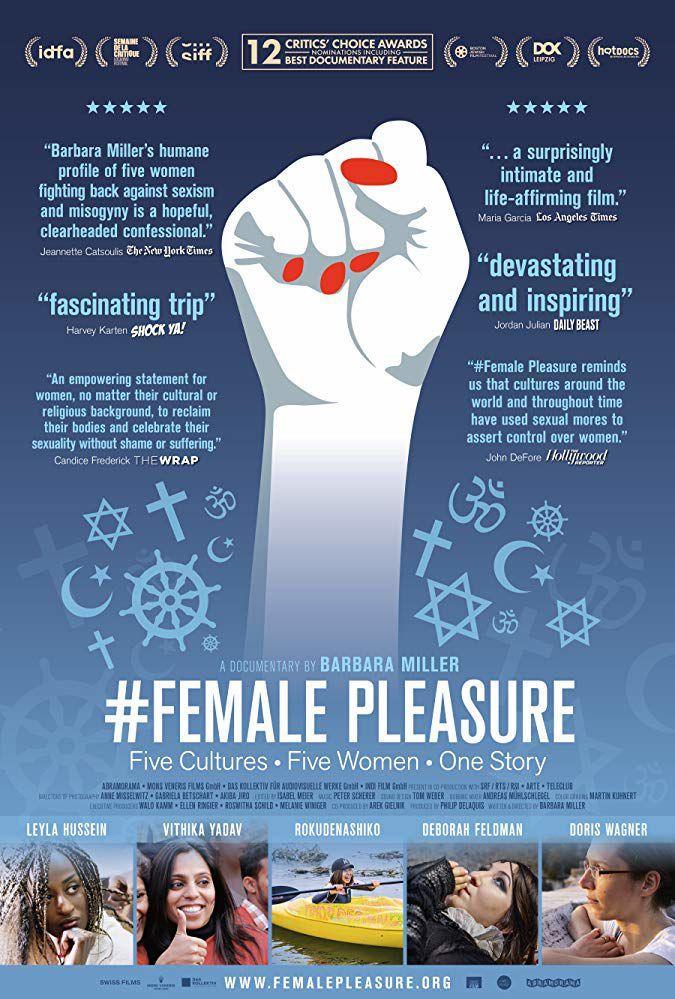
Monday evening, UT showed a 2018 documentary by Barbara Miller entitled “#Female Pleasure,” which discusses the journey to female empowerment.
The documentary follows five women from five different cultures: Rokudenashiko, Vithika Yadav, Leyla Hussein, Doris Wagner and Deborah Feldman. Each one of these women was oppressed for years due to restrictive religions or cultures. In the film, the women tell their stories and empower other women to do the same, as well as to accept and love their bodies.
Japanese manga artist Megumi Igarashi, who uses the psdeuonym Rokudenashiko as her professional name, was arrested after making a 3D image of her genitalia to distribute online for others to use for their own art. Japan is very closed off in regard to discussing and displaying women’s bodies, despite the fact that sexual images of women are often used to sell products.
Rokudenashiko later created a manga about her experience of being arrested simply for being in tune with her body. She also used the manga to empower both men and women to talk about women’s bodies more.
In the documentary, Vithika Yadav spoke a lot about her experiences growing up in India. She was groped constantly in public places, anytime she would go out, and these frequent assaults led her to break free from social constraints.
Yadav later started her own website, where she and her small team work on promoting consensual and loving sex. She believes in love and wants to marry for love, and she feels that love-based marriages need to be broadcasted more, hence the website.
Leyla Hussein was only seven years old when she underwent a “procedure” called female genital mutilation, during which some or all of the female genitalia is removed, typically on young children. Because of her experience with this invasive medical procedure, Hussein speaks up for many women who have gone through the same thing to try and put an end to female genital mutilation.
In the documentary, Hussein explained that her daughter is her muse, and she stated that could not let anything as horrific as female genital mutilation happen to her daughter. Hussein talks in many different countries to raise awareness among men and women about female genital mutilation.
Next, Doris Wagner became a nun when she was very young. She felt that such a profession was her calling from God. While in training to become a nun, Wagner was repeatedly raped by a priest. Upon confiding in the Mother Superior at her convent about the rapes, Wagner was blamed for the incidents, and others in the church community lashed out against her.
It is very important to note that ultimately, this priest kept his job. Wagner became more independent within the convent and studied intensely so that she could one day leave the convent and share her story with people who would actually listen.
Deborah Feldman grew up in a Hasidic community in New York and was groomed from an early age on what it meant to be a wife and a mother. It was expected of her to have an arranged marriage and have children. In her community, women were seen as tools, essentially, and were praised for having children.
However, women were also viewed as evil beings who needed to be contained. Feldman followed through with the plan set in place for her life, until eventually she could not handle living up to social and religious standards anymore. Feldman took her son and left her Hasidic community so that he would not be forced into the same situations she was. Feldman has published a book on her life in the community and her journey to escape from the oppression.
I fell in love with this documentary. It is so amazingly powerful, and it is a film that everyone needs to see at some point in their life. I personally had a hard time not breaking down in tears because of some of the traumatic events they brought up.
The scenes depicting solidarity between women and men who were standing up for equal rights for women, or for women to be able to comfortably talk about their bodies and sex, were also extremely moving.
These stories need to be told and heard because female oppression is very much evident in every day life globally. Women are constantly being praised for looking or acting one way, but they are easily put down for it as well.
That’s what “#Female Pleasure” is about. It showcases different cultures and how they view women and sexuality. The film demonstrated how easy it is for someone to say to a woman “You can’t dress or act like that” or “You need to wear this and act like this.”
This incredible film shows how women are more than just their bodies, but it also shows the importance of being comfortable with your body and being your own person–taking back ownership of your body and mind. That is something that has always been relevant in our society, but it isn’t brought up enough in my opinion.