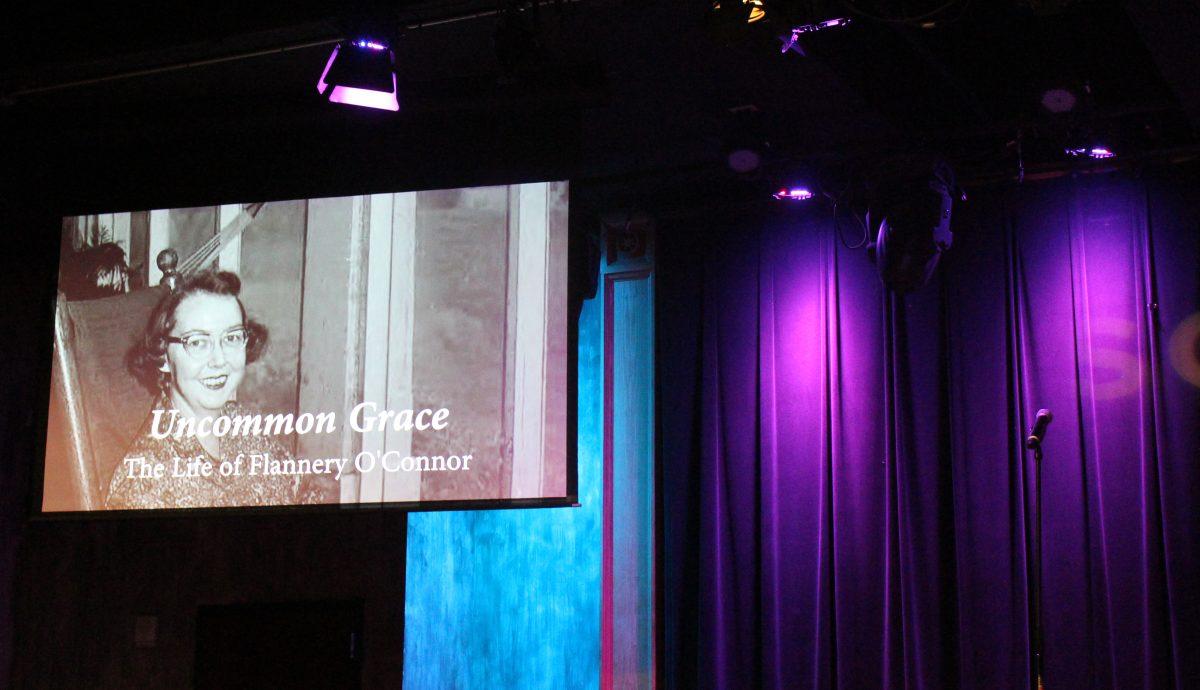
Saturday morning, Knoxville residents and book lovers alike gathered for a showing of “Uncommon Grace: The Life of Flannery O’Connor.”
At the event venue, the Square Room, the scent of freshly brewed coffee from the adjoining Café 4 permeated the air as viewers wafted in. Its entrance hidden in the petite alleyway between Tomato Head and Café 4, the Square Room is a rustic venue that is, in fact, shaped like a square (in addition to being located on Market Square).
Created by Knoxville resident Michael Jordan along with Bridget Kurt, director of the movie, the documentary “Uncommon Grace” was produced with the aim of exposing new generations to O’Connor, a 20th century author from Savannah. Her award-winning work is increasingly slipping out of the limelight.
“We realized that her legacy is really at risk of being lost,” Kurt said. “She’s not being taught in high schools and colleges the way she used to be.”
After realizing the necessity of preserving O’Connor’s literacy, Kurt approached Jordan with the idea of creating the film. An award-winning documentary maker, author and former news anchor, Jordan has created dozens of films, 31 of which have been about Savannah, O’Connor’s hometown. However, the creation of “Uncommon Grace” proved to be an entirely new venture for him.
“I didn’t know anything about Flannery O’Connor. I had never made a literary film,” Jordan said. “This was a radical departure from anything that I had ever done. And at first, I thought Bridget was crazy. But I decided that I would join the ride and see where it took us.”
As depicted by the film, O’Connor was an extremely mature and creative child, who spent much of her childhood drawing, writing and devouring books, which she even voluntarily annotated. As a young woman, she faced many challenges, one of which was the discrimination that was often held against Irish Catholics such as her at the time.
Additionally, O’Connor lost her father, who was also her best friend and the biggest supporter of her creativity, when she was 15. And perhaps the most daunting of all, O’Connor was diagnosed with Lupus, a terminal and horrific disease, at the beginning of her budding career. After this diagnosis, she eventually moved back to Georgia with her mother. They purchased a large farm named “Andalusia,” which would eventually become the backdrop for several of her short stories.
These stories developed out of necessity; due to the Lupus pain she often experienced in her arms and her short life expectancy, O’Connor was limited to writing shorter pieces and therefore developed her signature short story style. Her stories have won numerous awards and are regarded as the pinnacle of her writing.
O’Connor’s writing, often dark and violent, put a twist on Southern grace as it is commonly regarded. A devout Catholic, O’Connor contrasted nihilism with her strong faith to reach nonreligious readers. This juxtaposition, in combination with the Southern dialect in her work, demonstrated a unique representation of the South and Christianity.
As a realist author, O’Connor tackled difficult topics such as religion, violence and illness within her work, all while maintaining a traditional early 20th century dialect. Due to the language of the era, her writing, which often included the n-word, has been regarded as racist, which Kurt believes to be a gross misunderstanding.
“It’s sort of like with Mark Twain, sometimes people don’t want to teach Tom Sawyer or other things,” Kurt said of the vendetta against O’Connor. “Students really need to understand historical context and understand the language. Unfortunately, sometimes teachers don’t want to, or they don’t have time, or they themselves haven’t been exposed to Flannery O’Connor.”
At the end of production, Jordan found that an author who was previously a mystery to him had greatly changed his life.
“[Uncommon Grace] has become one of the most successful films that I have ever been involved with. But the more important thing for me is that it changed the way that I look at life and at suffering and at grace,” Jordan said. “Maybe instead of trying to avoid suffering, we can allow the suffering to teach us.”
The film has been shown across the country and is making large strides towards preserving the O’Connor name and her work itself.