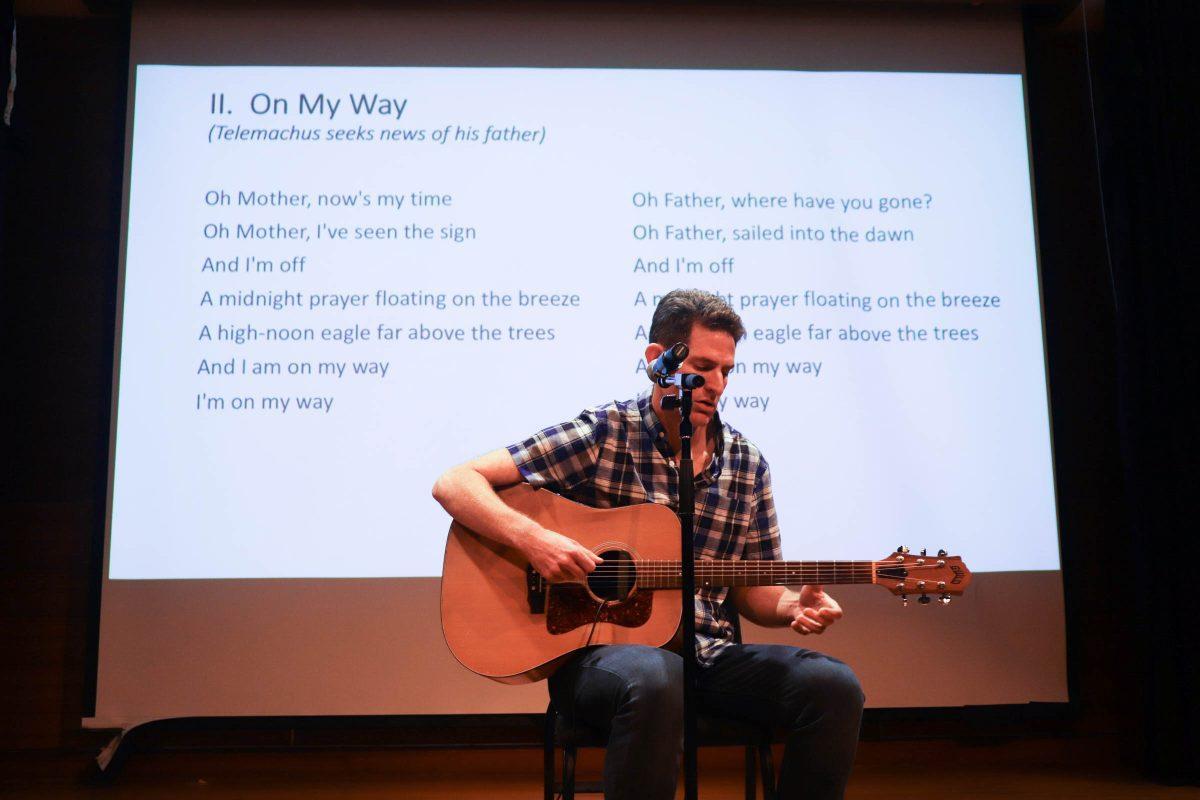
Contemporary bard Joe Goodkin stopped by the Alumni Memorial Building on Monday to perform a half-hour long folk and blues-infused interpretation of Homer’s Odyssey.
Goodkin’s combination lecture and performance was hosted by the Classics Department as part of the Annual Haines-Morris Distinguished Lecture series.
Past lecturers in the series include professional storyteller Kathleen Mavourning, who gave her own oral rendition of the Odyssey, and Professor Alden Smith of Baylor University, who presented a lecture on Epicureanism and the Aeneid.
Justin Arft, professor of Greek poetry, opened the event. Introducing Goodkin, Arft noted that the musician’s performance would be unique among classics lectures given at UT.
For Goodkin, however, the single-song set was hardly singular. Since 2015, Goodkin has performed his rendition of the Odyssey 286 times in over 37 states.
Goodkin’s guitar-accompanied folk-aria recounts the tale of Odysseus, the titular protagonist of Homer’s 12,000- line epic poem.
Most scholars believe that the Odyssey originated in 8th century B.C. Greece as an oral poem, a song repeated and modified by many bards over time.
The musician’s interpretation follows the same book-by-book structure as the Odyssey; his original, American-blues verse captured the world-weary yet restless intensity of the homeward war veteran Odysseus while still being comprehensible to a twenty-first century, English-speaking audience.
A solo singer/songwriter with a bachelor’s degree in Classics from the University of Wisconsin-Madison, Goodkin views the Odyssey not as a tale alienated by time but as an intensely personal story, one that relates directly to his own experience.
“There are some hurdles to getting into the text … but the emotional core of (the Odyssey) is super relevant,” Goodkin said. “I didn’t have to change anything to make it relevant to me. I just looked at it closely.”
Goodkin cited the themes of identity, loss and family that pervade the Odyssey—themes that, he believes, anyone can identify with. “That’s the real world, you know?”
Riley Miller, a junior majoring in Classics with a double concentration in Greek and Latin, felt that Goodkin did an excellent job of translating the sense of reality while grounding the performance in today’s cultural context.
“We don’t have the same instruments or same style of performance as they did back then. He’s (given) us the sense of it … without necessarily being historically accurate, which makes sense,” Miller said.
Differences aside, Miller agreed with Goodkin about the significance and value of texts such as the Odyssey.
“The heart of classics and humanities is understanding other people … the themes in classics are very universal and can apply in any context … human nature and people don’t really change,” Miller said. “It helps us to understand one another, to know that there are these universal things that we all experience and share, regardless of time, place or culture.”
As a classics professor, Arft was himself rejuvenated by Goodkin’s live rendition of the Odyssey.
“Sometimes I’m more intellectually than emotionally invested in (classics). To see someone perform it reminds me that there’s more than the nuts and bolts, and that it’s this real living thing that people still enjoy,” Arft said. “I can study it all I want, but seeing it performed live gives it a new and needed dimension.”
As Goodkin performed his Odyssey, this living and universal dimension unfolded line by line, chord by tensely beautiful chord. As he strummed and picked out a winding melody, hands gliding across frets and strings like wave-tossed boats on a tempestuous sea, voice harmonizing at times like a tortured sailor, at times a man glad to be finally home, Goodkin’s final preface deepened in meaning:
“This is my Odyssey,” Goodkin said. “See you in thirty minutes.”