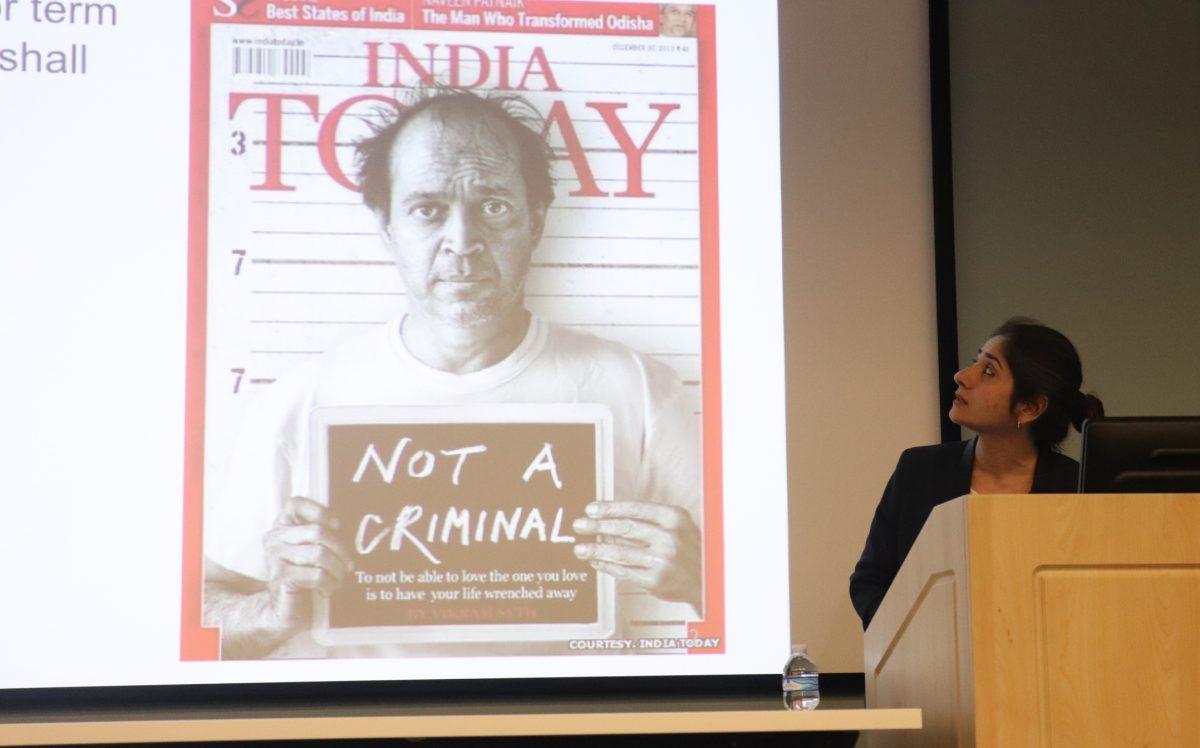
As a part of Sex Week and the Many Visions, Many Versions exhibit, the McClung Museum hosted Indian lawyer Arundhati Katju who dove into her case of overturning a law that oppressed members of the LGBTQ community.
Katju has over 13 years of experience, running her own office since 2011, and has presented cases in front of the Indian Supreme Court. Her areas include white collar defense, legal aide and LGBTQ rights litigation. She is also a barrister for many leading Indian law firms as well as representing clients from all over including India, Singapore, Germany and the United States. At Columbia Law School in New York, she is pursuing her Ph.D.
The lecture was sponsored by UT’s law school and the McClung Museum on Thursday.
Katju spoke about the Many Visions, Many Versions exhibit and said it reminded her of home and encouraged others to see it while it is still here on campus.
“Sometimes it’s not until you are out of your own country that you realize how much you miss and value its art, its culture, its legal system … your language,” Katju said. “I spent some time earlier today walking around that exhibition. It’s really beautiful.”
The main topic of the lecture was how she and other lawyers, with the help of twenty students, overturned a 158-year-old law. The law was put into place on October 6, 1860 while India was still under the colonization of the British. It said that carnal intercourse with any man, woman or animal was a criminal offense and those who violated it would face imprisonment for life.
This led to the question: “Can you really choose who you love?”
The law was originally challenged in the early 2000s without success, and wasn’t challenged again until 2013. Katju and her team lost their case and when they went to challenge it again, they thought about what caused them to lose.
The problem was that they didn’t have anyone that this law affected inside the courtroom during trial. So, when they filed the case in 2016, they planned on having members of the LGBTQ community in court with them. At this time, more people were coming out in the media including Vikram Seth, an Indian novelist and poet, and chef Ritu Dalmia.
In January of 2018, the Indian Supreme Court agreed to hear Katju’s case after two years. The team was led by women and this time there were 20 LGBTQ students who were nominated by their school in the courtroom to provide a story, so the judges could see the people that this century-old law was disheartening and oppressing.
Katju used the Indian constitution which states, “Equality of status and of opportunity; and to promote among them all, fraternity assuring the dignity of the individual and the unity and integrity of the Nation; in our constituent assembly this twenty-sixth day of November, 1949, do hereby adopt, enact and give to ourselves this constitution.”
This wasn’t only India declaring their independence from Britain, it was also giving the citizens their constitutional rights. By using this in her case, those constitutional guarantees were extended to the LGBTQ community.
Senior in history Hannah Nelsen said that she had heard of this case before, but she never looked into it. She said that it was great to hear what it was and what was actually happening.
“The biggest takeaway is to kind of see what’s happening in other countries because I know that we have a lot of debate going on in our own country and in our own state about the different rights of LGBTQ people,” Nelson said. “So I thought it was really a good perspective to see how other people are doing and see how they’re arguing those cases and maybe people who are going through that here can reflect on that and maybe collaborate potentially.”
As of now, the LGTBQ community in India are recognized as citizens and have all of their constitutional rights, but same-sex marriage isn’t legalized. Maybe in the future more people will step up and challenge that as well.