Patricia Summitt left behind a legacy of success, marking a proverbial golden age for basketball in both Tennessee and the nation.
But perhaps one of her greatest accomplishments occurred at the start of her career, when she helped to lift restrictions on women during the “Cape v. Tennessee Secondary School Athletic Association (TSSAA)” court case.
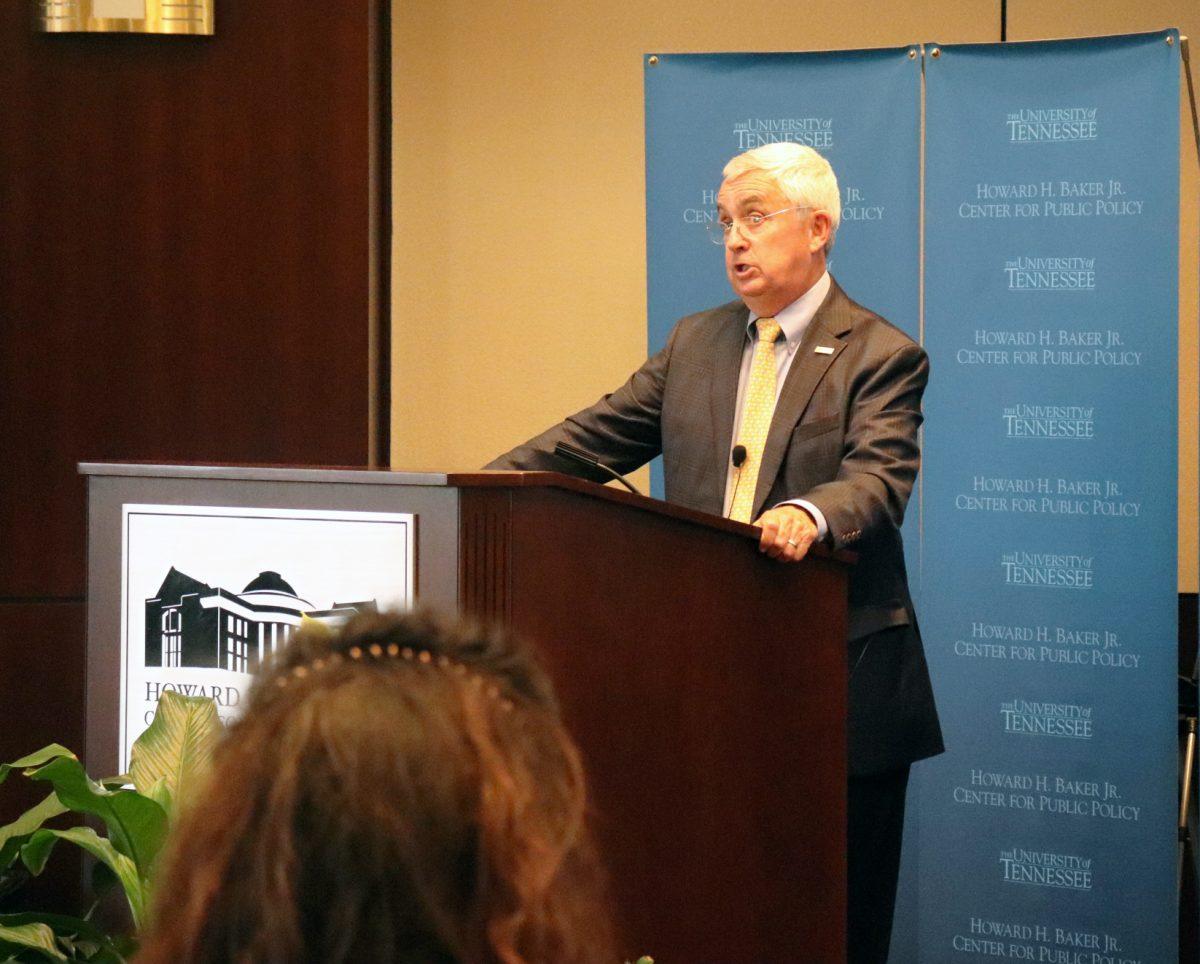
Former lawyer Bill Haltom chronicled this case in his 2018 book, “Full Court Press: How Pat Summitt, a High School Basketball Player, and a Legal Team Changed the Game,” and discussed it further in a presentation this Wednesday at the Howard Baker Jr. Center for Public Policy.
During his presentation, Haltom, a UT graduate with seven books under his belt, described why he wrote about Pat Summitt.
“I like to write the stories of courageous people,” Haltom said. “I just wanted to tell this story of how Pat, a 15-year-old high school basketball player and a couple of lawyers did something—not just (affecting) the game at that moment—(that) had an impact on NCAA women’s sports to this day.
He also expressed his desire to honor Summitt’s legacy by highlighting one of her greatest accomplishments.
“Cape v. TSSAA” was a 1976 court case that changed the way U.S. high schools played women’s basketball. Before the case, women players were only allowed to play with half the court, which seriously damaged their scouting prospects.
“When girls played basketball, it was considered—and I’m not making this up—dangerous for (them) to run the full court,” Haltom said.
Eventually, a young woman named Victoria Cape sued the TSSAA for her Title IX right to play full court basketball.
Cape, now Victoria Cape Hermes, attended Haltom’s presentation, and described how she felt about her court experience.
“I was terrified, really terrified,” Hermes said. “People didn’t sue other people back then (and) kids were meant to ‘respect their adults.’ There were a lot of relationships that I had to keep in check with, like my coach— who I was suing— and my school— who I was suing. It was very awkward for me.”
According to Haltom, Summitt testified in the case as an expert witness. Thanks to her help, as well as the recent passage of Title IX in 1972, Cape won.
Haltom held the case up as a monumental win for women’s rights in sports.
“It’s always easy to look at stories in hindsight and say ‘of course they did that,’” Haltom said. “Put it in the context of the times, there wasn’t even NCAA women’s basketball at the time. (Cape and Summitt) were opening doors, and no one could (have envisioned) that, because of what they did, a whole generation of women would become college athletes.”
Even with the event’s importance, however, Cape said that her only motivation was to do the moral thing and make right what was wrong.
After the presentation, Haltom remained to answer questions and sign copies of his book. He closed by encouraging attendees to not dismiss the story as something exclusive to the past.
“Don’t take this as some ancient story saying how awful things used to be. There are still battles to fight. There are still people to this day that believe Title IX has had a very detrimental effect,” Haltom said.
One attendee, senior microbiology major Eriko Gordon, agreed with this sentiment, saying that society can do better to address women’s rights violations.
“We forget about how women’s rights are still a contested issue,” Gordon said. “We need to acknowledge (women’s rights problems) in the first place, and not act like it’s a done issue.”