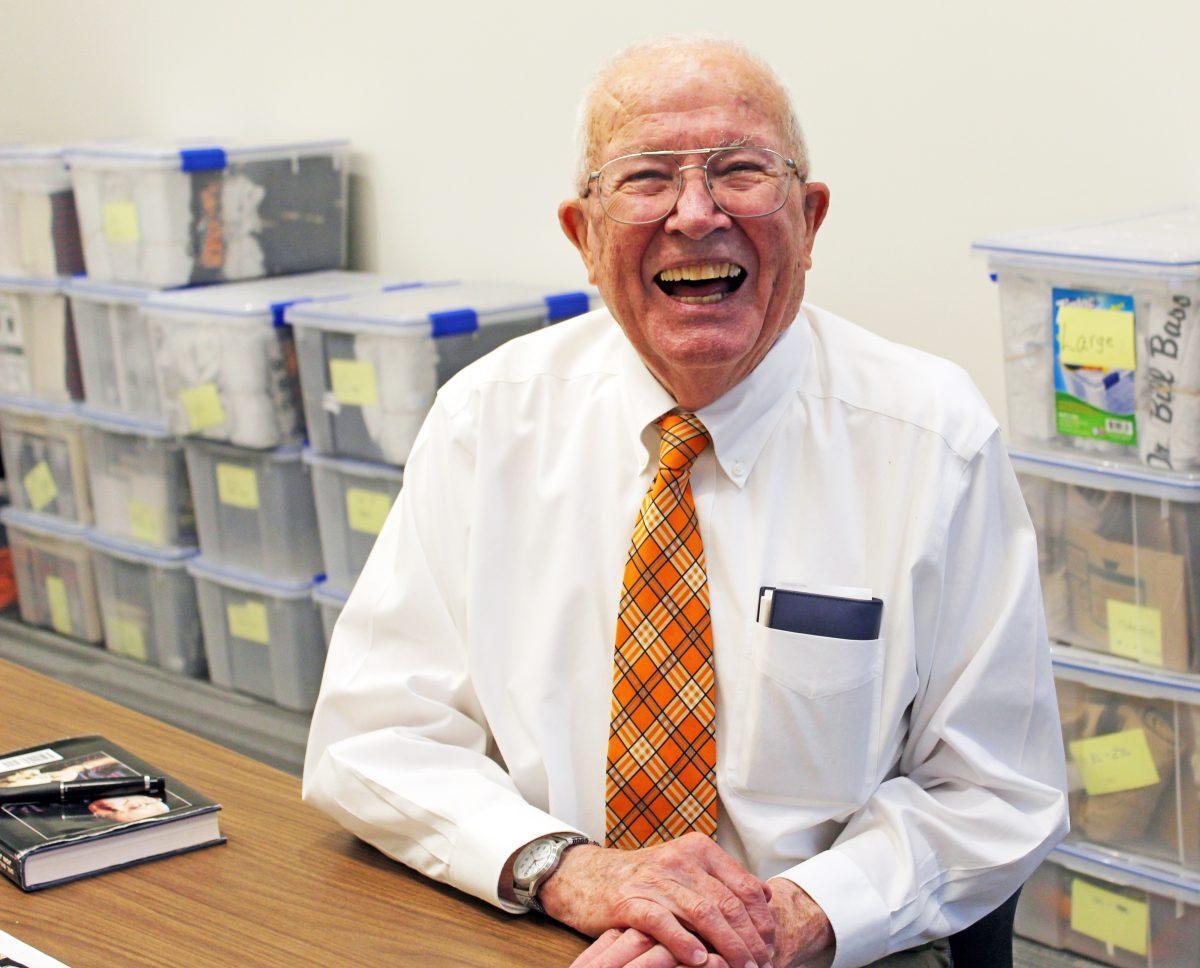
UT’s Undergraduate Anthropology Association (UAA) held its annual fundraiser at the Student Union Auditorium this past Tuesday night. The fundraiser consisted of a “Bass Lecture,” which is a presentation given by former UT professor William Bass.
Bass prefaced his lecture with the assurance that the audience was not about to observe anything similar to your average true crime television show.
“This is an interesting case. This is going to be absolutely different from CSI. CSI gets it done in 41 minutes, and of course you have to have, what 19 minutes for advertisements and things like that,” said Bass. “But they always know the answer, they always get it right, they don’t have to ask anybody anything. This is 180 degrees from what you see on CSI.”
Now 90 years old, Bass is a world-renowned anthropologist who has dedicated his life to forensics. During his time in East Tennessee, Bass pioneered UT’s “Body Farm,” an acres-long facility behind the UT hospital that studies and analyzes decomposing bodies and skeletons.
Bass started the facility after he made an estimation that a particular body had been recently deceased, when in reality the remains dated back to the Civil War era. After this mistake, Bass started the Body Farm in order to study forensics and increase the accuracy of the practice.
“It was kind of this like embarrassment to him, and so he decided, I’m going to start a research facility so I can know exactly when and how long ago somebody died, so that’s what started the Body Farm,” Katherine Brown, junior majoring in anthropology and secretary of UAA, said.
She explained that once a year, Bass comes to UT to give a lecture on a cold case that he’s solved with those refined forensics skills that he spent his entire career studying. Tuesday’s case was that of Leoma Patterson, a woman who went missing from Clinton, TN, a town just half an hour away from Knoxville.
“This case is like very interesting in terms of Bass personally,” Brown said. “This was one of the big cases where he was actually wrong about something.”
In October 1978, Patterson left a bar with a man and his son, one of whom was her grand-nephew, and was never heard from again. The following April, children playing in Norris Dam discovered skeletal remains and the body was quickly believed to be Leoma Patterson. Patterson was buried and the case was set aside—yet Patterson’s family were skeptical as to whether the remains were legitimately Patterson’s.
About 20 years later, Bass lectured about forensics for a chemistry class at UT and Patterson’s granddaughter happened to be in attendance. She quickly put her family in contact with Bass, who they recruited for help in hope of finding solid answers.
“We talked about this at some length and decided that with the new technology that we had, particularly DNA, that this is something we should do,” Bass said.
The body in question was exhumed, and Bass and the Patterson family were quickly in collaboration to solve the mystery. However, the solution they were in search of would take decades to uncover.
“This case, I spent 29 years from the very first of this until we really figured out what happened,” Bass said. “We went through, we thought it was Leoma, it is not Leoma, it’s maybe Leoma, it is Leoma.”
Throughout that time, Bass worked with the Patterson family and tried numerous methods to uncover the body’s identity. The body’s DNA was analyzed by two different labs, each of which came to different conclusions about its identity. Bass also used technology to layer a picture of Leoma with an image of the skull in order to visualize their physical similarities.
After a number of other forensic tests, Bass was able to conclude the body was in fact Patterson’s. An additional sample of her DNA, her scalp and hair, had been discovered and was used in the second DNA test. This sample was much more reliable than the first test, and the second lab was positive that the body was Patterson’s.
This elaborate case demonstrated that even for the most prolific of scientists, forensics is not easy. Although Patterson’s body has definitely been found, the details of the actions surrounding her death have yet to be confirmed. Her aforementioned great-nephew, Jimmy Ray Maggard, confessed to killing Patterson while in jail on other murder charges but later withdrew his confession. Additionally, no one is certain exactly what weapons were used in her death.
Brown hopes that this presentation offered the public insight into the reality of the practice.
“I think hearing cases about the way forensic science works and the way it can be used to actually solve cases and stuff like that, it’s super important, and I also think it’s important to hear it from somebody who is an innovator in the field,” Brown said. “He was the one who kind of originated a lot of the science, and it’s not like it is on TV, where you can have one drop of blood and know who the killer is. It’s a lot more science and a lot more kind of guess work, and Dr. Bass is kind of the best there is in the field with that.”