On college campuses across America, many students are exposed to alcohol, drugs and in particular, cannabis. Here at UTK, the Center for Health Education and Wellness strives to understand more about these substances and provide information to the campus in order to create a safer community.
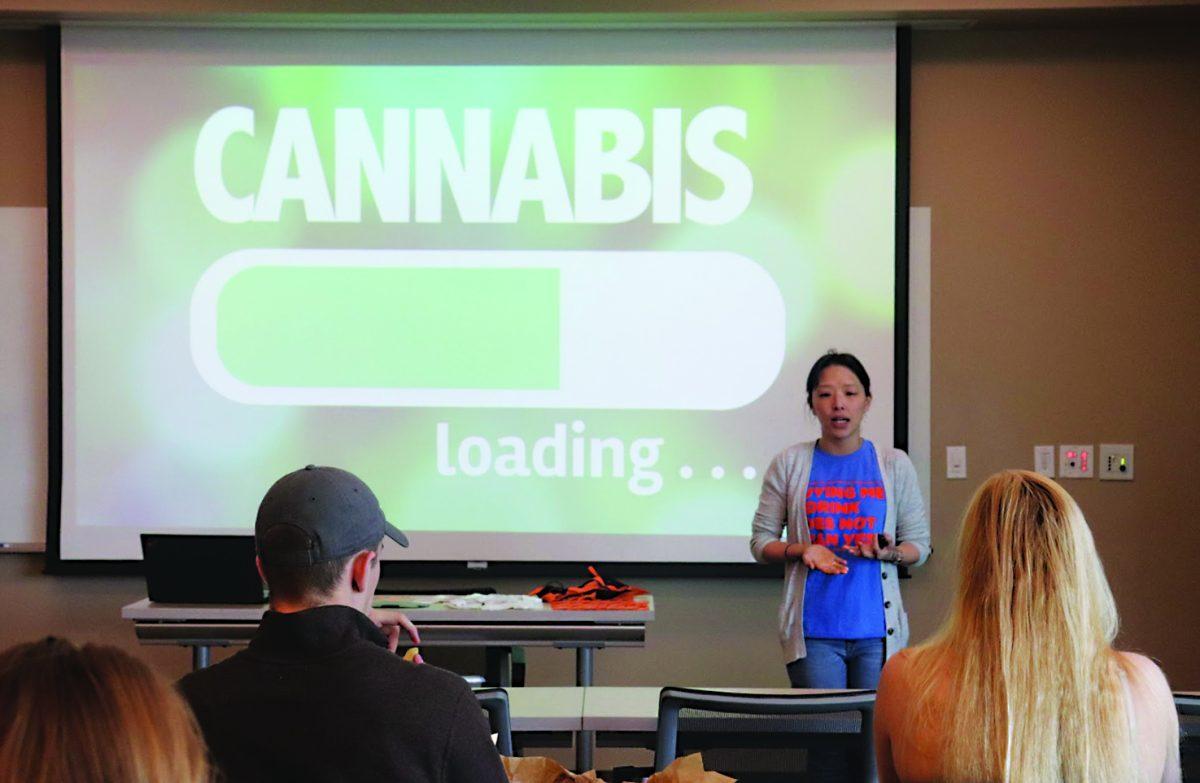
Rebecca Juarez, a staff member of the Center for Health Education and Wellness, gave a Lunch and Learn presentation titled “The Brain on Weed,” at the Student Health Center.
“Our office is a place where we work to promote student health and wellness, including general health, sexual health, cold and flu, and alcohol and drug issues,” Juarez said. “My personal focus is within drugs and alcohol.”
The goal of the presentation was to find what the group knew about cannabis, present information and discuss it; this was an extremely interactive experience, where anyone in the audience could pitch in, discuss what they thought of the topic and share their own personal stories.
Many questions were asked regarding the legality of it across the states, how commonly used it is among college students and the direct impacts it has on the brain. However, Juarez discussed the exact purpose of the presentation.
“If we focus on a debate over the legality of cannabis, it has no positive effect,” Juarez said. “We want to provide you all with information, provide a learning experience and be open to conversation in order to create a safer environment.”
Through the presentation, Juarez exhibited many different data points regarding cannabis; for example, through a survey at UT, they found that 38 percent of students have used the drug in the past year. However, attendees debated the reliability of this statistic and Juarez explained an important part of her job.
“As a professional working around these topics, the thing that scares me most is having a very limited amount of information around cannabis,” Juarez said. “We have so much information regarding alcohol, but we have barely any data on cannabis.”
Additional topics discussed were the impacts of cannabis on mental health, the difference in forms of consumption, debates on its impacts versus tobacco and alcohol, dosage issues, and many more.
Olayinka Kasunmu, junior psychology major and Vols to Vols peer health educator, said that lectures like this one were beneficial to students.
“I really think these programs are so important to put on, it is really beneficial for all of the students here, because I know a lot of people that smoke weed and are very casual about it and don’t think there are really any harmful effects from it,” Kasunmu said. “I think coming to something like this is very beneficial and eye opening for people like them.”
As a Vols to Vols peer health educator, Kasunmu also wanted to get the word out on how these programs can assist in addressing these topics.
“I think more programs in residence halls and organizations, and making things like these more accessible to students could be really helpful to our campus,” Kasunmu said. “Vols to Vols is available to come to organizational meetings and things like that, as well as classes and residence halls, and we would love for people to be more aware of this that we offer.”