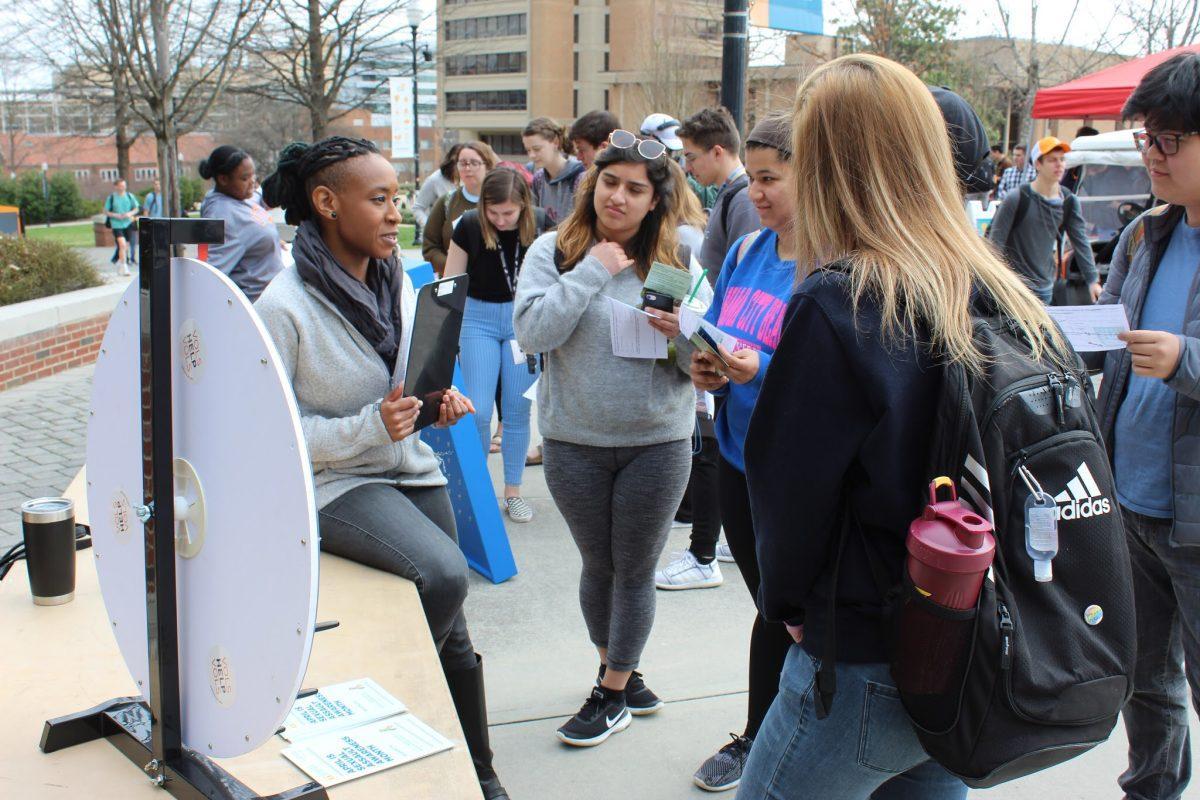
From sunburn treatment to safe sex, the Center for Health Education and Wellness’ Safe Spring Break fair offered students a variety of recommendations for how to stay happy as well as healthy during spring break.
The event took place on Ped Walkway in the courtyard near the amphitheater. Booths from the Center for Health Education and Wellness, other campus organizations and local Knoxville businesses were open to students heading to and from classes.
Booths offered safe habits to consider during spring break–wearing sunscreen, observing active consent—as well as resources on local events and attractions.
According to Rebecca Juarez, a wellness coordinator at the Center and a principal organizer of the event, this year marks the fifth anniversary of the Safe Spring Break fair.
“It’s been a continual growing and learning process in trying to understand how we meet students’ needs, how we provide the information in such a way that students really enjoy,” Juarez said.
Juarez expressed her own excitement for the latest addition to Safe Spring Break: a self-care station where students could make their own bath salts from Epsom salt and essential oils. Throughout the event, this booth proved to be especially popular.
Safe Spring Break began primarily as an outlet for other organizations to inform students about opportunities available during spring break.
This element of the fair was still apparent: local companies had booths offering tourist information and other activities within Knoxville.
Campus organizations were also present. The Center for Leadership and Service offered information on future fall, summer and spring break service opportunities. The Office of Student Conduct and Community Standards and RECsports also had booths.
This year, however, the Health Education and Wellness Office itself had stations for students to participate in.
Attendance at every booth was incentivized by cards that were stamped at each station upon completion of a health-related activity. After receiving six stamps, participants were able to collect a colorful tank top as well as get free food.
Eric Collins, a senior majoring in anthropology, thought this was a smart strategy.
“I think by (having to) go to booths, (people) actually participate … I did pay attention to the booths once I got there,” Collins said.
Laura Maples, a sophomore majoring in sustainability, laughingly agreed. “It’s bad (to say), but food is a great incentive.”
For many students, this incentive seemed to be effective in creating participation.
Mary Guzik, a freshman on the exploratory track, appreciated the advice relating to sun protection, as well as the booth that helped students make their own bath salts. Overall, Guzik felt that the fair made her more thoughtful about safety.
“Know your surroundings, watch your limits and know when you need to get help,” Guzik said.
This awareness was central to the message that the Center for Health Education and Wellness hoped to deliver.
Bilqis Amatus-Salaam, another wellness coordinator and organizer, noted the importance of being self-aware.
“Take the time to figure out what it is you need during spring break … it’s good to stop, check in with yourself, and do something that’s going to promote your health and well-being,” Amatus-Salaam said.
No matter the activity one is pursuing, the Safe Spring Break fair offered steps on how to enjoy one’s break in a way that promotes long-term health and rejuvenation for the second half of the semester.