Radio broadcasting legend reminisces on fascinating life, fate of journalism
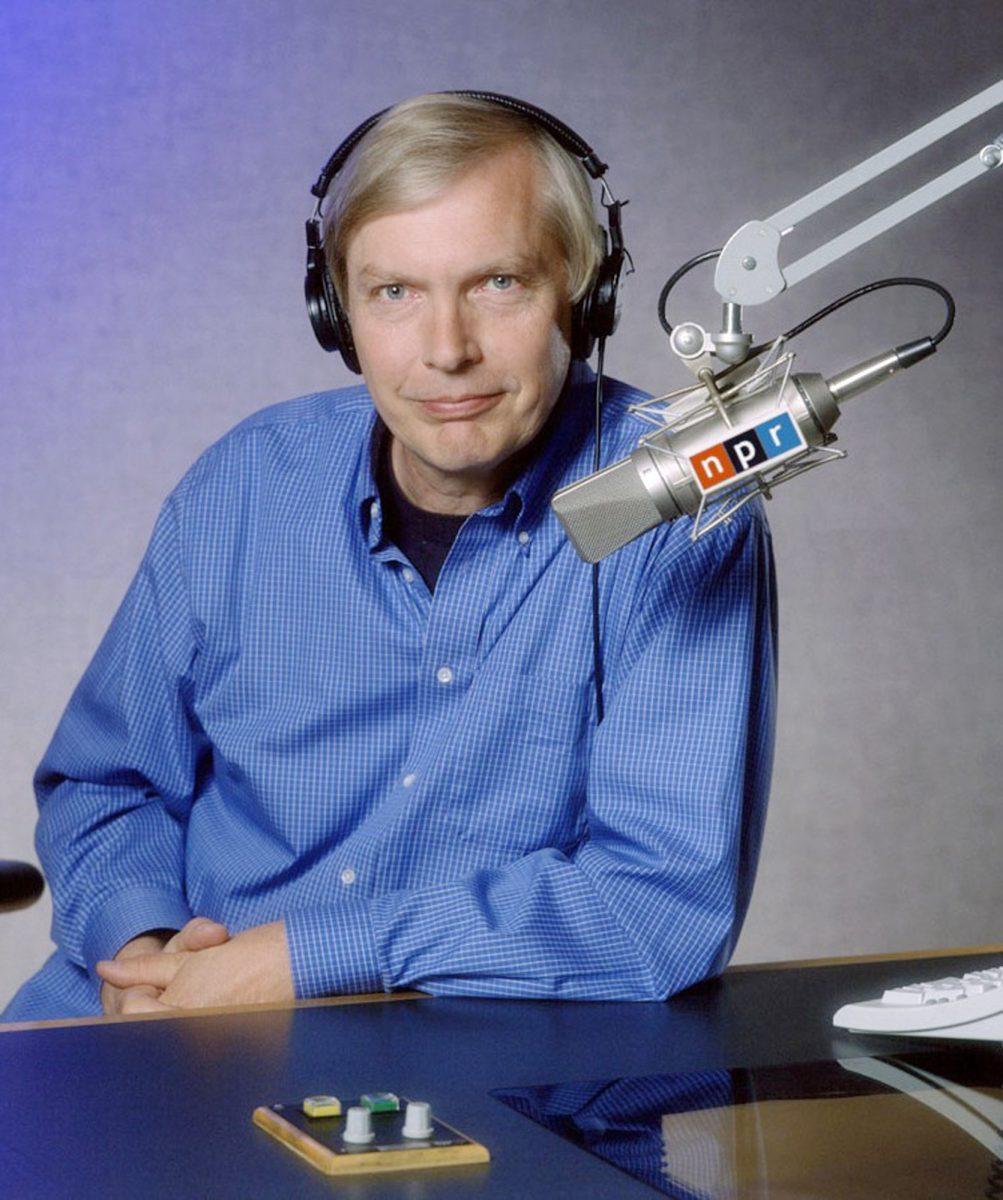
Bob Edwards, former host on National Public Radio, shared experiences from his career with faculty and students in the UC auditorium Wednesday.
Ashley Shoemaker, senior in political science, who provided questions to direct Edwards’ remarks, introduced him.
“We are very grateful to have Bob Edwards speak with us,” Shoemaker said.
The address was given in a Q-and-A format, with Edwards seated and relaxed next to a coffee table on stage. His demeanor was cool and collected but serious, as befits a man who has weathered all the major storms of the past several decades with his listeners at home.
Edwards first touched on his mentor-pupil relationship with Red Barber, the experienced sports broadcaster from Cincinnati who would appear on Edwards’ show in its early years.
He greatly appreciated the many lessons Barber was able to impart, learning through their interaction.
“I was used to scripted radio, but this was live,” Edwards said. “He taught me to be extemporaneous and broadcast on the fly. This was very valuable for the events that would come later. It was an important lesson, and I learned that from Red.”
Proceeding to expound on his experiences as a radio reporter, Edwards shared his experiences on Sept. 11.
“The big thing for me that morning was to avoid any kind of speculation, to say only what we knew,” Edwards said. “That’s really the only operating thought I had for 9/11.”
With his experience, Edwards was able to comment on his time spent with many different types of people, from many different walks of life.
“Politicians are defensive and have their ‘message of the day,’” he said. “Musicians are different. When I talk to someone who is open and creative, it’s very refreshing. I like to ask them what they do and why they do it.”
Edwards identified his favorite musician as Theresa Andersson. Her style aims to create a one-woman show, as she roams the country with a record player, drums, dulcimer, guitar and violin. She uses all of these instruments together, through the employ of loop pedals.
“She plays multiple instruments and will record instruments over themselves and harmonize with herself as well,” Edwards said. “She can then become a symphony all herself, barefoot, as she creates her music with pedals on stage. It’s not your everyday creation.”
With the changing of the journalistic environment, so too have come changes for Edwards and his reporting style.
“I did breaking news at NPR and had to do seven hours a day of ‘Morning Edition,’” he said. “The program I do now is an interview program, and I can talk to a person as long as I like. It’s simply conversation, and there should be a place for that.”
Edwards will be making the most of his visit to Knoxville, finding time to gather some material for his program.
“While I’m here I intend to do a story on workers at Oak Ridge in the 1980s,” Edwards said. “I may even sit down with Pat Summitt.”
Edwards has done at least 30,000 interviews over the course of his career. He described his most heated interview with James Watt, a Reagan staff member, who stormed out of his studio in anger. He shared many other anecdotes as well.
“My favorite interview was with Father Greg Boyle, who works in downtown Los Angeles, specifically with members of the Latino population involved in lives of gang violence,” he said. “He has a great gift of narrative. The stories of the people he has helped, and the people who aren’t able to escape the violence, are simply riveting.”
Edwards said he has a capable team who helps him locate interesting persons such as Boyle.
“I have a fantastic staff of young producers who know what I will do and what they want to do,” he said. “They tell me what’s going on in music, and I educate them on the Iran-Contra Affair.”
Another of his favorite interviews was with Johnny Cash, who had a special impact on Edwards.
“I spent so many years trying to get Johnny Cash,” Edwards said. “I knew I was going to call him the ‘Voice of America.’ I finally got him, just six months before he died, and we had a great time.”
He shared his stories from times of war and peace. Particularly interesting were his thoughts on the McCarthy years, with his belief that the public was responsible for preventing atrocities like this from occurring.
Edwards reflected on the future of journalism and its altered role in American culture.
“You have people in Washington who remain in makeup all day, pundits,” he said. “There is less attention to fact. If something shows up on Twitter, broadcasters go on the air with it. It’s not checked for accuracy.”
He brought up examples from his experience to justify this point.
“When Clinton was accused of his affairs, that’s when it began,” Edwards said. “Journalists reported rumors for the first time. There is now less care taken with information.”
Edwards also shared his view of his significant role in modern journalistic practice.
“There is no civility,” he said. “These programs are less about the mind than speaking from the gut. My program is a little place of escape from that. It will all be different in 10 years, because it’s all different now than it was 10 years ago. We seem to be going back to our historical roots, when political parties ran newspapers. Objectivity has ceased.”
He sees an extreme polarity in the media, which is a substantial diversion from journalism of the past.
“Once that (bias) begins, it flourishes,” Edwards said. “These outlets are going to multiply and increase. I don’t know that I would want to stop that. There should be freedom of opinion.”
Edwards still asserts the importance of the New York Times and the Washington Post in our society.
“We need successful big-time newspapers that can finance investigative reporting,” he said. “This is our only way to keep tabs on the activities of our politicians.”
Both “The Bob Edwards Show” and “Bob Edwards Weekend,” broadcasted through Public Radio International, currently feature Edwards. These programs are purely conversational, as Edwards interacts with prominent journalists, entertainers and a variety of interesting persons.
Edwards is currently affiliated with Sirius XM. Previously, he hosted National Public Radio’s “Morning Edition,” where his following included 13 million listeners on a weekly basis.