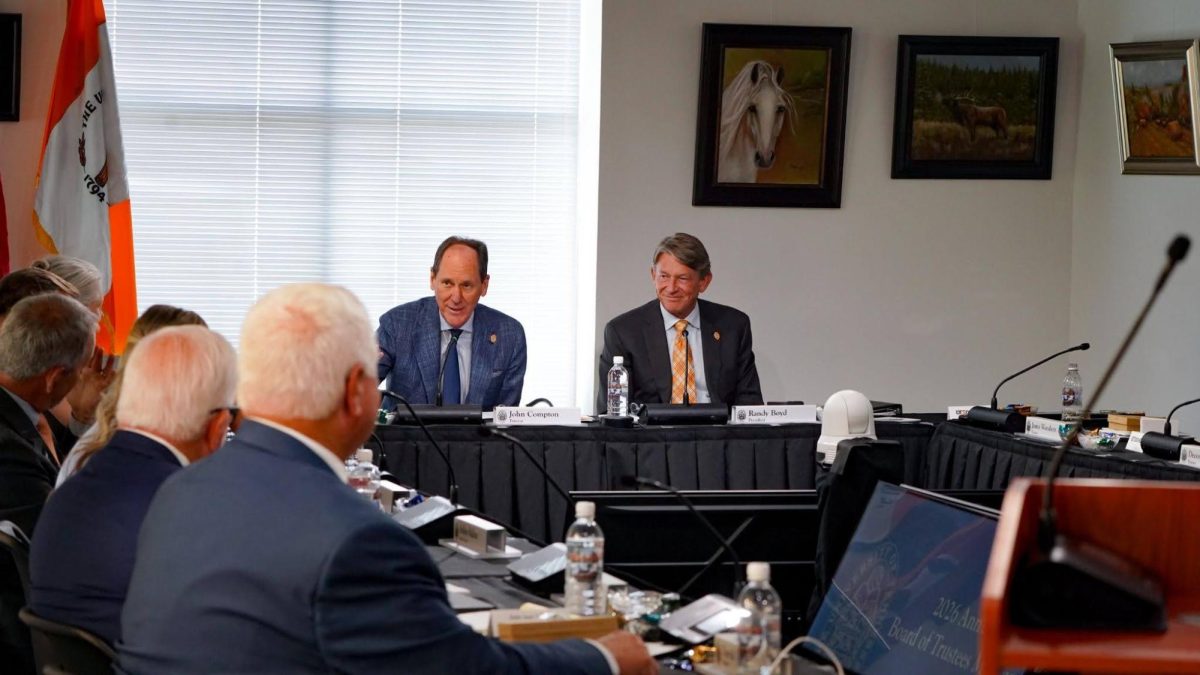
Ambassador Roman Kirn joined UT students and faculty on Tuesday to discuss Slovenia’s role in the European Union, specifically in the context of an increasingly global economy. This visit was timed in conjunction with his role in the inauguration of the Slovene Consulate in Tennessee.
The event was hosted cooperatively between the Baker Center’s Ambassadorial Lecture Series and the Geography Department. Professor Lydia Pulsipher of the Geography Department was recently appointed an Honorary Consul to the Republic of Slovenia and has been working to establish the consulate.
Kirn’s address highlighted the history of Slovenia, as well as the country’s strategies to become more prominent in global affairs.
The Baker Center was honored to host the ambassador.
“Our ambassadorial lecture series has thus far only included American ambassadors to elsewhere. This event is special, as it is our first time to host an ambassador from another nation,” Carl Pierce, director of the Baker Center, said.
Pierce gave Pulsifer the opportunity to introduce the honored guest and touch on the significance of his nation.
“Slovenia is one of those small places on Earth that has much more influence than you would expect, given its size,” Pulsifer said.
Pulsifer was excited to introduce Kirn, relaying several pieces of his impressive career.
“Ambassador Kirn has been an ambassador to a number of countries, and his experience is certainly broad,” she said.
The ambassador was enthusiastic about the Baker Center’s lecture series.
“There are many ambassadors serving in the U.S., and it is good for you to be exposed to news from different parts of the world,” Kirn said.
Kirn then focused his address upon his nation’s complex history.
“I want to speak with you about the history of Slovenia,” Kirn said. “Americans are very forward looking, while Europeans look back to search our past and ourselves. In Slovenia, we don’t dwell in the past, but we don’t forget it either. We look back to develop solutions for the future.”
Cementing a historical foundation seems to be a main concern for Slovenia currently.
“We are dealing with a great number of countries in the European Union, and as a young state, we do face identity problems,” Kirn said. “We focus on geography and history to give a sense of who we are.”
To frame the discussion around the resolve for establishment and recognition that defines his nation, Kirn began with a question.
“As a state the size of New Jersey, why is Slovenia even on the world map?” Kirn said.
He went on to recount some of the historical bases for Slovenia’s formation.
“In 1848, the Slovenian political elite designed a political idea of uniting Slovenes from different lands,” he said. “We were put on the map by our own effort. Of course, such things do not happen by will alone, but political circumstances must allow this change. The fall of the Berlin Wall was the window of opportunity for us.”
In the last 100 years, this area of Europe has been so turbulent that the region’s flag has changed six times.
Three different languages, three separate religions and many different cultures united to form the nation of Slovenia. Next year will be Slovenia’s 20th anniversary as a nation.
“You must have common interests to keep multinational states together,” Kirn said. “Slovenia was too Western-oriented and anti-communist to stay united with Yugoslavia. Unfortunately nationalism came to the surface, leading to the widespread violence in Yugoslavia. We gained our independence in 1991, and international recognition in 1992.”
Kirn seemed anxious for Slovenia to attain a more prominent role in interactions with democratic Westernized nations. Slovenia is actively involved in promoting stronger ties between the nations of the European Union as well.
“European processes of integration are slow, but we are gradually increasing the scope and number of our shared institutions,” Kirn said.
The Slovenian economy is strongly based on exports, and it is actively engaged in trade with the majority of Europe. With its drive for economic expansion, the nation is disturbed by a relatively small amount of trade with the U.S. Some links between the two countries, however, were made apparent in the recent recession.
“We were affected by the downturn as well. It was a real test for us, but it seems that we are now growing out of it,” Kirn said.
Slovenia has certainly prospered in many ways, as economic performance continues to improve. Recently the Global Peace Index ranked Slovenia the ninth most peaceful nation in the world, revealing a great deal about their national character.
The crowd was intrigued by the ambassador’s unique European perspective.
“I really enjoyed Ambassador Kirn’s lecture,” Mark Remec Pavlin, freshmen in mathematics, said. “It was a great opportunity for me, as my family is Slovene,”
Prior to his role as the Slovenian ambassador to the U.S., Roman Kirn served as Slovenian ambassador to the United Nations in New York for four years. He has previously acted as vice president of the U.N. General Assembly as well. The ambassador is fluent in English, French, Czech and Serbo-Croatian.
The new consulate in Tennessee is the outworking of prospective economic interactions between the state and Slovenia. The consulate is anticipated to serve as a bridge between the two cultures, expanding regional relations with this small yet emerging nation.
“The goal of the consulate is to increase interaction with central Europe here in Tennessee,” Pulsifer said. “I am looking forward to a rise in the opportunities for student exchange between Slovenia and the University of Tennessee.”
The last Slovenian ambassador to speak at UT was Samuel Îbogar, who gave an address in 2007 regarding the recent admission of Slovenia to the European Union.
The decision to unite with several of its neighboring European countries significantly affected the future of Slovenia’s banking, education and health care systems.
Slovenia is situated between Italy, Croatia, Hungary and Austria. Though it has a population of approximately two million, Slovenia is the richest Slavic nation-state. The capital of Slovenia is Ljubljana.