Mirrors, cultural histories and totem poles.
These are a few words that two printmaking students chose to summarize the work of professor Koichi Yamamoto.
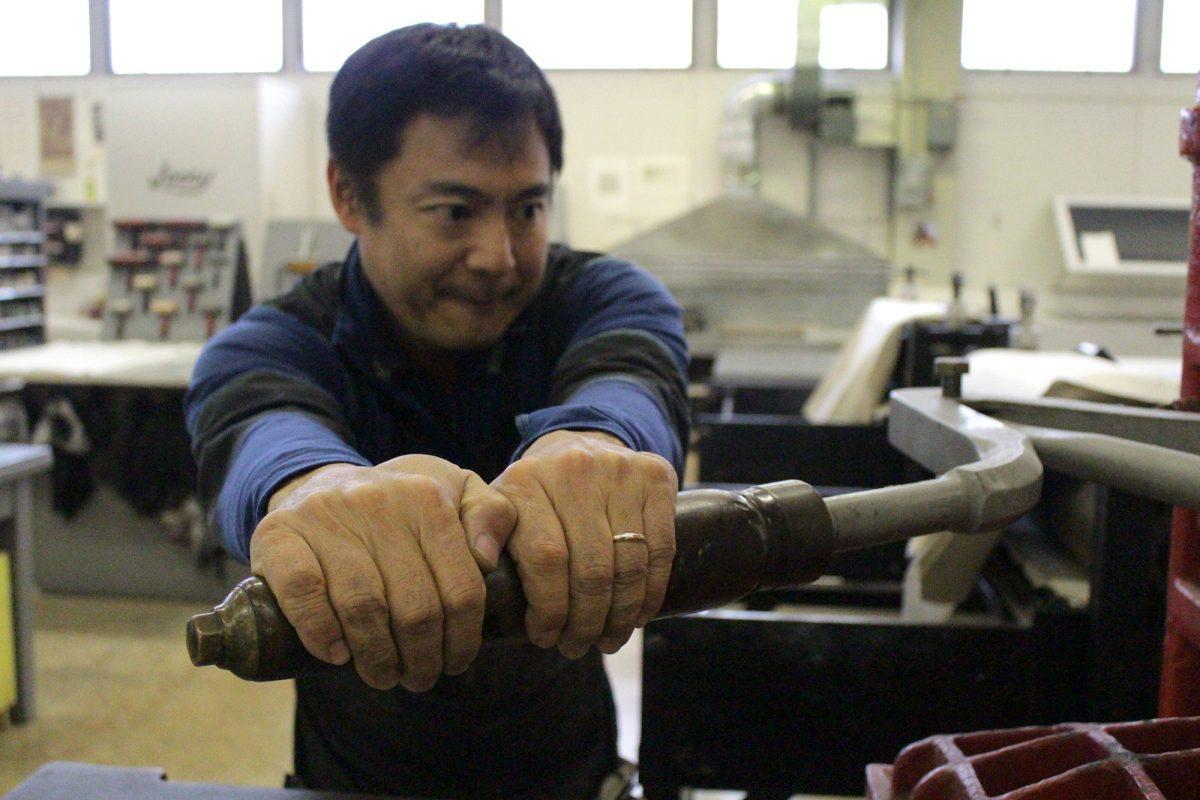
This winter, Yamamoto, associate professor of printmaking, was chosen to be one of 26 internationally acclaimed artists on display in the traveling exhibition by the Leonardo Sciascia Foundation. The exhibition will spend a little more than a year appearing in five different cities throughout Italy.
“This exhibition is unique because Mr. Sciascia preferred graphic art to be clean, high contrast, black and white images, so no colors are allowed,” Yamamoto said. “It’s very specific.”
The competition expects traditional techniques to be used with no digital work allowed. Fortunately, Yamamoto’s works already fit the exhibition’s standards.
“A lot of engravers generally work in black in white and therefore fit into this category,” Yamamoto said. “One particular type of technique that I do is called copper engravings, which is a very old-fashioned, 500-year-old technology.”
Geoff Silvis, a first-year graduate student in printmaking, elaborated on Koichi’s style.
“It’s incredibly intricate,” Silvis said. “It’s a lot of manual labor and probably a lot of copper splinters.”
Dan Hood, a senior in printmaking, sees the intricacies as lighthearted, though.
“His work is just very playful to me … lots of reflections,” Hood said.
Whatever the emotion Yamamoto strives for, he uses modern images to connect to his audience.
“I’ve been making lot of masks, human facial expressions,” Yamamoto said. “A lot to do with robotics. We are encountering this society where we are using a lot of machines, and slowly these machines start to have a human quality.”
Yamamoto draws this inspiration from a cultural situation in his homeland: Japan. He said the population is aging rapidly, so to care for the elderly, the bulk of the work force may soon be robots.
“Some of those robotics have a human figure, human face and human voice, and therefore there’s a lot of study about human expressions being universal,” Yamamoto said. “That’s my motivation to create human micro-expressions in my works.”
Yamamoto’s method of creating his facial structures is unexpectedly childlike, as he plays when searching for an image.
“I am really interested in symmetry, so what I do is use kinetic sand with a mirror,” Yamamoto explained. “I put sand here and put a mirror against it so you see the reflection. If I make half of the face, the mirror will reflect, and you can see the whole face together.”
He videotapes this process and then watches the footage for noteworthy expressions. When Yamamoto finds an image he likes, he takes a screenshot and begins sketching his work.
“This is a kind of play, exploration, like when you go to the beach and play with the sand and start making things up,” Yamamoto joked. “It doesn’t necessarily qualify as artistic exploration, but in a way I’m very interested in that intuitive object making that doesn’t require a whole lot of artistic mind.”
The youthful approach Yamamoto adopts toward his works may be in part due to his presence on a university campus. He describes his students more as colleagues or fellow researchers.
“Working with these people forces me to discover something new, and at the same time I get to present my work to them and hear what they have to say, which is always a privilege,” Yamamoto shared.
Hood described Yamamoto’s role in the classroom as “a facilitator of conversation trying to get our ideas going and getting people to talk about what’s going on in these works,” a role Silvis agrees with.
“He’s not trying to push us in any particular direction,” Silvis said. “He may give us suggestions and things, but he’s not trying to mold you. It’s not that direct.”
Yamamoto has also traveled to lecture at three other universities across the country, most recently Ohio State University. He cites this opportunity to travel as one of the greatest perks of his position at UT; he is influenced not only by the fresh ideas of his own students but by students nationwide.
“There is definitely a uniqueness to it, but there is a general pattern in the world of visual communication,” Yamamoto said. “It is sort of a reflection of how people think today, how they operate.”
For Yamamoto this lies in technological advances.
“The centralization of the media in the 20th century is breaking up in the 21st century,” Yamamoto said. “People start actually owning the media now.”
Yamamoto believes this impacts more than just the realm of visual communications.
“It used to be there was a centralized location for art, but I think this concept is breaking,” Yamamoto said. “You can make anything anywhere nowadays.”
However, he maintains the definition of art has remained constant regardless of how it is distributed or displayed.
“Definition of art always has been communication,” Yamamoto asserted. “It doesn’t necessarily have to be always beautiful or impressive. It could be ugly. It could be very improper. It could be violent; as long as it communicates content.”
On the other hand, Yamamoto does express caution in which ideas one chooses to communicate since art is now internationally available over media.
“I think that art has become available, so we have to become really careful with what we say and what we mean, because it is available to everybody,” Yamamoto cautioned. “There is freedom, but there is a consequence in freedom. I think artists have to think about this discretion.”