In her office at the Anderson Training Center, Allison Maurer struggles to remember where she was in the moments after Tennessee’s 45-42 victory over South Carolina on Nov. 1, 2014. In between making arrangements for the team’s postgame meal, she was just having trouble believing the Vols really completed the seemingly impossible comeback against the Gamecocks.
She recalls one memory, however, a recollection as clear as that November night sky in Columbia.
She remembers seeing then-senior Jordan Williams on his knees, crying. A bowl game that had eluded him in his four years at Tennessee was finally within inches of his grasp.
The moment illustrated the resounding pathos of college football, but to Maurer, the image was especially moving. Maurer had developed a close relationship with Williams, instructing him on his diet regimen and dispensing advice to him on how to maintain a healthy lifestyle in his four-year tenure at UT. So when she saw his uncontainable euphoria in the aftermath of the Vols’ victory, she too couldn’t help but feel thrilled.
There is a possibility that Williams might have felt gratitude towards Maurer in this moment of joy. If Maurer wasn’t always around the team offering dieting advice, or instilling healthy habits into the players’ lifestyles, Tennessee might not have had the physical stamina or mental strength to overcome the 14-point deficit in the final two minutes in Columbia.
Maurer works 55 hours a week in the spring. She considers that a vacation compared to the hours she works in the fall. Mark Elder, tight ends and special teams coordinator, says Maurer is a mother to the football players. Tennessee head coach Butch Jones calls her invaluable. Her official job title, however, is sports nutritionist.
Her job responsibilities involve teaching athletes how to develop healthy eating habits, offering cooking classes and grocery shopping tours to the players and delivering lunches to the team on campus. She ensures that the players who are supposed to gain weight actually gain weight and players who are supposed to lose weight actually lose weight. She also assists any athletes who have special needs like medical conditions or food allergies.
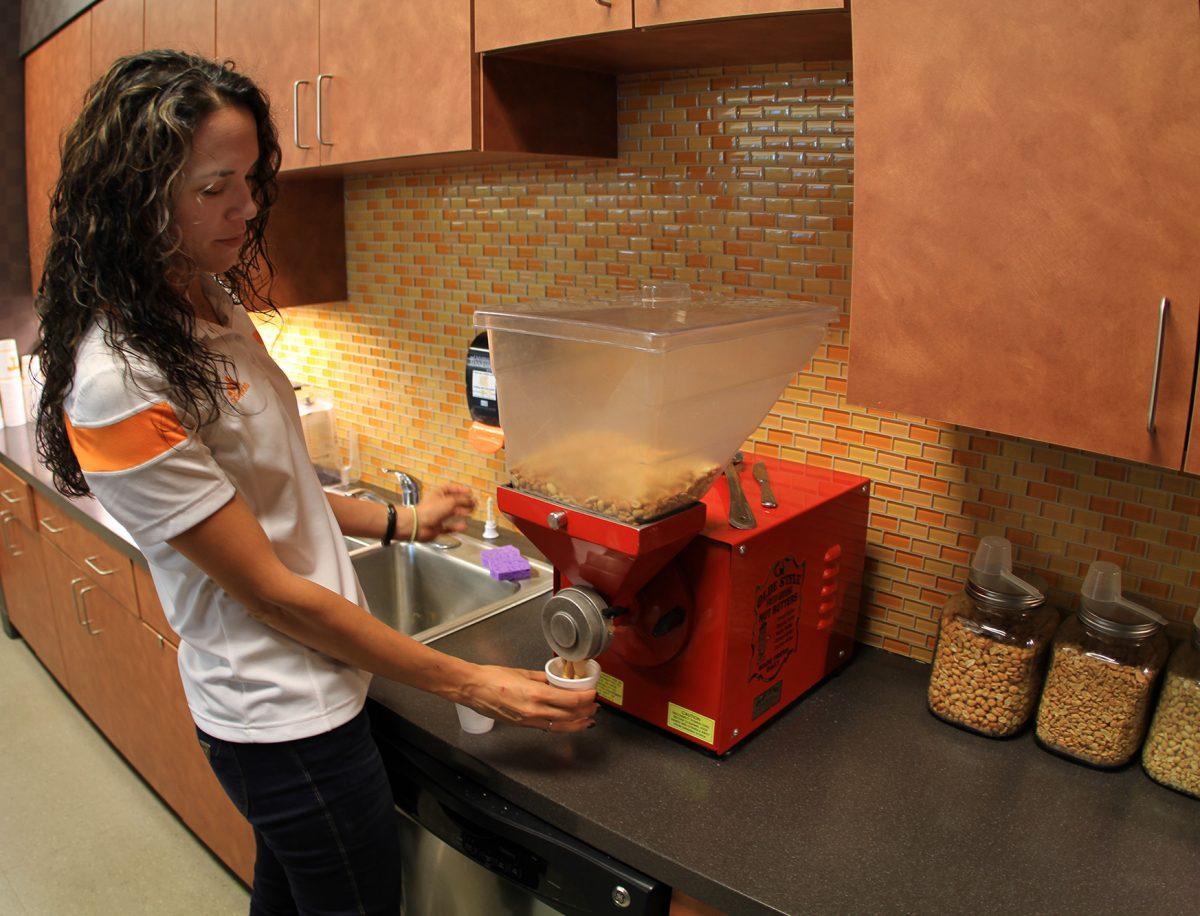
Maurer also operates the fueling station, an area in the Anderson Training Center that offers athletes nutritional supplements. The nutritional goodies include, but are not limited to, fresh fruit, peanut butter, oatmeal bites, specialized shakes, vitamins and a form of chocolate milk that the athletes call “liquid gold.”
“We couldn’t do it without her,” Jones said. “She is as important as any coach that we have on our staff.”
Despite the numerous responsibilities, Maurer believes her job tasks can be encapsulated in one role.
“I like to look at myself more as an educator than anything else,” Maurer said. “And I think above and beyond anything else, that is really where my main focus is.”
Maurer assumed her duties as UT’s sports nutritionist in 2007, hearing about the Tennessee job through a colleague. This colleague held the nutritionist position at Tennessee before Maurer, but left for a different job. Knowing his position was vacant, Maurer applied.
She got the job and has held the position for nearly eight years.
“We value her loyalty,” Jones said. “She has been extremely loyal.”
She has been so loyal that she has worked with four different coaching staffs in her eight years with Tennessee.
Maurer admitted the transitions between the different coaching staffs were hard, listing different personalities and expectations as reasons for the difficult process.
“Every time it’s like selling your services: ‘This is what I do, I hope you really like it,’” Maurer said. “It’s tough, but I am such a better professional than if I had not gone through that.”
Maurer has had an easier time developing relationships with the players, describing those relationships as “fun.”
The reason for the successful relationships — Maurer and the players understand each other.
She says the players know her only goal is to ensure that they are performing at their highest level. She also recognizes the challenges a college lifestyle presents to eating right. Add trying to maintain a healthy diet with working out, watching film and keeping up with coursework, and the challenge becomes especially daunting.
This is why Maurer says she goes out of her way to help the players with their eating habits; she wants them to overcome the challenge.
“Being able to take away the anxiety of, ‘When am I going to eat? What am I going to eat? How am I going to get it?’ is important to me,” Maurer said. “And I think they realize that because it is that important to me, they make it a priority too.”
Maurer texts the players who have to either gain or lose weight, asking them what they ate for breakfast, what time they woke up, etc.
She said she doesn’t do this to be some sort of food police; she just wants the players to be cognizant of their eating practices. Is their daily diet conducive to reaching their weight goal?
With a football roster of upwards of 100 players, there is a low probability that every individual consistently has a healthy diet. Maurer knows this, and the coaching staff knows this.
“There are some picky eaters in there,” wide receivers coach Zach Azzanni said, referring to the football team.
Maurer is around the players enough to know the players who have developed poor eating habits.
Sometimes, she doesn’t have to rely on any intuition; the players just approach her.
“Sometimes I feel like I am the confessional because (players) would be like, ‘I had (Raising) Canes last night,’ like they just can’t hold it in,” Maurer said. “Again, that just shows how good our relationship is, that they trust me enough to tell me those things. And I am like, ‘Okay, let’s fix that.’ I pretty much know most of their habits.”
When such a confession occurs, Maurer prods the athlete. What led to the unhealthy decision? Was it because you were hungry? Were your roommates going? Did you have extra Dining Dollars? Did you have nothing in your dorm room?
“When you usually get to the bottom of it, it’s just that they went because everyone else was going,” Maurer said, “and they weren’t necessarily that hungry.”
While Maurer administers tough love to the athletes with wayward diets, she didn’t exaggerate when she said she goes out of her way to help the football players.
Maurer delivers lunches to the players on campus, making sure the athletes have a nutritious meal before the grueling practices.
“A lot of people don’t realize, these kids have a full-time job,” Azzanni said. “There might be times when a guy goes from 8 a.m. to 2 p.m. and we have meetings at 2:30 p.m. here without a lunch break because we have practice, whereas a normal student might have a break in there to go get some lunch. So her and her crew will drive on campus and make sure these kids are getting the right nutrition at lunch time.”
To the outsider, delivering lunches may seem like a simple gesture of kindness. But in reality, it’s imperative that athletes eat lunch. Large gaps between meals result in a decrease in metabolism, tiredness and a decrease in concentration. These are consequence people want to avoid, especially athletes with an intense schedule.
That is the reason Maurer goes out of her way to see that the athletes are eating frequent, wholesome meals.
“A good example is one of our linemen one day, I was supposed to deliver lunch to him and he texted me and said ‘I can’t make it, I will just grab something at the complex.’” Maurer recalled. “So he managed to get a peanut butter sandwich before practice and he was like, ‘That was the worst practice I had, in a long time.’ They are so used to doing all the right things now that they feel it when they don’t.”
Maurer doesn’t just concern herself with players, though, as there is a certain coach who has pitfalls in his personal diet.
“I have let her down a few times personally with my diet and she is all over me,” Jones said after a practice. “I understand what the wrath is when she gives it to you.”
When asked about Jones’ dieting flaws, Maurer laughed, before adding, “Coach Jones is a salty chip eater and it drives me crazy. He could eat healthy all day long and he will go home and have a bag of chips and I am like, ‘Really? This is what we are dealing with here.’
“I do get on him a lot, so we do go back and forth on his eating habits.”
Maurer’s concern for Jones’ affinity for chips underscores a much larger issue: coaches have to eat healthy, too.
Coaches work long hours and have few vacation days in the year. If they are not on the road recruiting, then they are watching film and searching for ways to improve the team.
They also have to have the energy to coach the players during practice and make sure they are receiving adequate instruction.
A healthy diet ensures that coaches have the mental energy to push the players to perform at their highest level in practice.
“I learned this a long time ago from some people I had worked for: those three hours on the field with those kids are the most important,” Azzanni said. “And if we are here to midnight every night and not eating right, guess what? We are not going to have a whole lot of energy to coach these kids for those three hours. We need energy.”
Azzanni lauded Maurer for assisting the coaches with their diets, saying she regularly offers the coaching staff smoothies, vitamins and fresh foods so they can maintain a high level of energy.
Maurer also helps the coaches with their diets when they are on the road or the recruiting trail, telling them what snacks they should pack at the airport, how much they should eat and when they should eat it.
The advice worked. Several coaches lost body fat during the recruiting season, Maurer said, a surprising and impressive accomplishment.
The head coach might also be improving his diet regimen.
“The other day he told me there was a devil on his shoulder telling him to eat chips and he didn’t give in,” Maurer said of Jones. “He was pretty proud of himself.”
After working for the Vols for eight years, Maurer has had her share of thrilling games and wins.
But her favorite memories don’t involve the moments on game days. Instead, her favorite memories are created on routine workdays, days that include visits from familiar faces.
“I love when former Vols come back,” Maurer said. “When (the players) come back and they say, ‘Oh I was hoping I would see you,’ or ‘I have been looking all over for you,’ that just make me feel like maybe I did make a little difference.”