The war in Gaza has become a major issue on the international stage over the last year. While numbers could never truly encapsulate the destruction that has been caused by this war, they do offer insight into the severity of the violence being experienced.
The conflict, which has since been described as a genocide by official United Nations sources, began Oct. 7, 2023, after the Palestine-based terror group Hamas launched a massive surprise attack against Israel, killing approximately 1,000 Israeli and foreign civilians and taking some 200 hostages, according to the United Nations.
Israel’s widespread bombing and ground campaign within Gaza against Hamas in retaliation for this attack has wreaked havoc on the civilian population living there.
Al Jazeera, a news organization based in Qatar, has reported that at least 42,600 Palestinians have been killed in Gaza thus far — nearly 17,000 of which are children. The report further states that 1,139 Israelis have been killed.
A recent letter written by 99 western medical professionals who had been operating within Gaza since Oct. 7, 2023, estimates the death toll could be significantly higher. The group wrote that it is not unreasonable to say some 186,000 Palestinians have been killed.
Omar Hamad, a sophomore studying business analytics and a member of the Students for Justice in Palestine organization, shared a personal story detailing the severity of Gazans’ suffering.
“My best friend’s family had 25-plus members of his family killed,” Hamad said. “One of the famous photos that was surfacing online was four quadruplets that were all killed together, and those were his cousins … That was very devastating to hear.”
Israeli citizens are also suffering due to the severity of the conflict. Judith Rosenberg, president of the Knoxville Jewish Alliance, spoke about some of the dangers Israeli citizens face.
“It’s important to note that Israel is also engaged in a military conflict on the Lebanese border with Hezbollah, another terrorist group funded by Iran with massive weapons stockpiles and also intent on the destruction of Israel and the Jewish people,” Rosenberg said. “Knoxville Jewish community members have family members in Israel who are currently displaced from their homes because of Hezbollah’s attacks.”
However, civilians are not the only non-combatants who have suffered due to the destruction.
The Committee to Protect Journalists has reported that upwards of 128 media workers and journalists have been killed in the conflict, marking this as the most dangerous period for reporters since the CPJ began to collect this kind of data in 1992.
In a recent statement, UN Relief and Works Agency commissioner-general, Philipe Lazzarini, stated that 222 UNRWA aid workers have been killed in Palestine since the conflict began.
Infrastructure throughout Gaza has been similarly devastated by the Israeli bombing campaign.
A UN report from September asserted that, on top of damage to commercial and industrial buildings, an estimated 227,591 housing units have been destroyed in Gaza. All in all, 66% of structures in Gaza have sustained some form of structural damage.
Healthcare has been hit especially hard within Gaza. ReliefWeb, a UN-sanctioned humanitarian information source, reported that 19 of the 36 hospitals within Gaza are completely shuttered, leaving only 17 partially functioning hospitals to serve the immense and growing needs of Gazans.
The widespread bombing of houses and hospitals further exacerbates the humanitarian crises currently being experienced on the ground. Palestinians are forced out of their homes and into the street, setting the stage for a litany of healthcare disasters.
There is no better demonstration of this fact than an August Associated Press article that reported on a Palestinian child who had developed polio, the first case in the region in 25 years, due to infrastructural problems caused by Israel’s bombing campaign.
The conflict has also limited access to water and food, adding another layer of complication to the already dire situation on the ground.
A BBC article from May found that, out of the 603 water facilities they analyzed, some 53% were either destroyed or damaged by Israeli bombings.
The article also highlights how multiple wastewater plants were bombed, greatly increasing the chances of diseases spreading within Gaza as raw sewage is left to run through the streets.
ReliefWeb has also reported that more than 2.1 million Gazans currently face acute food insecurity, meaning that food deprivation directly threatens their lives.
The war in Gaza has become a hot-button issue for many Americans. The international community has condemned Israel’s execution of this conflict, and many Americans feel the country shouldn’t support this kind of warfare.
An August Gallup poll showed that 32% of Americans see the Gaza invasion as justified, while 34% believe it to be unjustified. Thirty-three percent said that they were unsure whether Israel’s actions were justified.
Despite the current administration’s claims that it is sensitive to the needs of the Palestinian people, they have paradoxically continued to increase the U.S. footprint in the conflict.
A recent report from the Watson Institute for International and Public Affairs reports that the U.S. has sent, in total, $22.76 billion in military aid to Israel since Oct. 7, 2023.
Al Jazeera reported in October 2024 that the U.S. deployed a modern missile defense system and 100 soldiers to defend the weapon against Israel.
It’s possible that this indifference contributed to Donald Trump’s recent election, though it is unclear what exactly will change under this new administration.
President-elect Donald Trump has touted himself as a “protector” of Israel and has defended the country’s execution of its military campaign.
The president-elect recently announced Marco Rubio as his pick for Secretary of State, who made headlines in November after his comments regarding a cease-fire in Gaza.
“I want them to destroy every element of Hamas they can get their hands on. These people are vicious animals who did horrifying crimes,” Rubio said.
The conflict has even made waves here in Knoxville with the local Jewish and Palestinian communities.
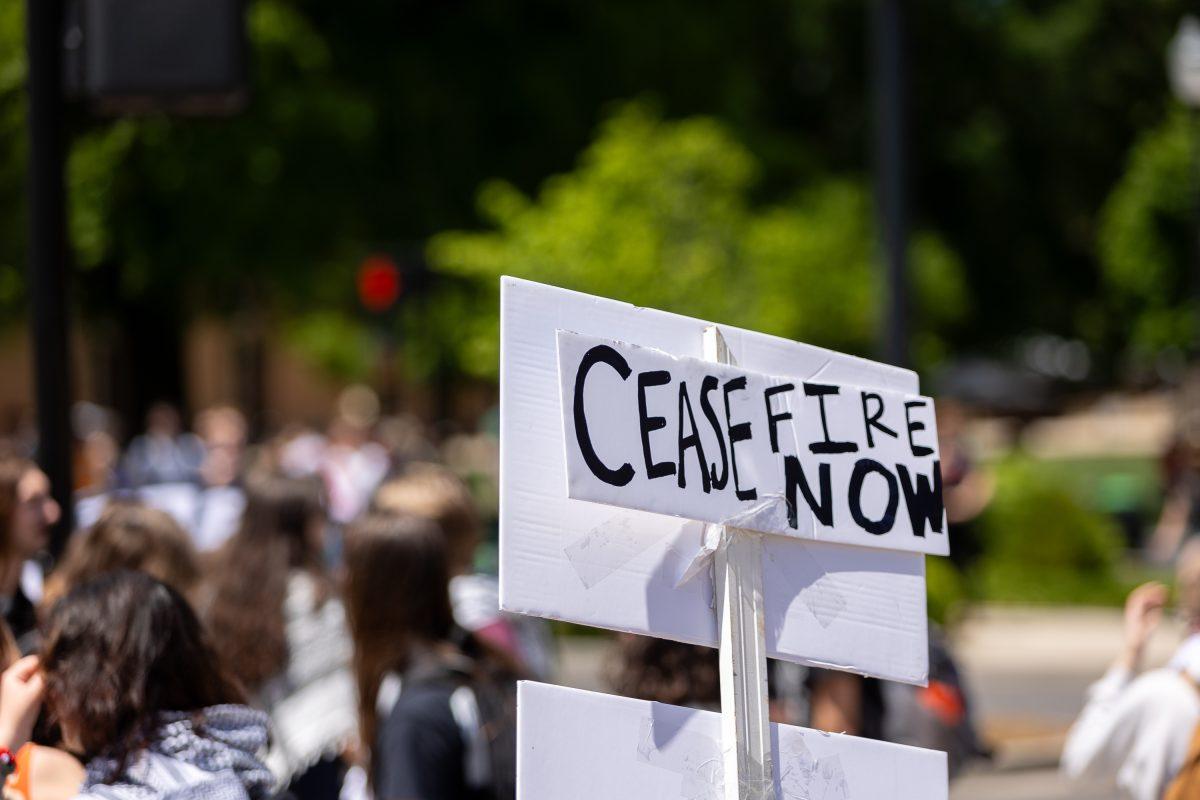
Earlier this year, 11 UT students were arrested following a pro-Palestine demonstration on university grounds.
In October, the Knoxville Chapter of Jewish Voice for Peace held an event in remembrance of the Oct. 7 attack and to promote peace between Israelis and Palestinians.
Omar Hamad provided further context into how the local Jewish and Palestinian communities have interacted since the conflict began.
“There have been a lot of Jewish people who have come out and supported the Palestinian cause and freedom for Palestine,” Hamad said. “There is definitely some common ground between the local Jewish and Palestinian communities.”
Rosenberg, president of the Knoxville Jewish Alliance, also spoke about the interaction between these two communities here in Knoxville.
“The Knoxville Jewish community has no intention whatsoever of diminishing the real pain, suffering, loss of life and fear also experienced by the Knoxville Palestinian community. The war in Gaza must end, and diplomacy must start,” Rosenberg said. “Too many Palestinians and Israelis have perished, and too many Palestinians and Israelis have had their lives shattered and destroyed. We are ready and willing to work collectively on positive, productive solutions and a shared future for our communities — ways we can come together for collaboration, and perhaps even healing, moving forward.”
Despite these feelings of solidarity between the groups at home, the war does not seem likely to end anytime soon.
Israel has initiated another ground campaign in Lebanon and recently attacked Iran in retaliation for their missile attacks on the country. The country also recently passed legislation that threatens to ban UNRWA from operating in conjunction with the Israeli government. Further, the International Criminal Court has issued an arrest warrant for Israeli Prime Minister Benjamin Netanyahu on the grounds of war crimes and crimes against humanity.
Over the past year, Gazans and Israelis alike have suffered immensely due to the war. The war and reactions to it have created the context for an intensification and proliferation of violence that could threaten to engulf the Middle East at large if a solution is not discovered.