On Tuesday, Nov. 4, the voters of Knoxville elected Karyn Adams to represent the constituents of South Knoxville and Fort Sanders in Knoxville’s 1st District. Adams sat down with The Beacon to discuss how her term will address the concerns of students living in Fort Sanders.
Adams, originally from Kingsport and a University of Tennessee alum, has been living in Knoxville since the early 1990s. Her interest in running for the seat has been long-standing.
“I guess it was about 15 years ago the first time that someone asked me to run, and then all of a sudden, like, oh, OK, it’s not just my interest. Other people think that I could do this, too,” Adams said.
Adams maintained her interest in politics the entire time, but was motivated to run for her seat when the current 1st District representative approached her.
“But then the councilman that serves in this seat right now, his name is Tommy Smith. I think he’s done an exceptionally good job in terms of really leading to bring the community together,” Adams said. “And I watched him and thought, that’s how you do it. And then he asked me to run. And I’m like, OK, I think now’s the time.”
Housing affordability, availability
Adams articulated housing affordability and availability to be a top priority of hers, particularly as it affects the student population living in Fort Sanders. When she launched her campaign, she conducted a survey of her potential constituents to understand their most pressing needs.
“I wanted to make sure that the things I thought were important were also the things the community thought were important and at the top of that list were housing affordability and homelessness, and, unique to the South Knoxville part of District 1, were protecting green spaces,” Adams said.
Adams said she hopes her focus on these priorities will help make Knoxville a place where students and young residents can build their futures.
“I want you to stay here,” Adams said. “You’ve come, you come to school here, and you’ve gotten a great education, or you’re in the process of that, and I want you to see opportunity here and the viability of an affordable city you can stay in, and right now that’s really challenging.”
Adams explained that while there’s been a boom in housing construction, achieving affordability is a different problem.
“When you talk about affordability, the planning commission has actually issued more permits, more building permits, in the last few years than ever before. But that’s a supply issue, it’s not the affordability issue,” Adams said.
Adams discussed the importance of “smart sustainable growth.” That is growth that is small in scale, around two to three stories tall, mixed-use and along transportation corridors.
“One of the things I want to do is start growing out opportunity zones for this mixed-use development along these corridors … Make it doable, but almost templatized so we’ve solved some of the problems and the city staff that’s in charge of managing those sorts of things isn’t reinventing the wheel each time,” Adams said.
Adams discussed the use of new incentives and tools to prompt this specific form of development. She expressed that while many of the new apartments on Cumberland Avenue and in the Fort help address the supply side of the issue, keeping prices down was a different problem to wrangle.
“There are state laws that make it impossible for us to say, you know, your rent has to be kept here. So we don’t have that tool,” Adams said.
Adams talked about potentially testing new policies and initiatives to keep prices down, such as student housing cooperatives modeled after programs in Toronto, such as the Campus Cooperative Residence Co-Op. Those in Toronto are nonprofit, student-run residences that offer affordable, community-oriented living by allowing residents to collectively manage and maintain their housing.
Adams emphasized that the cooperative proposal is still conceptual and subject to legal approval.
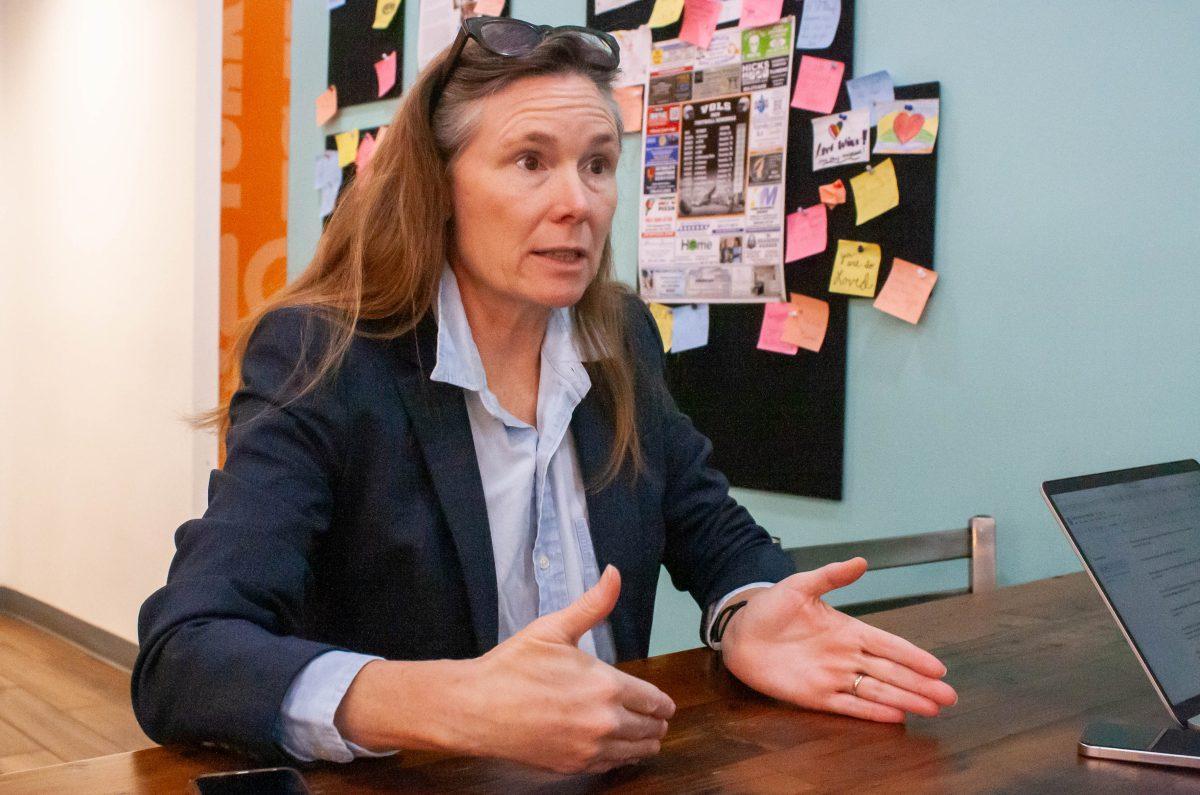
Councilwoman elect, Karyn Adams, during an interview with The Daily Beacon on Saturday, Nov. 8, 2025.
Safety in the Fort
If you spend much time at all on Cumberland Avenue or in Fort Sanders, homelessness is a visible problem. Adams acknowledged that the problem has been exacerbated.
“I can tell you that homelessness has absolutely increased exponentially from when I first got to the city,” Adams said.
Adams said the growing visibility of homelessness reflects a larger trend the city has struggled to manage.
“I think that there are compassionate things we can do as a city to address (homelessness) better. I don’t think that we’ve done a good job thus far,” Adams said.
Recently, as prompted by conversations with the Cumberland Avenue Merchants Association, the Knoxville Police Department has been increasing visible enforcement around Fort Sanders aimed at combatting vagrancy. Adams said she approved of the recent move.
“I think that’s community. And I think that’s what KPD is trying to foster is an increasingly good relationship with the residents here,” Adams said.
Knoxville Police Department Communications Manager Scott Erland confirmed that a strong relationship exists between the department and CAMA, and that KPD carries out patrols in the area.
“Our department has an outstanding relationship with the Cumberland Avenue Merchants Association and engages with CAMA on a regular basis, to include in their monthly meetings,” Erland said. “Our officers do maintain a regular, visible presence in the Fort Sanders and Cumberland Avenue areas, which are focal points for our Central District officers and staff.“
Transportation and infrastructure
Adams touched on the failed half-cent tax increase referendum on Nov. 4, which would have increased city revenue by an estimated $47 million. The revenue would have been primarily spent on infrastructure improvements, affordable housing and city maintenance.
“As a candidate, I didn’t feel like it was my job to come to you and say, ‘You need to vote for this tax increase.’ I felt like it was my job to listen to you and understand what your concerns were, and if you had questions to be able to answer those with facts, then what I could commit to,” Adams said.
Adams explained the importance of empathizing with local voices in the community during the process of proposing landmark policy changes.
“This community just wasn’t ready. It’s a very uncertain economic time right now, and I get that,” Adams said.
Adams addresses the responsibility of public servants to oversee the usage of funds for communal spaces, ensuring that taxpayer dollars are spent as promised, or reaching an alternative if necessary.
“(My role) if elected … is to either, A, make sure that that was spent the way that it was promised, or, B, look for other ways to fund those initiatives, because they are important infrastructure, things that the community wants,” Adams said.
There have been a multitude of concerns regarding funding infrastructure and green spaces in the city, considering that Knoxville lost a federal grant of more than $42 million after President Trump defunded the Neighborhood Access and Equity Grant Program, earlier in July.
“How do we make sure that everything that is important to us can be funded? I’ve talked about some of the affordable housing components and things that we need to keep doing, but in terms of the green spaces, one thing I want to make sure that folks know is the grant that we lost,” Adams said.
Student outreach
Adams touched on how integral, yet often overlooked, Fort Sanders and student voices are to the 1st District in Knoxville.
“It’s the most dense part of the entire city. The university, the hospitals, the museum, like, these are huge economic drivers, and they need representation. So I need to hear from you. I’m open to all ideas that you all have about engagement. But my goal is to be present,” Adams said.
Adams explained her motivation behind living in south Knoxville, and how its proximity to UT makes it a hub for new energy and ideas.
“It’s why I chose to live in south Knoxville because I wanted to stay close to the university. My husband teaches here. … I know this is a generator of ideas and innovation, and bringing new ideas through (students), so I want to support that in every way I can,” Adams said.
Adams also aims to reach the large, student-dense living spaces in Fort Sanders.
“I understand that students have unique needs that may be different from the larger district. So I would want to ask first before I come in and say, ‘this is how it’s all gonna be,’” Adams said.
Adams emphasized the importance of student perspectives and engaging with local government.
“What do you want and what do you need? What are your ideas and what are your concerns? And then start working from that,” Adams said.