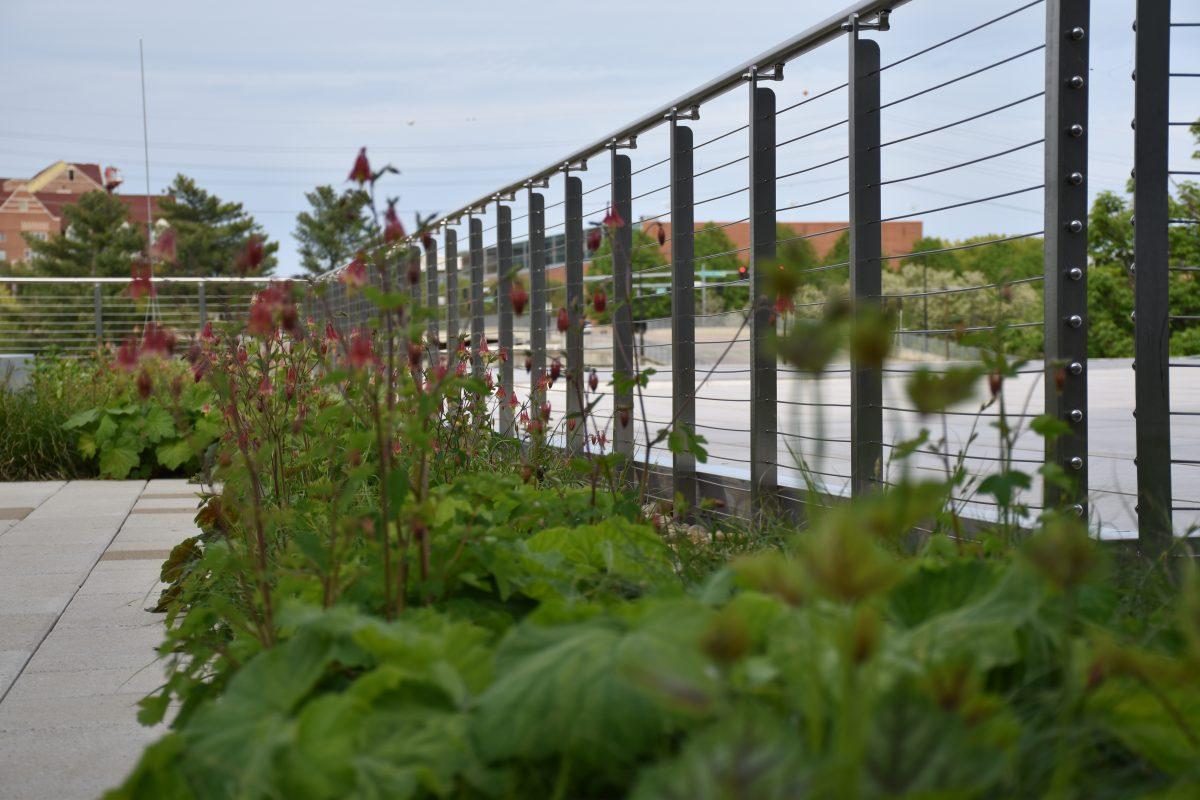
Overlooking the urban metropolis of Knoxville, an explosion of green is hidden among a sea of gray.
The new “Green Roof” on top of the Agriculture and Natural Resources Building is a lush addition to the campus that fosters sustainability while bringing a break to an otherwise concrete skyline.
“The green roof is an integration of ecology and the social space where humans, wildlife and nature can coexist,” Mike Ross, an assistant professor in the Department of Plant Sciences and key player in the project, said.
The primary purpose of the roof, according to Ross, was to meet state requirements for managing stormwater. While a simpler project could have met those demands, the green roof provided the opportunity to take things a step further.
“There’s no question it’s sequestering stormwater. It’s doing a good job in that regard,” Ross said. “But by going the extra step and putting a glade ecosystem on top of this roof we’ve not only addressed stormwater, but we’ve also got all these other ecosystem services that come into play in a more rich and robust way.”
While the roof is not technically finished, as a final walkthrough remains, it is open to the public and already features many local plant species.
Additionally, the idea of a finished green roof is quite nebulous, given the nature of the project.
“It’s never done. It’s never finished. The ‘a-ha’ moment you get right now is one thing, but in five years from now it will be totally different,” Ross said. “That’s the allure of designing with living material — it changes.”
Benvy Kelly, a senior studying ecology and evolutionary biology, discussed her feelings about the project.
“I think it’s great that the school is trying to implement more green projects into their architecture. It’s a great movement and the plants they have there — purple echinacea and columbine, to name a few I remember — are great natives,” Kelly said.
The green roof is also becoming an important social spot on campus. Campus tours visit the rooftop garden, and Ross noted there has been a steady stream of visitors since before they had planted anything.
The roof is also being used to study spontaneous vegetation and similar events through the Green Roof Experimental Lab, of which Ross is a co-director.
While the Green Roof represents a step in the right direction for the university, some concerns surround the project.
“I’m happy to see the school’s decision to embrace more green architecture on campus, but we really need to consider the surrounding environment of UT,” Kelly said. “Maybe we should consider bigger steps, like a native wetland to help with natural water filtration.”
As more native green space is lost to development, UT will need to find a way to balance growth with sustainability.
While there is a desire for new green roofs, several strategies have proven successful and will continue to be supported by the campus community.
“More green roofs would be great, but I’m after sustainability in any capacity,” Ross said. “It’s not the specific intervention, it’s all the interventions.”
Students interested in exploring a highly specialized and beautiful local ecosystem can visit the green roof on the third floor of the ANR building on the Agriculture campus.
“The landscape which the roof is based on is one that is highly sensitive to development and exploitation. It’s very possible we will see less and less of them, or even have access to them,” Ross said. “I would encourage anyone to come and see that.”